
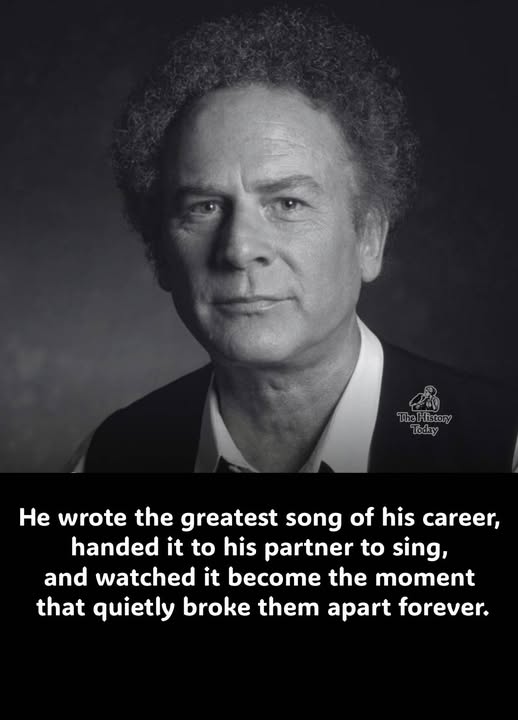
Paul Simon sat down in 1969 and wrote “Bridge Over Troubled Water” in a single sitting.
When he played it for Art Garfunkel, the room went silent in the way rooms only go silent when something is clearly, undeniably extraordinary.
Then Garfunkel said something that surprised him.
“You should sing it yourself.”
It wasn’t false modesty. Garfunkel knew exactly what this song was. A centerpiece. A career-defining moment. The kind of performance that follows a singer for the rest of their life. And deep down, he wasn’t sure he wanted that weight.
Because for years, the unspoken truth of their partnership had been sitting right there on the table between them. Paul created. Art delivered. Singing Simon’s greatest song would cement that reality out in the open, permanently, for the whole world to see.
Simon listened. Then he made his decision.
“No. You’re singing it. Your voice is right for this.”
He wasn’t wrong.
When Garfunkel recorded that vocal, that quiet, almost fragile opening slowly building into something vast and aching by the final verse, it was breathtaking. The song and the voice fit together the way very few things in music ever do. Simon knew it the instant he heard the playback.
But he had just given away the greatest song he would ever write.
The album dropped in January 1970. “Bridge Over Troubled Water” shot to number one and stayed there. It swept the Grammys, winning six awards including Record of the Year and Song of the Year. It became the defining moment of their entire career, the first thing strangers thought of when the name Simon and Garfunkel crossed their minds.
And it was built on a quiet fault line neither man could ignore.
Simon had written every word. Constructed every layer of the arrangement. Made every creative decision. Garfunkel had sung it gloriously, in a way nobody else on earth could have matched. But when audiences heard that song, they heard Art’s voice soaring over everything.
Simon kept the authorship. Garfunkel got the spotlight.
Neither felt they had received what they truly deserved.
By the end of 1970, less than a year after the album’s release, Simon and Garfunkel had quietly gone their separate ways. No dramatic fight. No press conference. No single moment anyone could point to. Just two people who had built something magnificent together, finally acknowledging what they had both already known.
They reunited over the decades. Tours. Performances. A concert in Central Park that drew half a million people. Each time there was genuine warmth between them. But the same unresolved weight was always there too, that same dynamic that had never shifted, never healed, never been fully spoken aloud.
The men who gave the world “The Sound of Silence,” “Mrs. Robinson,” “The Boxer,” and “America” could not sustain the partnership that made those songs possible.
Because “Bridge Over Troubled Water” had told the truth about them before either was ready to hear it.
It was never really a collaboration. It was two separate gifts, offered across a table, to a partnership that had already quietly ended.
Simon gave Garfunkel the song because Art’s voice genuinely deserved it. That was real generosity.
Garfunkel delivered a performance that lifted the song beyond what Simon alone might have made of it. That was real greatness.
But generosity and greatness don’t automatically produce equality.
Paul Simon went on to one of the most celebrated solo careers in music history. Art Garfunkel made beautiful records of his own. Both proved they could stand alone.
But they needed each other. And they couldn’t be what the other needed.
There is a song you already know. You have turned to it in your hardest moments because it promises that someone will lay themselves down, like a bridge, so you can cross.
Paul Simon wrote that promise.
Art Garfunkel made you believe it.
And the distance between those two things turned out to be exactly as wide as everything that separated them.