
I already have a blog post on how to work out your basic purpose in life which I heartily recommend you read soon.
https://www.tomgrimshaw.com/tomsblog/?p=37862
I am told it was Confucius who said, “Do something you love to do and you will never work a day in your life.”
My reality is, when you are working on your basic purpose it is almost like you are being paid to have fun.
I often say to people, “When you are on your Basic Purpose, progress is more like a hot knife through butter than walking through molasses in the middle of winter.”
In my experience there is a particularly strong inverse relationship between “Purpose and Motivation Requirement”.
The more aligned an activity is with your:
basic purpose
identity
meaning
values
curiosity
mastery
contribution
or intrinsic enjoyment
the less external motivational force is required.
This could be represented by a graph with ‘on Purpose’ on the horizontal axis and ‘Necessity to Bootstrap Your Motivation’ on the vertical axis. The line would start at top left and progress on a straight line to bottom right indicating the more ‘on purpose’ are people’s activities, the less they needed to try to motivate themselves.
The more people are meaningfully engaged, the less exertion feels like “effort” or work and the more it feels like flow or fun.
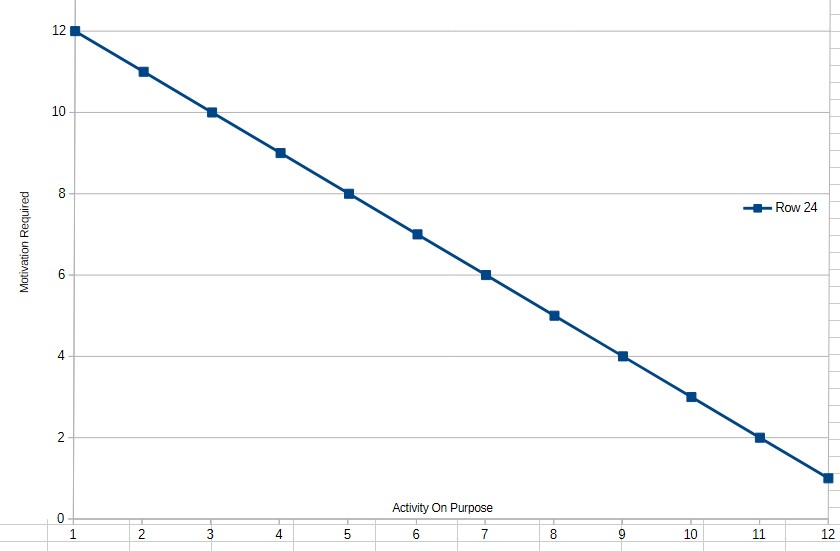
You could even visualise it something like:
Top Left:
“Maximum motivational force required”
drudgery
coercion
meaningless labour
externally imposed goals
Bottom Right:
“Self-sustaining engagement”
vocation
calling
obsession
creative flow
mission
Purpose does not eliminate difficulty, it changes the relationship to difficulty as even purpose-driven work still contains:
administration
repetition
maintenance
frustration
uncertainty
and sacrifice
A parent caring for a child may be exhausted but still deeply willing.
An entrepreneur building a mission-driven company may work extremely hard without perceiving themself as oppressed by the work.
That distinction matters.
One useful framing is that motivation is multi-faceted. Different activities are powered by different energy sources.
| Source | Stability | Example |
|---|---|---|
| Fear | Short-term | Avoid punishment |
| Reward | Moderate | Earn treat/money/status |
| Obligation | Moderate | Duty/responsibility |
| Identity | Strong | “I am this kind of person” |
| Purpose | Very strong | Meaningful mission |
| Love/Curiosity | Extremely strong | Intrinsic engagement |
The higher the source, the less conscious willpower is required.
But we are not all blessed enough to be working on our basic purpose right now. So we need ways to feel more motivated towards the task at hand. One way is to look at the product of the activity rather than the task. Another is to offer yourself a reward for completing the task. As discussed in the blog post ‘Systematizing Willpower’ there is also constructing a framework that makes it easier to do the task rather than not do it.
Motivation vs Discipline vs Willpower
These are often confused.
Motivation is the emotional desire to act.
It is useful but fluctuates heavily.
Discipline is conditioned consistency of behaviour.
Doing things whether emotionally inclined or not.
Willpower is the short-term override capacity.
The ability to resist impulses or force action temporarily.
Willpower is best viewed as:
finite
exhaustible
and unreliable if overused
Which is why a systems approach is so important.
The Problem With “Try Harder”
Many motivational systems fail because they rely on continual conscious exertion but humans are not designed for perpetual self-coercion.
A better strategy is:
reduce friction toward desired behaviours
increase friction toward undesired behaviours
automate good defaults
attach behaviours to identity and meaning
In other words it is vastly more sustainable to construct environments where the right behaviour is easier than the wrong behaviour.
Decision
Just a quick word here on the subject of decision. I have sometimes pulled myself up after observing that I had not done something for some time and realised I had been aware of the necessity to do a certain task without actually making the decision to do it. These things take up mental memory as unfinished tasks. They occupy your head space without paying rent! Just like a bad tenant they need to be moved on!
The Four Major Levers of Sustainable Motivation
1. Purpose and Meaning
These are the strongest long-term drivers.
Questions that increase motivation:
Why does this matter?
Who benefits?
What larger goal does this serve?
What future does this create?
Humans can tolerate enormous effort if the effort feels meaningful. Without meaning, even light work becomes draining.
2. Vision the Outcome
Focusing on the product rather than the task is extremely powerful. A bricklayer may consider “I am stacking bricks.” or “I am building a cathedral.” The physical actions may be identical but the mental experience is radically different.
Visualization techniques work partly because they focus on futue emotional gratification rather than present effort. They minimize present discomfort by concentrating on future reward.
Examples:
athlete visualising victory
dieter visualising health
entrepreneur visualising impact
student visualising competence
The mind tolerates present sacrifice more readily when future value feels vivid.
3. Reward Systems
Immediate rewards help bridge the gap between:
present effort
and delayed benefit
Because humans are strongly biased toward immediate gratification.
Useful rewards
breaks
favourite drink
music
recreation
social reward
tracking streaks
visible progress markers
Rewards work best when
modest
immediate
and linked clearly to completion
4. Environmental and System Design
Is porobably the most underrated factor. Behaviour is highly situational. People often overestimate character and underestimate environment.
Examples:
Factors That Increase Desired Behaviour
Prepare workspace in advance
Put gym clothes beside bed
Keep healthy food visible
Use checklists
Schedule tasks into calendar
Batch similar tasks
Reduce startup friction
Factors That Decrease Undesired Behaviour
Remove distracting apps
Use website blockers
Keep phone in another room
Disable notifications
Add accountability
Increase effort required for bad habits
The goal is to make good behaviour:
obvious
easy
automatic
and repeatable
Identity-Based Motivation
People defend identity remarkably strongly. One of the strongest modern insights is that behaviour tends to stabilize around identity.
Instead of “I want to write.” the stronger frame is “I am a writer.”
Instead of “I should exercise.” the better alternative is “I am someone who trains.”
This shifts behaviour from externally forced to internally coherent.
Momentum and Activation Energy
Starting is often harder than continuing.
Many tasks have high:
emotional resistance
uncertainty
cognitive startup cost
Once begun, resistance falls sharply so effective systems reduce “activation energy.”
Examples:
Commit to 5 minutes only
Open the document
Put on shoes
Write one sentence
Do one push-up
Action frequently generates motivation more reliably than waiting for motivation to generate action.
The Motivation Trap
Many people wait to feel motivated before acting. They natively think: Motivation > Action > Progress
But in practice the sequence is often: Action > Progress > Motivation
Progress itself is motivating.
Which is why:
checklists
visible tracking
completion markers
streaks
and milestones
are effective progress boosters.
The Importance of Friction
A surprisingly useful concept is that tiny frictions dominate behaviour.
Examples:
one extra click
needing a password
shoes not nearby
unclear next step
cluttered workspace
Similarly:
tiny conveniences encourage action.
The practical implication:
small environmental modifications can outperform large amounts of willpower.
Emotional Resistance
Often “lack of motivation” is not laziness. It may actually be:
fear of failure
fear of judgement
overwhelm
perfectionism
ambiguity
lack of clarity
or lack of emotional reward
Sometimes the solution is not “motivate harder” but “reduce psychological threat.”
Breaking tasks into smaller pieces is powerful partly because it reduces perceived danger and uncertainty.
Rest and Recovery
Motivation collapses without recovery. Sleep deprivation, chronic stress and cognitive overload reduce:
impulse control,
emotional stability,
persistence,
focus,
and optimism.
Many people try to solve exhaustion with discipline. That usually fails. Biology eventually overrides ideology.
Social Reinforcement
Humans are deeply social.
Motivation increases when behaviour is:
visible
shared
encouraged
or culturally reinforced
Examples:
workout partners
writing groups
public commitments
mentoring
accountability systems
Isolation weakens persistence for many people.
Perhaps the Most Important Principle
The ultimate goal is not maximum self-coercion it is alignment.
Alignment between:
basic purpose
values
identity
goals
environment
incentives
habits
and behaviour
When alignment is high:
less willpower is needed
less internal conflict exists
and effort becomes far more sustainable
At the extreme end, people sometimes experience:
vocation
calling
mission
or devotion
At that point motivation becomes almost self-fueling.
Action recommendations:
0. Make a list of your incomplete tasks or projects.
For any area where you experience anything other than full motivation or drive:
1. Work out the end product of the activity.
2. Specify how it aligns with your goals and purposes.
3. Decide on a reward for completing that task.
4. Identify actual or potential friction points and implement a convenience that eliminates the friction point.
5. Make the decision you are going to achieve the end-product of the activity.
6. Set a target date and time for the completion of it.
7. Set a starting time for it. Even if it is only for 50-15 minutes of allocated time.
Lastly, recognise that there is a part of the mind set up to help you fail and that it is a non-ending source of resistance to your success. Do not be surprised or dismayed when you experience thoughts counter to your intentions. Some of the above recommendations are ‘work arounds’ to help you overcome the mental resistance. The optimum solution is to remove that part of the mind, the source of the counter-intention. Can you imagine how freeing that would be?