
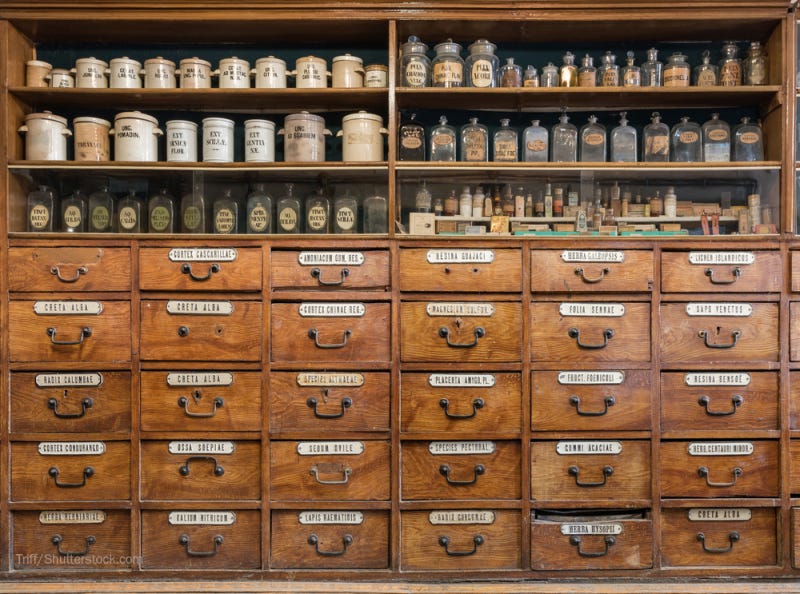
From the 1899 Merck Manual to a 1932 pharmacist’s map, the historical record is unambiguous: natural medicine was displaced not because it failed, but because it couldn’t be owned.
Let’s begin with a question that should unsettle anyone who has ever been told that natural medicine is “alternative”: alternative to what, exactly?
Not to the medicine of 1899. Not to the medicine of 1932. Not, in fact, to any era of medicine prior to the mid-twentieth century, when a legal and commercial infrastructure was deliberately built to ensure that the only substances recognized as “drugs” would be those that could be patented, manufactured at scale, and sold for profit.
Before that infrastructure existed, the original medicine was plant medicine. And the documentation proving it is hiding in plain sight.
THE 1899 MERCK MANUAL: WHERE IT ALL BEGAN
The Merck Manual is the oldest continuously published English-language medical textbook and, by most measures, the best-selling medical textbook in the world. Its first edition, published in New York in 1899 by George Merck — founder of what would become a $43 billion pharmaceutical empire — was not a catalog of synthetic drugs. It was a compendium of natural ones.
The manual drew from the Materia Medica tradition: the full body of accumulated knowledge about the therapeutic properties of substances used for healing. In 1899, that tradition was still largely intact. The remedies it recommended included arnica, papain, cod liver oil, valerian, camphor, myrrh, and beef tea. It recommended dried ovaries of cow for hormonal conditions. It recommended papaya enzyme for digestion. And it recommended Cannabis Indica, extensively, for a striking range of conditions.
Keep reading: https://sayerji.substack.com/p/they-called-it-alternative-it-was?