
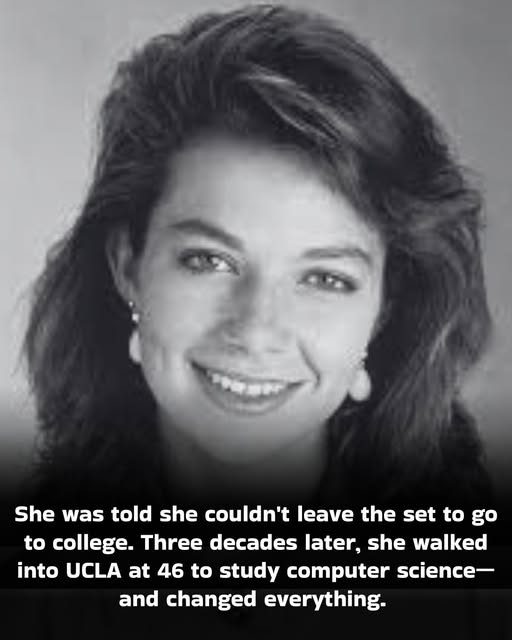
In 1982, a sixteen-year-old girl from New York stepped onto a soundstage and became Mallory Keaton—the sharp-tongued, fashion-obsessed sister on Family Ties who would earn Emmy nominations and become a household name for seven seasons.
But behind the fame, Justine Bateman had a dream that wouldn’t wait.
She wanted to go to college. She had recommendation letters from the show’s writers. She was ready to apply.
Then a line producer sat her down and said the words that would haunt her for thirty years:
“You’re under contract to Paramount Studios.”
She couldn’t leave. The decision wasn’t hers to make.
When Family Ties ended in 1989, Bateman kept working. She appeared in films with Julia Roberts and Liam Neeson. She took television roles throughout the 90s. She even launched her own fashion design company in 2000, selling couture pieces at Saks Fifth Avenue under the label SECTION 25.
She guest-starred on her brother Jason’s show, Arrested Development. She appeared on Desperate Housewives and Californication.
She never stopped moving.
But she also never stopped remembering what she’d been denied.
In 2012, at forty-six years old, Justine Bateman walked through the doors of UCLA as a freshman.
Not for publicity. Not for a certificate program. Not for a single class.
She enrolled in a full four-year computer science degree program.
She sat in lectures on Java, C++, and engineering ethics alongside students half her age—teenagers who’d grown up with technology while she’d grown up on television sets.
She studied chemistry. She coded. She failed tests and cried in parking garages. She faced job fairs where every other student had perfect GPAs and tech internships while she had… Emmy nominations.
Which meant nothing in a computer lab.
One professor later called her “one of the most terrifyingly motivated students I’ve ever had.”
Think about what that means.
At forty-six, when many people are coasting toward retirement, Justine Bateman was pulling all-nighters studying algorithms. Learning programming languages from scratch. Competing with nineteen-year-olds who’d been coding since middle school.
And she didn’t quit.
In 2016, at forty-nine years old, she graduated with the degree she’d been told she couldn’t pursue at seventeen.
Thirty years. She waited thirty years to finish what a contract had interrupted.
Then she kept going.
She wrote two bestselling books—one dissecting the psychology of fame (Fame: The Hijacking of Reality), another challenging society’s obsession with women erasing their age through cosmetic surgery (Face: One Square Foot of Skin).
She wrote, directed, and produced her feature film debut, Violet, which premiered at SXSW in 2021 and won awards at multiple festivals.
She created more films. Directed. Wrote. Produced.
And when Hollywood faced the 2023 AI crisis—when artificial intelligence threatened to replace actors, writers, and entire crews—Bateman didn’t just speak out.
She built a solution.
She founded CREDO23, an organization that certifies films made without generative AI, protecting the very artists and crews who make entertainment possible.
She turned her computer science degree into a shield for an industry that once told her she couldn’t leave to learn.
Today, Justine Bateman is fifty-eight years old.
She appears on camera without filters or apologies. Her face shows her age, and she refuses to apologize for it.
When the internet comments on her appearance, she points them to her book about exactly why she won’t “fix” anything.
When people ask what happened to her career, she shows them four decades of acting, designing, studying, writing, directing, and building organizations that matter.
She didn’t fade when the spotlight moved.
She didn’t become bitter when doors closed.
She didn’t stop when people said her time was over.
The girl who couldn’t go to college at sixteen became a computer science graduate at forty-nine.
The actress told her best roles were behind her directed feature films in her fifties.
The woman told to “fix her face” wrote a bestseller explaining exactly why she wouldn’t—and became a voice for women refusing to erase themselves to stay relevant.
She didn’t just survive Hollywood. She outgrew it.
And at fifty-eight, she’s still building.
Here’s what her story actually means:
It’s never too late.
Not to go back to school. Not to change careers. Not to pursue the dream that got interrupted thirty years ago.
Contracts end. But determination doesn’t.
She was trapped by Paramount at sixteen, but she didn’t let that contract define the rest of her life. She waited. She remembered. And when she was ready, she walked into UCLA and started over.
Reinvention doesn’t have an age limit.
At forty-six, she became a freshman. At forty-nine, she graduated. At fifty-plus, she directed films. At fifty-eight, she’s fighting AI exploitation in entertainment.
Each decade brought something new because she refused to accept that her story was already written.
Your face doesn’t determine your worth.
In an industry obsessed with youth and appearance, Bateman wrote a book called Face that challenges every assumption about women, aging, and value. She shows her age proudly, not because she’s “brave,” but because she refuses to pretend time doesn’t pass.
Justine Bateman didn’t lose fame.
She outgrew it—and built something bigger.
She turned a contract that denied her education into motivation that lasted thirty years.
She turned a computer science degree into a weapon against AI exploitation.
She turned society’s obsession with aging into a bestselling challenge to change the conversation.
And she’s still going.
Not because she’s chasing relevance. Because she’s building things that matter.
At sixteen, they told her she couldn’t leave.
At forty-six, she proved she could start over.
At fifty-eight, she’s proving you’re never done building.
Justine Bateman
Actress. Designer. Computer Scientist. Director. Author. Advocate.
The woman who waited thirty years to go to college—and used that degree to change everything.