
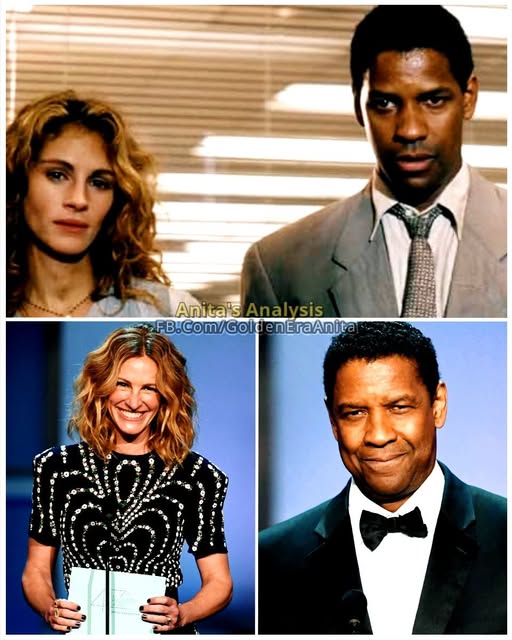
At the AFI Life Achievement Award ceremony honoring Denzel Washington in 2019, Julia Roberts surprised the audience by reading a recommendation letter written about him decades earlier by one of his acting teachers. The letter described Washington as a dedicated young actor with remarkable focus and integrity. Roberts used the moment to remind the audience that the qualities admired in him today were already visible long before Hollywood knew his name.
The audience quickly realized that the tribute was not just about celebrating a successful career. The letter revealed a portrait of a young man still searching for opportunity yet already carrying the discipline that would define him. According to the teacher who wrote it, Washington stood out because of the seriousness he brought into every rehearsal and class. While other students sometimes chased attention, he focused on learning the craft.
Roberts read the words slowly, allowing the room to absorb them. The letter described Washington as thoughtful, determined, and quietly confident. It praised his willingness to work harder than expected and his respect for fellow actors. Those early observations felt striking because they mirrored the reputation Washington would later earn across Hollywood.
Many people in the audience had worked with him over the years and knew those descriptions were accurate. Washington built his career not only through powerful performances but through consistency and preparation. Directors often describe him as an actor who arrives fully prepared and ready to collaborate. Crew members frequently recall his kindness and calm presence on set.
Julia Roberts knew that side of him well. The two stars worked together in ”The Pelican Brief” (1993), a political thriller that became one of the decade’s most successful suspense films. Roberts played a determined law student uncovering a dangerous conspiracy while Washington portrayed the investigative journalist who helps her reveal the truth. Their performances created a strong partnership that audiences still remember.
During the tribute Roberts spoke with warmth about their experience working together. She described Washington as someone who leads quietly through example rather than through loud gestures. His professionalism shaped the atmosphere on set and helped everyone focus on telling the story well. Roberts explained that his presence often made younger actors feel more confident because they knew they were working alongside someone who valued the craft deeply.
The recommendation letter made that idea even more powerful. It showed that Washington’s integrity did not develop after success. It was present from the beginning. The teacher described a student who listened carefully to direction and treated every exercise as if it mattered. That level of commitment often separates actors who simply pursue fame from those who build lasting careers.
As Roberts continued reading, laughter and applause occasionally moved through the audience. Some lines described Washington’s seriousness with gentle humor. His teacher had written that he approached acting with the focus of someone who believed every rehearsal was a step toward something meaningful. Those words felt prophetic now that his career included decades of memorable performances.
Over the years Washington has become known for roles that carry emotional weight and moral complexity. Films such as ”Glory” (1989), ”Malcolm X” (1992), and ”Training Day” (2001) demonstrated his range and intensity. Yet colleagues often say that his greatest strength is the respect he brings into every collaboration.
The AFI Life Achievement Award celebrates artists whose work shapes the history of American cinema. Washington’s influence reaches far beyond individual films. Many younger actors credit him for showing that discipline, patience, and self respect can guide a long career. His example has quietly encouraged others to approach the craft with the same seriousness.
Roberts understood that message and wanted the audience to hear it clearly. By sharing a letter written long before fame arrived, she reminded everyone that character often begins in unseen moments. Teachers, classmates, and early mentors sometimes recognize greatness before the world does.
When Roberts finished reading, the room filled with applause. Washington smiled with a mixture of humility and gratitude. The moment felt personal rather than ceremonial. It connected the celebrated actor on stage with the determined student described in the letter.
A few simple words written years earlier still echoed in that room. Talent may open doors. Character decides how far the journey continues.