
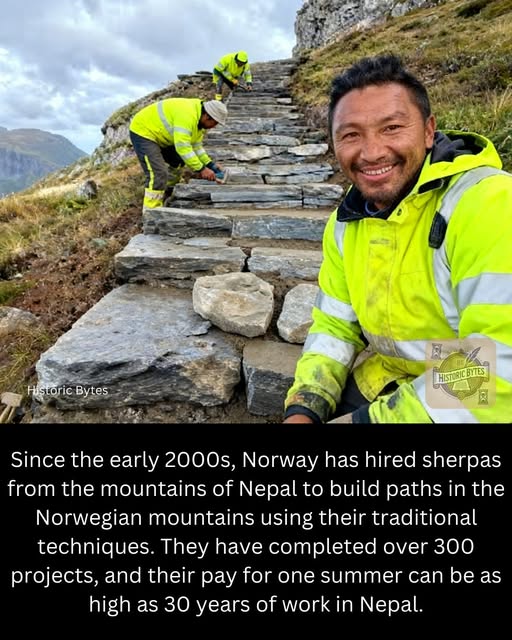
In the summer of 2000, a Norwegian farmer and conservationist named Geirr Vetti had a problem. Norway’s most celebrated mountain paths were being loved to death.
The country’s dramatic landscape of fjords, peaks, and waterfalls had become a magnet for hikers, and the trails connecting them could not keep up. Soil was eroding. Rocks were loosening.
In some places the paths had become genuinely dangerous, and the standard Norwegian approach to trail maintenance, which relied on local labor and conventional tools, was too slow and too expensive to fix the damage at the scale it was happening.
Vetti had watched a documentary about Mount Everest and noticed something. The Sherpa people of the Solukhumbu district in Nepal had spent a thousand years building stone stairways through some of the most severe terrain on earth.
Their technique required no heavy machinery, no imported materials, and no roads. It needed only hands, simple tools, an understanding of how rock fractures under pressure, and the ability to carry stones heavier than a person up a near-vertical slope. Vetti made contact with a group from Nepal. Four Sherpas arrived in Norway that first summer.
The results were immediate and obvious. The Sherpas worked at a pace and with a precision that Norwegian trail crews had not seen before. They read the landscape to find local stone, shaped it by hand, and set each piece so it locked against its neighbors and shed water naturally.
The paths they built did not require cement. They did not require maintenance crews returning every season to repair erosion damage. They lasted because the technique itself was designed to last, refined over centuries in conditions far harsher than anything Norway’s mountains could offer.
Four workers became a steady flow. Sherpas came every summer, spending seven months to a year in Norway before returning home. Over time they worked across more than two hundred locations, building stairways up to the Pulpit Rock, across the Lofoten archipelago, along the Hardanger fjord, and dozens of trails in between.