
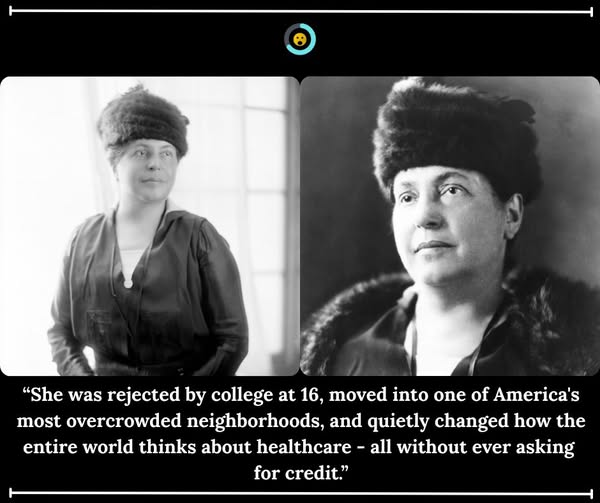
She could have lived a comfortable life.
Her father was a successful merchant. Her home in Rochester, New York was always full of books, music, and warmth. She had everything most people dreamed of.
But Lillian Wald walked away from all of it.
Not once. Not twice. Three times.
The first time, she was 16 years old – bright, determined, and full of ambition. She applied to Vassar College, one of the most respected women’s colleges in America. They rejected her. Not because she wasn’t smart enough. Simply because she was too young.
Most people would have taken that rejection personally. Lillian took it as extra time.
She spent six years traveling the world and even worked as a newspaper reporter. She was curious about everything. She was watching, learning, absorbing life.
Then, in 1889, she met a young nurse – and something shifted inside her. She enrolled at the New York Hospital Training School. She graduated in 1891. She was finally on her way.
The second time she walked away, it was from medical school.
After graduating as a nurse, she started teaching home nursing classes to poor immigrant families on New York’s Lower East Side – one of the most densely populated neighborhoods in the entire world. Families of ten people crammed into apartments barely 325 square feet in size. Children sleeping in shifts. Parents working in dangerous conditions. Sickness everywhere.
One day, she was called to help a young girl’s sick mother living in a filthy, crumbling tenement. What she saw in that apartment changed her forever.
She left medical school the next day.
Not because she gave up. Because she couldn’t justify sitting in a classroom while real people were suffering just a few streets away.
She moved directly into the neighborhood.
In 1893, Lillian Wald did something no one had done before.
She created a new kind of healthcare worker – one who didn’t wait for the sick to come to a hospital. Instead, these nurses went into homes, into dark tenements, into the streets. She called them public health nurses. She literally invented that term.
And then, with her friend Mary Brewster and the support of generous donors, she founded the Visiting Nurse Service of New York – bringing affordable, dignified healthcare to people who had never received it before.
A year later, in 1894, she opened the Henry Street Settlement House – a place offering not just medical care, but education, community support, and belonging for thousands of immigrants trying to build a new life in America.
She helped establish some of the first playgrounds in New York City. She personally helped pay the salary of the first public school nurses in NYC history.
The third time Lillian walked away from comfort was perhaps the most powerful.
She could have run her Settlement House quietly – kept her head down, helped her neighbors, and stayed out of the bigger battles. But Lillian Wald understood something important,
Treating sickness wasn’t enough if the system creating the sickness was never changed.
So she fought.
She helped launch the United States Children’s Bureau, pushing for the rights and protection of children across the nation. She co-founded the National Child Labor Committee, working to end the cruel practice of sending young children to work in dangerous factories and mines. She helped build the National Women’s Trade Union League, giving working women a voice.
She marched for women’s right to vote. She advocated for women’s access to birth control. She fought for workplace safety laws that protected laborers from dangerous conditions.
And when the devastating Spanish Flu epidemic swept through America in 1918 – killing hundreds of thousands of people – Lillian Wald led the Red Cross campaign to fight it, coordinating care across the country.
By 1913, the Henry Street Settlement had grown to seven buildings. It had 3,000 active members in its classes and clubs. Ninety-two nurses were making approximately 200,000 home health visits every single year.
In 1922, the New York Times named Lillian Wald one of the 12 greatest living American women in the country.
She later received the Lincoln Medallion – awarded to outstanding citizens of New York – for a life poured entirely into others.
Lillian Wald retired in 1930 and passed away peacefully on September 1, 1940, at the age of 73.
At a memorial held at Carnegie Hall, 2,500 people gathered – including the Governor and the Mayor of New York – to speak about one woman who had refused to look the other way.
She never sought fame. She never asked for monuments. She simply saw people who were suffering, and she moved closer instead of further away.
The Henry Street Settlement still stands on the Lower East Side today – more than 130 years later. The Visiting Nurse Service of New York still operates, one of the largest home healthcare organizations in America.
All of it began because a young woman from Cincinnati looked into a dark, crowded tenement apartment and decided that what she saw there was her responsibility.
Not someone else’s. Hers.
That is the kind of person who actually changes the world. Not the loudest voice in the room. The one who quietly moves in, rolls up their sleeves, and stays.
We don’t need to be extraordinary to make a difference. We just need to refuse to look away.
Who in your life quietly shows up for others? Tag them below. They deserve to be seen.