
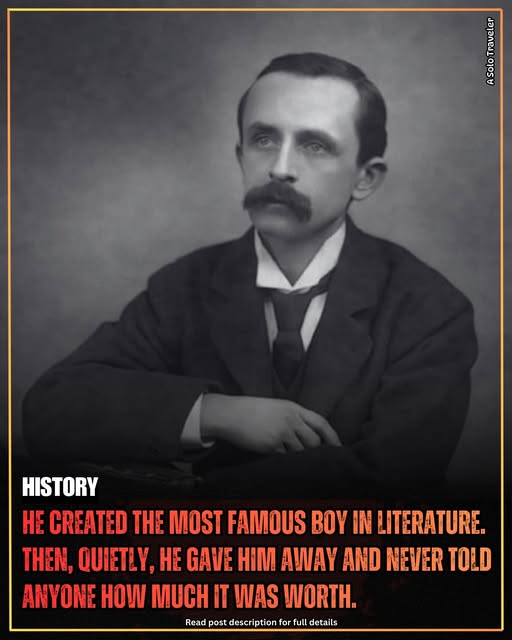
James Barrie was six years old when his brother David passed away.
David was thirteen his life was cut short in an ice-skating accident the day before his birthday. Their mother’s grief was immeasurable. But she found one small, devastating comfort in it: her boy would be thirteen forever now. He would never grow up. He would never leave her.
Young James spent his childhood trying to become the brother he couldn’t replace. He wore David’s clothes. Copied his mannerisms. Tried with everything he had to fill a space that could not be filled by anyone living.
The boy who wouldn’t grow up was born in that grief.
Barrie moved to London, became a playwright, and through a series of chance encounters in Kensington Gardens beginning in the late 1890s, befriended a family that would change everything – the five Llewelyn Davies boys, whose games and stories and wild imaginative energy handed him something he had been circling toward for years.
In 1904, he gave it a name: Peter Pan, or The Boy Who Wouldn’t Grow Up.
The play was an immediate phenomenon. The novel that followed became one of the most beloved books in the English language. The royalties made Barrie wealthy. He had no children of his own — his marriage ended in divorce — but he had become devoted guardian to the Llewelyn Davies boys after both their parents were lost at a young age, and he had a deep, lifelong tenderness for children, particularly those who were vulnerable.
In 1929, he made a decision he told almost nobody about.
He donated all rights to Peter Pan — the play, the novel, every license and royalty and adaptation — to Great Ormond Street Hospital, Britain’s leading children’s hospital.
Not a portion. Not a fixed sum. Everything. Forever.
One of the most valuable literary properties in the world, transferred quietly to a children’s ward.
When asked why, Barrie deflected with characteristic obliqueness and refused to allow the hospital to publicize the amount. He made one request: never reveal how much.
They have kept that promise for nearly a century.
From that moment, every copy of Peter Pan sold, every stage production performed, every film adaptation licensed sent money directly to the children being treated inside that hospital—children fighting illnesses with no cures, in wards where imagination was sometimes the only thing that made the waiting bearable.
When Barrie departed in 1937, British copyright law meant the rights would expire fifty years later. In 1987, the royalties would end. The hospital would lose everything.
So Parliament did something it had never done before and has never done since.
It passed a special Act granting Great Ormond Street Hospital perpetual rights to Peter Pan royalties within the United Kingdom. The only law of its kind in British legal history. The boy who wouldn’t grow up would never stop helping children fighting to survive childhood.
Since 1929, the Peter Pan rights have funded the UK’s first pediatric neuroscience unit, pioneering heart surgery equipment, gene therapy research, and hundreds of thousands of treatments for children with conditions that, a generation earlier, would simply have been terminal.
In 2019 alone, the hospital treated 238,000 children.
Many went home.
Barrie wrote in his original play: “To depart will be an awfully big adventure.“
Because of what he gave away in 1929, thousands of children got a different adventure instead.
They got to grow up.
He created a fantasy about a boy who refused to age — born from his own childhood grief, shaped by his own longing for something that could not be recovered.
Then he transformed it into a lifeline for children who were desperate to have a childhood at all.
He asked for no recognition. He requested that no one reveal the numbers. He simply handed over the thing he had made and walked away.
Some legacies fade when their creators are gone.
This one has been saving lives every single day for nearly a hundred years.