
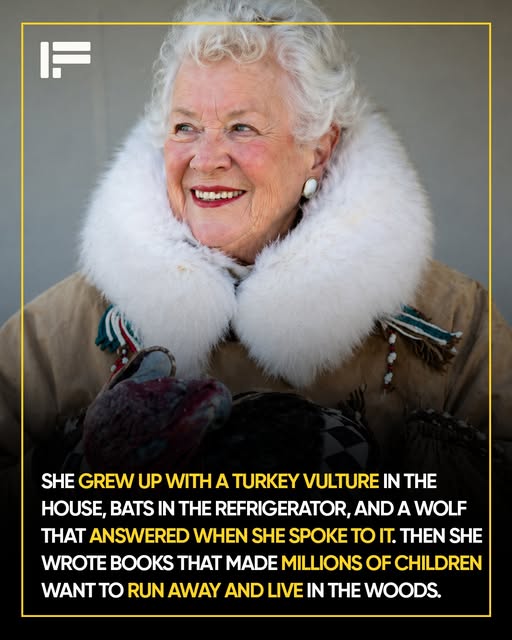
By the time Jean Craighead George had finished writing her last book, 173 wild animals had lived in her house.
That figure does not include the dogs and the cats. It does include the turkey vulture (her first pet), the crows, the owls, the raccoons, the tarantulas, the bats, the foxes, the falcons, the geese, the chipmunks, and the long succession of other species who came and went freely from the back porch of her old house in Chappaqua, New York, between roughly 1944 and her death in 2012. They were not in cages. They were not behind glass. They came in through the door, ate at her table, slept where they pleased, and at the end of the season — when the light shifted and some old instinct turned in their bodies — they let themselves out and went back to wherever it was they had come from.
Each one of them, before they left, gave her something her library could not.
A character. A detail. A verified piece of behavior. A line of dialogue she could put in the mouth of an animal in one of her hundred-and-some books for children.
Her most famous of those books is the one almost every American who attended elementary school after 1960 has read.
It is called My Side of the Mountain.
Jean Carolyn Craighead was born in Washington, D.C., on July 2, 1919, into one of the most extraordinary American naturalist families of the 20th century. Her father, Frank Craighead Sr., was an entomologist with the U.S. Department of Agriculture and an obsessive naturalist who spent every weekend pulling his three children — Jean and her older twin brothers, Frank Jr. and John — into the forests around the city. They studied owls. They identified plants. They climbed trees. They learned to make fish hooks from twigs. Their mother, Carolyn, was a fellow naturalist who shared the obsession.
Jean’s twin older brothers grew up to become two of the most consequential wildlife biologists in American history. Frank Jr. and John Craighead’s twelve-year radio-telemetry study of the grizzly bears of Yellowstone National Park, conducted from 1959 to 1971, fundamentally rewrote what scientists understood about grizzly population dynamics and is widely credited with helping protect the species from extinction in the lower 48 states. The brothers had a long and famous battle with the National Park Service over the closing of Yellowstone’s open garbage dumps, which the Craigheads correctly predicted would cause a population crash before they had finished their fieldwork.
Their younger sister Jean took the same family obsession in a different direction.
She graduated from Pennsylvania State University in 1940 with degrees in both English and Science. She worked as a reporter for the Washington Post in the 1940s and was a member of the White House Press Corps. She married a fellow naturalist named John L. George in 1944, and the two of them co-wrote her earliest books for children — including the American Woodland Tales series, beginning with Vulpes the Red Fox in 1948.
She started keeping wild animals at home around the time the children started arriving.
She and John had three children: Twig C. George (who would grow up to be a children’s book author herself), Craig George (who would become an environmental scientist), and T. Luke George (who would also become an environmental scientist). The household they grew up in was, by every account anyone has ever given of it, like nothing else in suburban Westchester County. Bats in the refrigerator. Owls in the bathroom. A crow at the breakfast table. A raccoon in the hallway. The owls came naturally — Jean’s brothers’ lifelong work with raptors meant that every Craighead family gathering had at least one bird of prey in attendance. The raccoons and the foxes and the chipmunks came in, in Jean’s later words, because she could not stop them and did not particularly want to.
Most of them, when the season changed, simply left.
Her 1959 book My Side of the Mountain — about a boy named Sam Gribley who runs away from his family’s small Manhattan apartment to live alone in a hollowed-out hemlock tree in the Catskill Mountains, surviving on his own foraged food and training a young peregrine falcon named Frightful — won a 1960 Newbery Honor and has not been out of print since. It has been on American elementary school reading lists for sixty-six years. There are several generations of American adults who can still remember exactly where they were sitting when they finished it. Most of them, somewhere quietly inside themselves, briefly considered whether they could actually do what Sam did.
Sam was Jean. She had been him.
She and John divorced in 1963. She kept writing.
In the summer of 1970 — alone now, with her youngest son Luke in tow — Jean traveled to the Naval Arctic Research Laboratory in Barrow, Alaska, where a small team of scientists was attempting something nobody in modern Western science had quite tried before. They were learning to communicate with wolves. The research was led by the wildlife biologist Gordon Haber. The team had identified the specific signals — postural, vocal, scent-based — by which wolves communicated within a pack, and they had begun, with small successes, to use those signals to communicate back.
Jean tried it.
She told the story for the rest of her life. She had stood out on the open tundra outside the Barrow lab. She had used the postural and vocal cues she had been taught. A wolf had answered her.
Two specific images from that summer — a small Inuit girl walking alone across the tundra outside Barrow, and a magnificent alpha male wolf leading his pack in Denali National Park — stayed with her for more than a year before she sat down to write what would become her most famous book.
Julie of the Wolves was published in 1972. The story of an Inuit girl named Miyax — who runs away from a violent forced marriage on the North Slope of Alaska, gets lost on the open tundra, and survives by patiently earning the trust of a wolf pack — won the 1973 Newbery Medal, the highest American honor in children’s literature. It has sold millions of copies worldwide. It became, like My Side of the Mountain, a permanent fixture on American school reading lists. It was followed by two sequels: Julie (1994) and Julie’s Wolf Pack (1997).
Jean kept writing, kept keeping animals, and kept writing about them, for the rest of her life.
She wrote more than a hundred books for children. She wrote two cookbooks for foraged wild foods. She wrote her own autobiography, Journey Inward, in 1982. She wrote up until her death, working on her last manuscripts in her ninth decade. Her brothers Frank Jr. and John outlived her, eventually dying within nineteen days of each other in 2016 at the ages of 100 and 99. The three Craighead siblings — born within three years of each other in the early 20th century and shaped by the same Maryland woods on the weekends — collectively shaped how Americans understood and cared for wild animals for the better part of a hundred years.
Jean Craighead George died on May 15, 2012, in Mount Kisco, New York. She was 92 years old.
She had spent nearly a century trying to tell anyone who would listen one specific thing about the natural world.
It is not a destination. It is not a documentary. It is not a school field trip.
It is something you let into your kitchen. Something you learn the language of. Something that, if you are patient enough — and if you do not panic, and if you do not put it in a cage — speaks back.