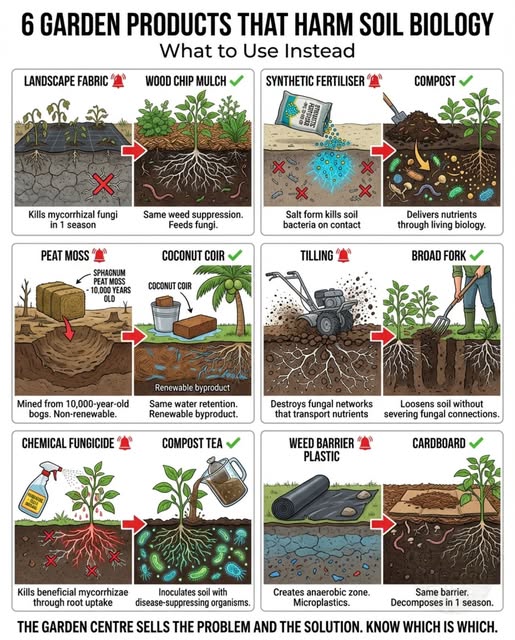
Your garden centre sells the problem and the solution in the same aisle.
Six products on the shelf damage the soil biology they promise to support. Every one has a swap that costs less and works better.
– Landscape fabric blocks oxygen and moisture from reaching the fungal networks your plants depend on — they die within one season under a sealed barrier. Wood chip mulch does the same weed suppression while feeding the fungi instead.
– Synthetic granular fertiliser delivers nutrients in salt form that damages soil bacteria on contact. Compost delivers the same nutrients through living biology that stays active in the soil long after application.
– Peat moss is mined from bogs that took thousands of years to form. Coconut coir provides identical water retention from a renewable source at a similar price.
– Tilling destroys the fungal networks that transport nutrients between plants underground. A broad fork loosens compacted soil without severing them.
– Chemical fungicide sprayed on foliage is absorbed through the roots and kills beneficial fungi in the soil below. Compost tea inoculates the same soil with competitive organisms that suppress disease naturally.
– Weed barrier plastic creates an airless zone that suffocates soil life underneath. Cardboard does the same job and decomposes into the soil within one season.
The pattern behind all six:
– The expensive option sterilizes. The cheap option feeds. Every swap saves money and builds soil at the same time
– Wood chips, compost, and cardboard are often available free from local tree services, municipal composting programs, and recycling bins
– The results aren’t instant — living soil biology takes one to two seasons to establish, but once it does the soil improves on its own each year instead of needing more inputs.
Stop buying products that work against the soil. Start using ones that build it.