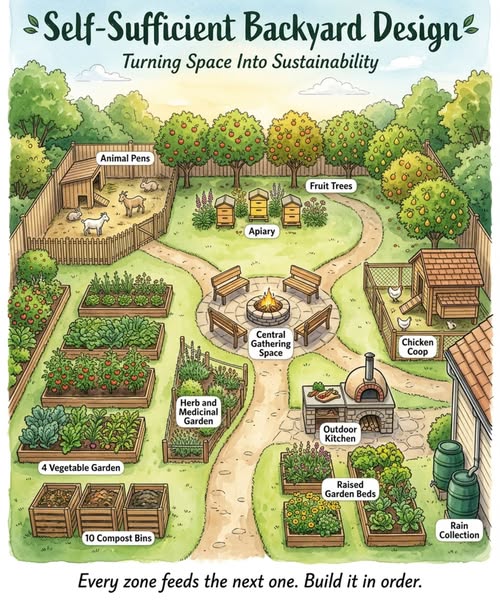
A self-sufficient backyard isn’t built all at once. It’s built in zones, each one adding a layer that feeds or supports the ones around it. This layout shows how ten elements work together in a single property.
Working from the outside in:
Fruit trees along the perimeter — the slowest investment and the longest return. Plant these first. Apple, pear, peach, and plum all work well in most US climate zones and provide decades of harvest once established.
Animal pens and apiary in the back corner — positioned upwind of the kitchen garden to keep manure smell away from the harvest areas. A small goat, rabbits, or laying hens produce fertility for the entire system. Two beehives service the fruit trees and vegetable garden simultaneously.
Chicken coop on the opposite side — chickens are rotated through the vegetable beds after harvest to scratch, fertilize, and break pest cycles before the next planting.
Vegetable garden and raised beds — the core production area. Multiple beds allow crop rotation across seasons. Raised beds near the outdoor kitchen shorten the distance from harvest to preparation.
Herb and medicinal garden — positioned close to the kitchen path for daily cutting access. Perennial herbs anchor this bed permanently.
Central gathering space — a fire pit with stone seating in the center of the layout functions as the organizing hub. Paths radiate outward to every zone from this point.
Compost bins — positioned at the junction between the kitchen garden and the animal area so inputs from both flow in without long carries.
Rain collection — a cistern or barrel system fed from the house or outbuilding roof, positioned to gravity-feed the nearest raised beds.
Outdoor kitchen — wood-fired oven and prep area adjacent to the raised beds, closing the loop between growing and cooking on the same property.