A tree that outlived the dinosaurs just did something in an English backyard that no one thought was possible.
Ninety million years ago, while T. rex shook the earth, a quiet species of tree was already ancient. The Wollemi pine had been growing on this planet long before any creature we’d recognize walked it. Then, somewhere along the way, it vanished from the fossil record. Scientists assumed it had gone extinct alongside the dinosaurs.
For millions of years, no one questioned that assumption.
Then in 1994, deep inside a hidden gorge in Australia’s Blue Mountains, a park ranger named David Noble rappelled into a canyon and spotted something he couldn’t identify. The trees growing in that isolated ravine turned out to be Wollemi pines — alive, breathing, and utterly impossible. It was like finding a living dinosaur hiding in plain sight. Fewer than 100 mature trees existed, tucked away in a secret location the Australian government still refuses to publicly disclose.
The discovery shook the botanical world. But the Wollemi pine had a problem: reproducing. The species struggled to produce both male and female cones simultaneously, making natural seed production extraordinarily rare. Most new trees were cloned from cuttings. The species was alive, but barely holding on.
Then came Pamela and Alistair Thompson.
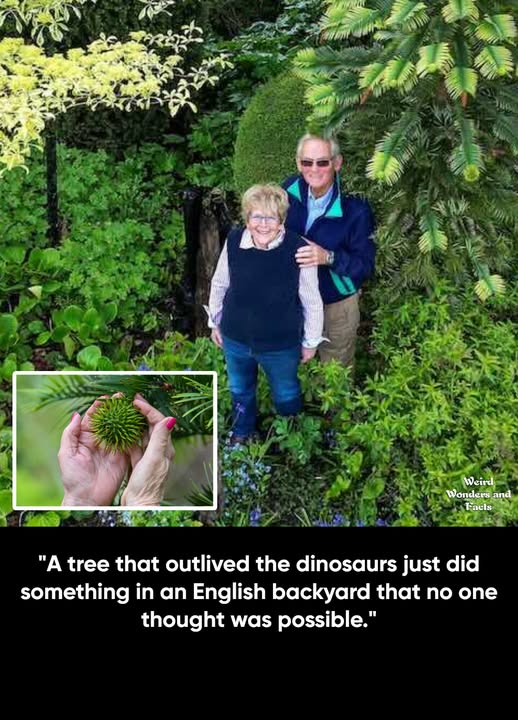
In 2010, this retired couple from Worcestershire, England, paid £70 for an 18-inch Wollemi pine sapling. They planted it in their garden and began what would become a 15-year labor of love. Year after year, they tended to a tree from another era, nurturing it through English winters that were nothing like the Australian gorge where its ancestors had survived in secret.
Most people would have given up. The Thompsons didn’t.
In August 2025, Pamela walked into the garden and noticed something extraordinary. Five large cones had formed. Both male and female cones had appeared at the same time, something exceptionally rare for this species. When she gently touched a cone, hundreds of seeds cascaded into her cupped hands.
She stood there holding the future of a 90-million-year-old species in her palms.
The tree had done what many scientists doubted was possible in a private garden outside Australia. It had naturally reproduced. Each seed, worth up to £10, represented not just monetary value but a lifeline for one of the most endangered trees on Earth. The couple plans to distribute the seeds to botanical gardens and conservation programs, giving this prehistoric survivor new footholds around the world.
Alistair joked that it proves money really can grow on trees. But what it truly proves is something far more powerful: that patience, dedication, and a little bit of love can help bring even the most ancient life back from the brink.
Sometimes the greatest acts of conservation don’t happen in laboratories or national parks. Sometimes they happen in an ordinary backyard, with two extraordinary people who refused to give up on a tree the rest of the world had already written off.