
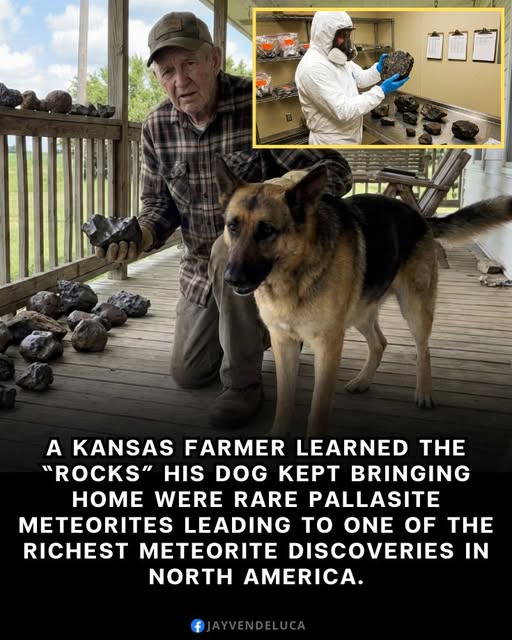
A farmer’s dog kept bringing back strange metallic-smelling rocks from the woods.
When the farmer had them analyzed, it changed his life forever.
In the spring of 2023, Kansas farmer Dale Henderson was repairing fence posts along the eastern edge of his property near Russell County when his German Shepherd, Max, came trotting out of the tree line carrying something in his mouth.
Another rock.
Max had been doing this for weeks. He’d vanish into the small woodland that bordered the farm, sometimes for hours, and return with dark, heavy stones clutched in his jaws. He’d drop them at Dale’s feet like offerings, tail wagging, waiting for praise.
Dale had assumed the dog was just being a dog. Finding interesting things. Bringing them home. That’s what dogs do.
But these rocks were different.
They were heavier than they should be. Covered in a smooth black crust that didn’t match anything Dale had seen in forty years of working this land. When he held them close, they smelled like iron—like blood, almost. Like metal left out in the rain.
And Max kept finding more.
By early April, Dale had a collection of nineteen stones piled on his porch. The smallest was the size of a golf ball. The largest weighed nearly eight pounds.
His wife, Ellen, wanted him to throw them out. “They’re just rocks,“ she said. “The porch looks like a quarry.”
Dale couldn’t explain why, but something told him to keep them.
On April 14th, he loaded twelve of the specimens into his truck and drove ninety miles to the geology department at Kansas State University in Manhattan.
He felt foolish walking into the building. A sixty-three-year-old farmer in dirty boots, carrying a cardboard box full of rocks his dog found.
But Professor James Chen didn’t laugh.
He picked up the first stone, turned it over in his hands, and his expression changed.
“Where exactly did you find these?”
“I didn’t,” Dale said. “My dog did.”
Professor Chen ran the first round of tests that afternoon. Density measurements. Magnetic response. X-ray fluorescence.
Dale paced in the hallway for two hours.
His neighbor, Roy Perkins, called during the wait. Roy owned the adjacent 160 acres. He’d found similar stones scattered across his fields after spring plowing. Three of them. He thought they were slag from an old railroad line.
Dale told him to bring them to the university.
Professor Chen emerged just before 5 PM, holding a printout of analysis results. His hands were shaking.
“Mr. Henderson, these aren’t rocks. They’re meteorites. And based on the composition, they’re from the same fall event. Probably thousands of years old.”
He paused.
“I need to see where your dog has been finding them.”
The geology team arrived at Dale’s farm three days later with ground-penetrating radar, metal detectors, and magnetometers. They started in the woodland where Max had been hunting.
Within four hours, they’d identified over sixty additional specimens buried in the soil.
Then they expanded the search to the open fields.
The equipment went haywire.
Beneath Dale Henderson’s 200-acre farm lay the remnants of an ancient meteorite shower—thousands of fragments from a single asteroid that broke apart in the atmosphere and scattered across what is now central Kansas, likely between 10,000 and 20,000 years ago.
Subsequent surveys revealed the strewn field extended across Dale’s entire property and onto Roy Perkins’s land as well. It was one of the largest and richest meteorite fields ever discovered in North America.
But the composition was what made it extraordinary.
The meteorites were pallasites—an extremely rare type containing crystalline olivine embedded in an iron-nickel matrix. They also showed unusually high concentrations of platinum-group metals: iridium, palladium, and rhodium.
The scientific value was immense. The commercial value was almost incomprehensible.
Pallasite specimens sell to collectors for $40 to $60 per gram. Some of the larger pieces on Dale’s property weighed several kilograms each.
Museums began calling within a week of the announcement. The Smithsonian. The American Museum of Natural History. Private collectors from Europe and Asia.
A single 4.2-kilogram specimen from Dale’s north field sold at auction in September 2023 for $892,000.
Dale Henderson’s farm, which he’d been considering selling due to declining crop prices, became the site of one of the most significant meteorite recoveries in American history.
The total estimated value of recoverable specimens across both properties exceeded $47 million.
Dale and Roy formed a partnership. They hired a professional excavation team to conduct systematic recovery while preserving the scientific integrity of the site. The University of Kansas was granted research access in exchange for authentication and documentation services.
Dale kept farming. He said he wasn’t going to let space rocks change who he was.
But he did build a new barn. And a new house. And set up college funds for all seven of his grandchildren.
Max, the German Shepherd who started it all, became a minor celebrity. A geology magazine ran a feature calling him “the most valuable dog in America.” A pet food company offered a sponsorship deal.
Dale turned it down.
“Max doesn’t need to be famous,” he said. “He was just doing what dogs do. Finding things. Bringing them home. Hoping someone would notice.”
He scratched Max behind the ears.
“I almost threw those rocks away. Ellen wanted me to. But Max kept bringing more. It was like he was trying to tell me something.”
Max still disappears into the woods sometimes. He still comes back with stones in his mouth.
Now, every single one gets tested.
Last month, he found a 340-gram fragment that preliminary analysis suggests contains the highest iridium concentration of any specimen yet recovered from the site.
Estimated value: $180,000.
Good boy.