
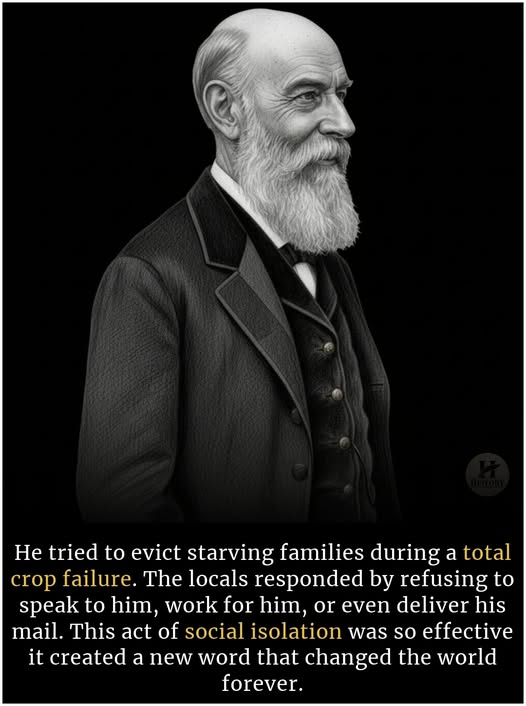
In 1880, a wealthy British land agent named Charles Boycott lived on a sprawling estate in County Mayo, Ireland. He was an uncompromising man who managed lands for an absentee lord.
A terrible harvest had left the local farmers starving and unable to pay their full rent. They didn’t ask for a handout. They simply asked for a 25 percent reduction to survive the winter.
But Charles Boycott was not a man of compromise. He refused their pleas and began the process of eviction to throw families out of their homes.
He expected the peasants to fold under his authority. He expected them to fear the law he represented.
But the people of Ireland had found a new champion in the Land League. Their leader, Charles Parnell, had proposed a different kind of warfare.
Instead of violence, Parnell suggested a policy of total social isolation. He told the people to treat an unfair landlord like a leper of old.
When Boycott tried to hire local workers to harvest his crops, nobody showed up. The fields sat heavy with overripe grain, rotting in the Irish rain.
He walked into the local shops to buy supplies, but the shopkeepers turned their backs. They would not take his gold.
He sent for his mail, but the postman refused to deliver it. His servants walked out of his house without a word, leaving him to cook his own meals.
He saw their resolve. He saw their silence. He saw their power.
But the British government stepped in to assist him. They sent 50 orange-men from the north and 1,000 soldiers to protect them while they harvested the crops.
It cost the government over 10,000 pounds to harvest a crop worth only 350 pounds. The victory was hollow.
Charles Boycott was a broken man. By December of that year, he fled Ireland in a carriage protected by a military escort.
His name was no longer just a name. It had become a verb that described the most powerful non-violent weapon in history.
Today, we still use his name whenever a community stands together to stop unfair practices. Collective action remains the strongest check on unbridled power.
Sources: Britannica / National Library of Ireland / History Channel