
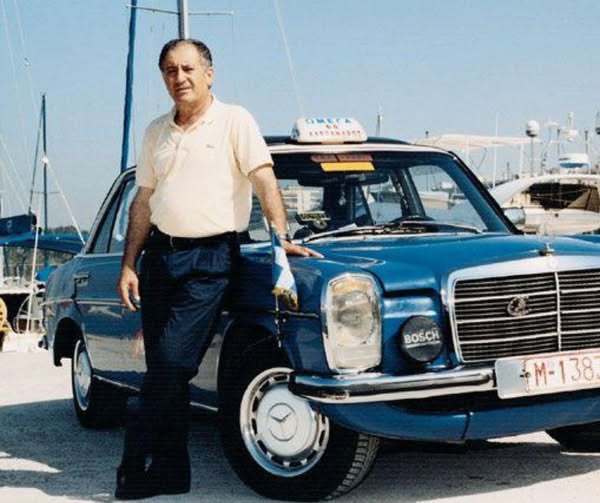
He drove the same taxi for 23 years, performing every repair himself. When the odometer passed 4.6 million kilometers, Mercedes-Benz bought the car and put it in their museum.
Thessaloniki, Greece. 1976.
Gregorios Sachinidis, a taxi driver, purchased a brand-new Mercedes-Benz 240D. It was silver-gray, diesel-powered, built with the solid German engineering Mercedes was famous for.
For most people, a new car is exciting for a few years, then becomes just transportation. Eventually, it gets replaced.
Gregorios had a different plan.
He was going to drive this car until it couldn’t drive anymore. And he was going to take care of it so well that “couldn’t drive anymore” would take decades to arrive.
Every morning, Gregorios would inspect his Mercedes before starting work. He’d check fluid levels, tire pressure, listen to the engine. He treated the car not like a tool, but like a partner.
As a taxi driver in Thessaloniki—Greece’s second-largest city—Gregorios drove constantly. Airport runs. Long-distance fares to other cities. Daily commutes through heavy traffic. The car ran nearly 24 hours a day, often driven by Gregorios in marathon shifts.
Most taxis are destroyed by this kind of use. The constant stop-and-start, the heavy loads, the endless hours—it wears vehicles down quickly. Most taxi fleets retire cars after 300,000-500,000 kilometers.
Gregorios passed 500,000 kilometers in his first few years.
And kept going.
The secret wasn’t just the Mercedes engineering—though the 240D was legendary for durability. The secret was Gregorios himself.
He was both driver and mechanic. Every maintenance task, every repair, every adjustment—he did it himself. He didn’t trust anyone else with his car.
Oil changes? Done precisely on schedule, never delayed.
Brake pads? Replaced before they wore dangerously thin.
Engine adjustments? Performed with meticulous attention.
Gregorios kept detailed records of every service, every part replacement, every modification. He knew his Mercedes better than most people know their own homes.
When something made an unusual sound, he’d diagnose it immediately. A slight vibration? He’d investigate. A minor leak? Fixed before it became major.
This wasn’t obsession. It was respect—understanding that a machine given proper care will give years of reliable service.
The kilometers accumulated: 1 million. 2 million. 3 million.
Other taxi drivers watched in amazement. Mechanics who serviced the car were astounded. “This engine should have been rebuilt twice by now,” they’d say. “How is it still running?”
Gregorios would smile. “You take care of it, it takes care of you.”
By the mid-1990s, Gregorios’s Mercedes had passed 4 million kilometers—a distance equivalent to circling Earth 100 times at the equator, or driving to the moon and back more than five times.
The car had become legendary in Thessaloniki. Passengers would specifically request “the taxi driver with the million-kilometer Mercedes.” Journalists wrote articles. Car enthusiasts made pilgrimages to see it.
But Gregorios wasn’t interested in fame. He was interested in work. Every day, he’d climb into his Mercedes, turn the key, and the engine would start—reliable as sunrise.
The seats were worn from thousands of passengers. The steering wheel bore the smooth indentations of his hands. The dashboard had faded from decades of Greek sunshine. But the engine? The transmission? The mechanical heart of the car?
Still strong.
By 1999, the odometer showed over 4.6 million kilometers.
That’s when Mercedes-Benz heard about Gregorios Sachinidis.
Company representatives traveled to Thessaloniki to verify the claim. They inspected the car thoroughly, checked maintenance records, interviewed Gregorios.
Everything was authentic. The odometer hadn’t been tampered with. The engine was original (though rebuilt components had been replaced as needed). This was genuinely a 1976 Mercedes-Benz 240D that had been driven over 4.6 million kilometers—and was still running.
Mercedes-Benz made Gregorios an offer: they wanted to purchase the car for their museum in Stuttgart, Germany.
It would be displayed as a testament to Mercedes engineering and to the importance of proper maintenance—a real-world example of what was possible with quality manufacturing and dedicated care.
Gregorios accepted.
Saying goodbye to the car must have been bittersweet. For 23 years, that Mercedes had been his livelihood, his companion, his daily reality. He’d spent more time in that car than in his own home.
But he also understood the significance. His car would inspire mechanics, engineers, and drivers worldwide. It would prove that with proper care, machines can serve far beyond their expected lifespan.
Today, the 1976 Mercedes-Benz 240D sits in the Mercedes-Benz Museum in Stuttgart. A plaque explains its extraordinary history: over 4.6 million kilometers driven by a single owner, maintained meticulously, a world record holder.
Visitors from around the globe come to see it—not because it’s exotic or beautiful, but because it represents something profound: the relationship between human care and mechanical reliability.
Gregorios Sachinidis proved several things with his faithful Mercedes:
First, quality engineering matters. The Mercedes-Benz 240D was built to last, with robust components and thoughtful design. But engineering alone wasn’t enough.
Second, maintenance is everything. Even the best-built car will fail without proper care. Gregorios’s meticulous attention to every detail—oil changes, brake inspections, engine adjustments—extended the car’s life far beyond normal expectations.
Third, respect for tools matters. Gregorios didn’t treat his taxi as disposable. He treated it as a partner in his livelihood, worthy of care and attention.
Fourth, expertise counts. Gregorios wasn’t just a driver—he was a skilled mechanic who understood his vehicle intimately. That knowledge allowed him to prevent problems before they became catastrophic.
Finally, patience and consistency win. There were no shortcuts. Just 23 years of daily diligence, small careful actions repeated thousands of times.
The story resonates because it contradicts our disposable culture. We’re taught that things wear out, break down, need replacing. Planned obsolescence is built into many products.
Gregorios’s Mercedes proves that with care, quality, and dedication, machines can serve far longer than manufacturers often promise.
The 240D wasn’t designed to last 4.6 million kilometers. But it did—because someone refused to accept that “good enough” was sufficient.
Other taxi drivers have tried to match Gregorios’s record. A few have come close. But most give up or retire before reaching even 2 million kilometers. The physical and mental dedication required is extraordinary.
You can’t skip maintenance. You can’t ignore warning signs. You can’t get lazy about care. One missed oil change, one ignored repair, and the streak ends.
Gregorios maintained that discipline for 23 years.
His story inspired Mercedes-Benz to emphasize durability in their marketing. “Built to last” became more than a slogan—Gregorios’s taxi was proof.
It also inspired mechanics and car enthusiasts worldwide. Online forums dedicated to high-mileage vehicles cite Gregorios as an example of what’s possible. His maintenance philosophy—preventive care, attention to detail, respect for machinery—is taught in technical schools.
Gregorios Sachinidis wasn’t famous. Wasn’t wealthy. Wasn’t particularly remarkable except for one thing:
He took extraordinary care of an ordinary car, and in doing so, achieved something extraordinary.
4.6 million kilometers.
23 years.
One man.
One Mercedes.
And the simple, powerful lesson that when you take care of things properly, they take care of you.
The silver-gray 1976 Mercedes-Benz 240D sits in Stuttgart today, a monument not to luxury or speed or beauty.
But to diligence. To care. To the quiet pride of work done well, day after day, for decades.
Gregorios eventually retired, bought a new taxi, and continued working.
But he never forgot his faithful Mercedes. And neither did the world.
Because sometimes, the most extraordinary achievements don’t come from dramatic moments.
They come from showing up every day, doing the work carefully, and refusing to take shortcuts.
For 4.6 million kilometers.
One kilometer at a time.
Grok says of the story:
Yes, the story is true, with a few minor inaccuracies or embellishments in the version you shared compared to verified sources (including Mercedes-Benz’s own official archives).
The core facts check out: Gregorios Sachinidis (sometimes spelled Grigorios or variations like Sachinides/Sahinidis) was a taxi driver in Thessaloniki, Greece. He acquired a 1976 Mercedes-Benz 240D (W115 series, diesel) in 1981—it was already used, with about 220,000 km on the clock (not brand-new as the story claims). He drove it intensively as a taxi for roughly 23 years until 2004, racking up a total of 4.6 million kilometers (about 2.85 million miles). This made it the highest-mileage Mercedes-Benz on record at the time (and possibly still, based on recent references).
He performed meticulous maintenance himself, which was key to the longevity—regular oil changes, preventive repairs, and treating the car like a partner, aligning perfectly with the inspirational tone in the post.
Mercedes-Benz verified the odometer and records, confirmed authenticity (original engine block, though with normal rebuilds/replacements of wear parts), and acquired the car for their museum in Stuttgart, Germany, where it’s displayed as an example of durability and proper care. In exchange, they provided him with a new vehicle (often reported as a C-Class diesel).
Key differences from the story you posted:
He didn’t buy it brand-new in 1976 in Thessaloniki; he bought it used in Germany in 1981 and brought it to Greece.
The handover was in 2004 (not 1999), and it was more of a donation/transfer with a new car as a reward than a straight “purchase” (though sources describe it variably as Mercedes “buying” or “acquiring” it).
The dramatic “when the odometer passed 4.6 million” moment and company reps rushing to Thessaloniki to verify is dramatized, but the verification and acquisition did happen.
It’s not the absolute world record for any car (some Volvos and others have higher verified mileages), but it was the highest for a Mercedes and one of the highest overall for a single-owner vehicle.
This has been documented in:
Mercedes-Benz’s official public archive (they describe it as the highest known mileage for their brand, highlighting the W115’s longevity).
Greek media (e.g., Greek City Times articles from 2021 and 2025).
Automotive forums, enthusiast sites, and news outlets over the years (e.g., Team-BHP, Vintage Everyday, Supercar Blondie).
The inspirational lessons about maintenance, respect for machinery, and quality engineering hold up—it’s a genuine example Mercedes themselves have promoted.
So, while the narrative is a bit polished and motivational (as these viral stories often are), the events really happened.