
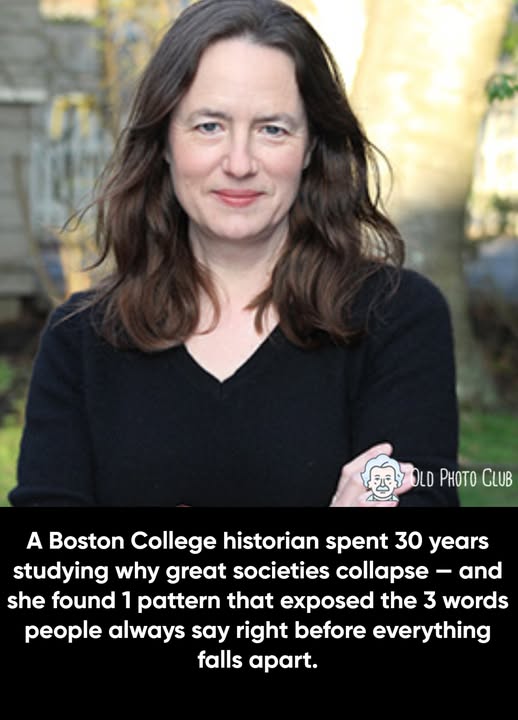
A Boston College historian spent 30 years studying why great societies collapse — and she found 1 pattern that exposed the 3 words people always say right before everything falls apart.
Her name is Heather Cox Richardson. She is a history professor at Boston College. She has spent over three decades studying the rise and fall of American democracy. While most of us doomscroll through headlines until our stomachs turn, she does something different. She opens dusty archives. She reads forgotten letters. She traces the invisible cracks that appeared long before any civilization crumbled.
And after studying centuries of history, she noticed something chilling. The same three words appear again and again, spoken by ordinary people, just before disaster strikes.
“Someone will fix it.”
Let me explain what she means.
Picture an ordinary American family in 1859. A husband and wife sitting at a kitchen table. They have noticed things changing around them. The newspapers are angrier. Neighbors who once waved at each other now cross the street to avoid conversation. Political arguments at church gatherings have turned bitter and personal.
They feel the tension. They sense something is wrong. But they tell themselves the same thing millions of others are telling themselves at the very same moment.
Someone will fix it. The leaders will sort this out. The system is strong enough to hold.
Two years later, 620,000 Americans were dead in the bloodiest war the nation had ever seen.
To us, reading history books, the Civil War feels like it was always going to happen. We see the dates. We follow the timeline. We watch the dominoes fall in a sequence that seems obvious and unavoidable.
But to the people living through those years, nothing felt inevitable. They were just regular folks trying to get through their days. They believed things would work out because they had always worked out before.
Richardson has studied this pattern across American history, and she says it repeats with heartbreaking consistency. Good people see warning signs. They feel the ground shifting. But they convince themselves that someone else will step in. That the system will correct itself. That the fever will break on its own.
And by the time they realize no one is coming to save them, the window to act has already narrowed.
This is the heartbreak of studying history. You can see exactly where the exit ramps were. You can see the moments when one brave conversation, one different choice, one act of courage could have changed everything. You want to reach through time and shake people awake.
But here is where Richardson’s message shifts from warning to something powerful.
Those families in 1859 cannot go back. Their story is written. The ink is dry. The pages are sealed.
But ours are not.
We are living in an unfinished chapter. The pages ahead of us are completely blank. And unlike those families in 1859, we have something extraordinary on our side. We have their story. We know what happens when people stay silent. We know what happens when citizens assume the system will protect itself. We have centuries of hard evidence showing us exactly what the warning signs look like.
That knowledge, purchased at a staggering price by the generations who came before us, is our greatest advantage.
Richardson reminds us that civilizations almost never collapse in one dramatic moment. There is no single explosion. No single villain. No single day when everything falls apart. Instead, they erode. Slowly. Quietly. They die by a thousand small surrenders. They fade when exhausted people decide the fight is no longer worth having. They crumble when citizens forget one critical truth.
The system is not something separate from us. The system is us.
But Richardson also teaches the opposite lesson. Because history is not only a record of failure. It is also a record of impossible victories.
The women who fought for the right to vote had no guarantee of success. They marched for over 70 years. They were jailed. They were beaten. They were mocked in newspapers and dismissed by the men who held power. Many of them died without ever casting a single ballot. But they kept showing up. And they changed the world.
The civil rights activists of the 1950s and 1960s faced firehoses, attack dogs, bombings, and assassinations. Every single day, they woke up not knowing if their movement would survive. The outcome was never certain. Victory was never promised. But ordinary people, bone-tired and deeply afraid, chose to stand anyway.
Those movements did not succeed because the odds were in their favor. They succeeded because enough people refused to sit down when everything inside them wanted to quit.
And here is what Richardson wants us to carry with us today.
We are standing at our own crossroads right now. The chapter ahead is unwritten. That blankness feels terrifying. It keeps us awake at night. It makes us wonder if the future is already decided.
But it is not.
Every single day holds choices. How we talk to the person who disagrees with us. Whether we engage with our community or retreat behind locked doors. Whether we let fear push us toward silence or whether we find the courage to speak. Whether we surrender to the idea that nothing can be done or whether we pick up the pen and start writing something different.
Heather Cox Richardson has spent her life studying the ghosts of history. She knows their stories like old friends. She has traced their mistakes with sorrow and their victories with admiration.
But she does not live in the past. She lives in the fierce, stubborn hope of this present moment. Because she understands something most of us forget.
Inevitability only applies to what has already happened.
Tomorrow is still wet cement. We can still leave our handprints in it. We can still shape it into something worth passing down.
History is not a prison sentence. It is a map drawn by those who walked before us, showing us both the dead ends and the open roads.
The people who understand that map best are the ones standing in front of us right now, saying the same thing.
We still have time. But time does not wait for people who keep saying someone else will fix it.
The question was never whether we could change the story. The question has always been whether we will.