
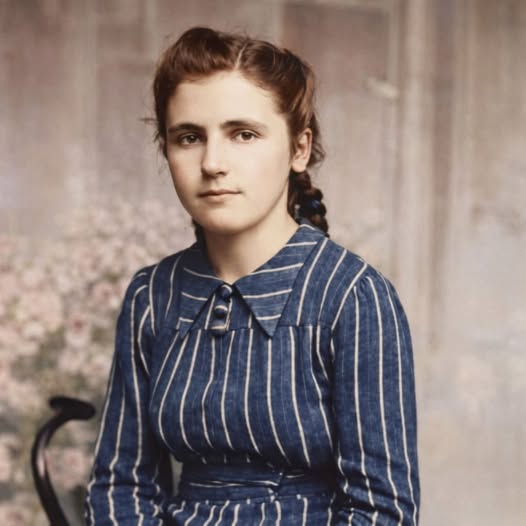
Four armed men came to take her home while her husband was gone. She gave them one warning, then reached for the rifle.
Montana Territory, October 1889.
The sound of approaching horses made Ellen McKenzie’s hands pause mid-stir over the stew pot. Her husband, James, had left two days earlier, driving their small herd to market. Their nearest neighbor lived four miles away through dense pine forest. And she was alone with their eight-month-old daughter, sleeping peacefully in a wooden cradle beside the stone fireplace.
Through the cabin’s single window, Ellen watched four riders emerge from the tree line.
No territorial badges. No official authority. Just the kind of men who knew exactly when homestead husbands left their claims unguarded.
Land grabbers.
They moved through the territory with ruthless efficiency—filing fraudulent claims while owners were away, counting on isolated wives to flee rather than fight. Most families couldn’t afford lawyers. The nearest marshal was three days’ ride. By the time disputes reached court, the land was usually sold and the men long gone.
They’d made a calculation about Ellen McKenzie.
They were wrong.
She lifted her daughter from the cradle, breathing in the soft scent of her hair, feeling the tiny heartbeat against her chest. Then she carried her down to the root cellar, wrapped her in quilts, and laid her gently on grain sacks among the potatoes and preserves.
“ Mama’s right upstairs, sweetheart,” she whispered. “I won’t let them take what’s ours.”
She bolted the cellar door from above.
Then she reached for her husband’s Winchester rifle and checked the chamber.
Six rounds loaded. A full box of ammunition on the shelf.
Her father had fought at Antietam as a Union sharpshooter. When she was seven, he’d handed her a rifle and said, “The frontier doesn’t ask if you’re ready. It asks if you can shoot straight when it matters.”
She could.
The first knock came—almost polite.
“Ma’am, we’re from the Territorial Land Office. There’s been a filing error on your claim—”
Ellen’s voice carried through the thick log door, steady as iron.
“The only error is you thinking I’ll open this door.”
Low laughter followed. The sound of men who had done this many times and never been challenged.
“Now, Mrs. McKenzie, there’s no need for trouble—”
The Winchester cracked once.
The bullet tore into the doorframe six inches from the speaker’s head, close enough for him to feel the air rush past.
The laughter stopped.
“That was your warning,” Ellen called. “Next man who steps on my property gets the bullet. And I don’t miss when I’m aiming to hit.”
For five hours, Ellen McKenzie held the cabin alone.
Every shadow crossing a window, the rifle tracked it.
Every boot on the porch, she drove them back.
Every attempt to circle behind the house, she was already there, having memorized every sightline around her home.
They tried bargaining. Threats. Waiting her out.
Nothing worked.
When her baby’s cries rose through the floorboards, Ellen knelt and whispered through the cracks in the planks:
“I hear you, my love. I know you’re scared. But we’re McKenzies. We don’t abandon what’s ours.”
The crying softened, as if her daughter understood.
As the Montana sky darkened to purple with approaching dusk, the men began to grasp something that defied everything they believed:
This woman wasn’t stalling for rescue.
She was the fortress.
Then—distant thunder rolled across the valley.
James appeared over the ridge with three neighboring ranchers he’d wired from town, a sudden unease having sent him racing home.
The land grabbers scattered like startled crows.
When James burst through the door, he found Ellen calm and steady, rifle still ready, their daughter on her hip, nursing peacefully as if nothing extraordinary had happened.
Ellen didn’t collapse in relief.
She simply met his eyes and said, “They thought I’d be easy.”
The story spread across Montana Territory faster than telegraph wire.
Within three weeks, two other homestead women successfully defended their claims while their husbands were away—both citing Ellen McKenzie’s stand as proof that being alone didn’t mean being helpless.
Territorial newspapers picked it up. Women’s groups in Helena and Butte referenced it in their organizing. The four would-be claim jumpers were quietly identified and encouraged to leave the territory.
Years later, when their daughter traced her fingers over the bullet scar still visible in the doorframe, James placed his weathered hand over the mark and said:
“Your mother taught grown men something they’d forgotten: kindness isn’t weakness. Mercy isn’t surrender. And a woman protecting her family is the most dangerous force on the frontier.”
Ellen didn’t answer. She simply smiled—the smile of someone who knows exactly who she is and what she’s capable of.
Because the frontier had its own lessons, harsh and unforgiving:
You could wait for someone to save you.
Or you could load the rifle, secure the door, and become your own salvation.
When frontier women faced that choice, they chose the rifle.
And the frontier learned to respect them for it.
(Tom: As a rule, the only thing that has ever stopped an armed, bad intentioned person is an armed, well intentioned person. Don’t ever forget that.)