
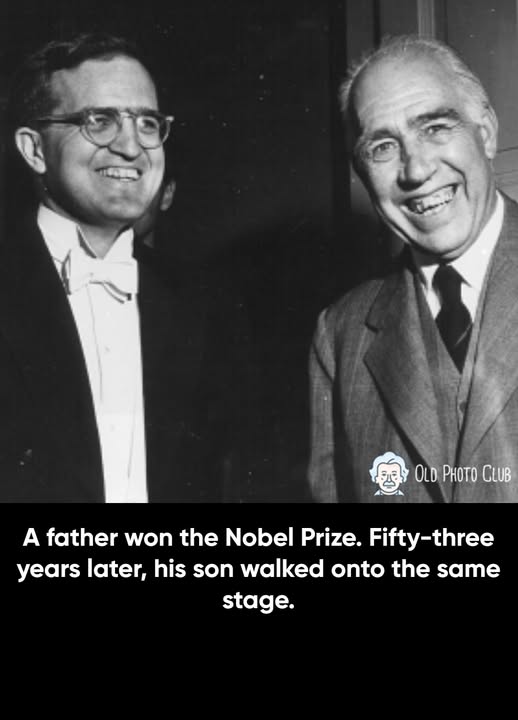
In 1922, a Danish physicist named Niels Bohr stood before the world’s greatest scientific minds and accepted the Nobel Prize in Physics.
His discovery had changed how we see the universe itself.
He revealed that atoms weren’t tiny solid balls, but miniature solar systems—with electrons spinning around a nucleus, jumping between invisible energy levels like climbers ascending rungs on a cosmic ladder.
This single insight cracked open the door to quantum physics.
But here’s what makes this story extraordinary.
Fifty-three years later, in 1975, another Bohr walked onto that very same Nobel stage.
His name was Aage Bohr—Niels’ son.
Where his father had mapped the architecture of the atom, Aage went deeper. He peered into the nucleus itself, that impossibly tiny heart of matter that holds an atom together.
And what he found astonished the scientific world.
The nucleus wasn’t just a static clump of particles. Protons and neutrons didn’t simply sit still. They moved together in waves and ripples, almost like a living thing breathing at the center of all matter.
His discovery, made alongside colleagues Ben Mottelson and James Rainwater, reshaped nuclear physics forever.
Two generations.
Two Nobel Prizes.
One family’s quest to understand the smallest building blocks of existence.
But perhaps the most beautiful part of this story isn’t about physics at all.
Those who knew the Bohrs said Niels never pressured his son to follow in his footsteps. He didn’t push Aage toward science or steer him toward greatness.
Instead, he simply lived his own life with wonder—asking questions, chasing mysteries, marveling at the unknown.
And somehow, that wonder became contagious.
Aage grew up surrounded not by expectations, but by curiosity itself. He watched his father puzzle over the universe with childlike fascination. And that fascination, it seems, was the only inheritance that truly mattered.
Some things cannot be taught. They can only be caught.
Curiosity is one of them.
And when it passes from one generation to the next—not through pressure, but through the quiet example of a life lived in wonder—it can change the world.
Twice.