
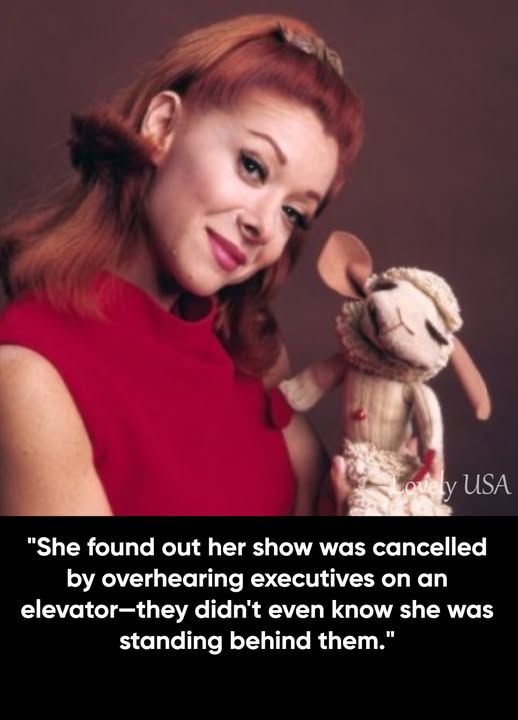
She found out her show was cancelled by overhearing executives on an elevator—they didn’t even know she was standing behind them.
In 1963, Shari Lewis was one of the most talented performers in television.
She could sing. She could dance. She could conduct a symphony orchestra. She could perform ventriloquism so precisely that audiences forgot they were watching a woman with a sock on her hand.
She had trained at the American School of Ballet. Studied acting with Sanford Meisner. Learned piano at two years old. Won a Peabody Award. Hosted a show that ran live television without error—week after week, year after year.
And NBC executives decided she was replaceable.
They cancelled The Shari Lewis Show to make room for cartoons.
She wasn’t told directly. She learned about it while standing in an elevator, listening to men in suits discuss the decision as if she wasn’t there.
“All of it… my entire field crashed around my ears,” she said later.
The industry had made its position clear: children’s television was filler. If the audience was young, the work didn’t count. And the woman who created that work? She was a novelty. A mascot. Not an artist.
But here’s what they got wrong about Shari Lewis:
She didn’t need their permission.
When American networks abandoned live children’s programming, Lewis moved to England and hosted a show on the BBC for eight years. When that work dried up, she performed in Las Vegas casinos, touring companies of Broadway shows, and appeared on variety programs with Ed Sullivan and Johnny Carson.
When those opportunities faded, she reinvented herself again.
She became one of the few female symphony conductors in the world—performing with over 100 orchestras, including the national symphonies of the United States, Canada, and Japan. She learned to speak Japanese for her performances there.
Once, she walked onto a stage at a state fair and found only four people in the audience.
She did the show anyway.
That was who Shari Lewis was.
Not a puppet act. Not a children’s entertainer waiting for permission. A performer who controlled timing, voice, pacing, and audience attention with surgical precision—and refused to stop working just because an industry decided she wasn’t serious.
Then, nearly 30 years after that elevator conversation, PBS came calling.
In 1992, at 59 years old, Lewis launched Lamb Chop’s Play-Along.
The show won five consecutive Emmy Awards. It was the first children’s program in seven years to beat Sesame Street for a writing Emmy. A new generation of children fell in love with Lamb Chop, Charlie Horse, and Hush Puppy—the same characters executives had declared “outdated” three decades earlier.
The audience hadn’t moved on. The industry had simply stopped paying attention.
Lewis didn’t treat this as a comeback. She treated it as what it always was: a correction.
She testified before Congress in 1993 to advocate for children’s television. Lamb Chop was granted special permission to speak. When elementary schools started cutting music programs, Lewis created The Charlie Horse Music Pizza to teach children about music through entertainment.
She was still innovating. Still refusing to be small.
In June 1998, Lewis was diagnosed with uterine cancer and given six weeks to live. She was in the middle of taping new episodes.
She finished them anyway.
Her final performance was a song called “Hello, Goodbye.” Her crew held back tears as she sang. She was saying goodbye to them, to the children watching, and to the character who had been her partner for over 40 years.
Shari Lewis died on August 2, 1998. She was 65 years old.
The industry remembered her fondly. It always does when it’s too late.
But her work didn’t need their remembrance. It endured on its own terms—passed down from parents to children, from one generation to the next, because the audience always knew what the executives never understood:
Precision is not small just because it serves children.
Craft is not diminished by joy.
And the woman who made a sock puppet come alive was never the novelty.
She was the reason it worked at all.