
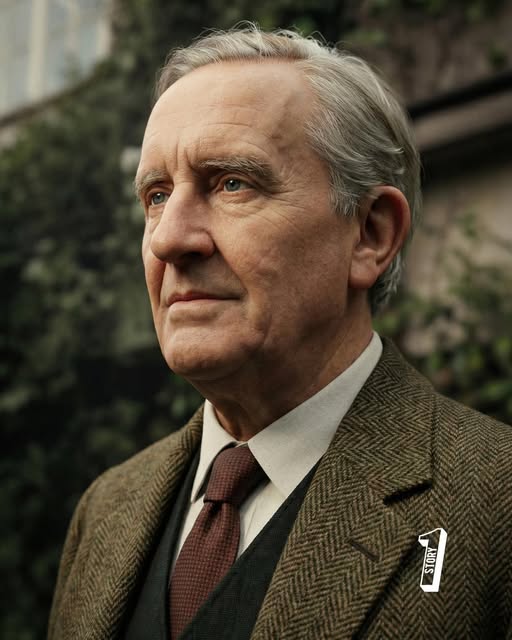
J.R.R. Tolkien’s hostility toward Disney was not the reflex of an aging scholar suspicious of cartoons or new technology. It was not jealousy, nor a cranky dislike of popular taste. It was a deeply reasoned rejection rooted in a clash of worldviews about what stories are, what they are meant to do, and what is lost when they are reshaped for mass consumption.
The conflict began with a striking convergence in 1937.
That year, Tolkien published *The Hobbit*. On the surface it appeared to be a children’s adventure, but beneath that simplicity lay a carefully engineered mythology. Tolkien was not merely telling a story. He was building a world shaped by ancient languages, medieval literature, and a belief that stories carry moral and spiritual weight. Every place name, every song, every creature belonged to a history that extended far beyond the page. The book was playful, but it was not casual.
Just months later, on December 21, 1937, Disney released *Snow White and the Seven Dwarfs*. It was the first full-length animated feature film, a technical triumph and a financial gamble that paid off spectacularly. When it reached Britain in early 1938, it was impossible to ignore. It dazzled audiences and redefined what popular entertainment could be.
Two visions of fairy tales had arrived almost simultaneously.
Tolkien and his close friend C.S. Lewis went to see *Snow White* together. Both were medievalists. Both believed fairy tales mattered. Neither viewed them as light amusement or childish diversion. They watched carefully.
They left unimpressed.
Lewis wrote in his diary that he found the film cloying. Tolkien’s reaction ran deeper and lasted far longer. What disturbed him was not the animation, which he openly admired, nor Disney’s skill, which he never denied. What unsettled him was what Disney believed fairy tales were for.
Tolkien’s view of fairy tales was precise and serious. In his essay *On Fairy-Stories*, he argued that they were not decorative fantasies for children but ancient instruments for confronting reality. True fairy tales, he believed, acknowledged fear, loss, danger, and moral consequence. They dealt in peril, not comfort. Their power came from the fact that disaster was genuinely possible.
Central to this belief was what Tolkien called “eucatastrophe,” the sudden turn toward joy that feels miraculous only because the darkness beforehand is real. The happy ending matters because it was never guaranteed. Remove the danger and the joy becomes sentimental. The story loses its truth.
Disney’s *Snow White*, as Tolkien saw it, did exactly that. The symbols were still there. The wicked queen. The forest. The dwarfs. But they had been reshaped into something safer, softer, and easier to digest. Evil was obvious and contained. The dwarfs became comic personalities. Fear was present but carefully managed. Everything moved toward reassurance.
To Tolkien, this was not reinterpretation. It was dilution.
He believed Disney had taken stories that once functioned as myth and turned them into spectacle. The transformation kept the outward form while hollowing out the inner purpose. It was like translating poetry into plain prose. The meaning might survive, but the force that made it poetry was gone.
Years later, in a 1964 letter to a film producer, Tolkien put his feelings plainly. He wrote of a “heartfelt loathing” for Disney’s work, not because of incompetence, but because he believed Disney’s undeniable talent had been “hopelessly corrupted.” Anything Disney touched, Tolkien feared, would be flattened into something visually rich but morally shallow.
This was not personal animosity. Tolkien never met Walt Disney. He did not concern himself with Disney the man. His objection was philosophical. It was about intent.
Disney believed stories reached their fullest purpose when they were simplified and clarified. Moral ambiguity became good versus evil. Characters were sorted cleanly into heroes and villains. Darkness was made approachable. Endings were unambiguously happy. This, Disney believed, allowed stories to reach millions.
Tolkien believed the opposite. He believed stories gained power by resisting simplification. Moral ambiguity was not a flaw but a reflection of reality. Characters could be brave and weak at the same time. Evil was rarely simple. Fear mattered because it was earned. Stories were not meant to comfort first. They were meant to tell the truth.
This belief shaped Tolkien’s fierce resistance to adaptation. Throughout his life, filmmakers approached him about adapting *The Lord of the Rings*. He resisted nearly all of them. He feared that Hollywood would do to his work what Disney had done to fairy tales.
He imagined Sam Gamgee turned into comic relief. Gollum reduced to a straightforward villain. Boromir stripped of his moral struggle. Mordor softened to suit family audiences. The darkness replaced by spectacle. The joy manufactured rather than earned.
These fears were not hypothetical. They were based on what Tolkien had already seen happen to traditional stories. He had watched the Grimm brothers transformed into merchandise. He had no reason to trust that his own work would be spared.
In his letters, Tolkien made his position clear. He would rather his stories never be filmed than be altered in ways that destroyed their integrity. Reaching fewer people mattered less to him than preserving what made the stories true.
To Tolkien, mythology was not raw material for improvement. It was something to be guarded. Stories changed naturally over time, he understood that. But there was a difference between organic evolution and alteration driven by commercial necessity. Disney’s changes belonged to the latter.
Critics accused Tolkien of elitism. They argued that Disney introduced fairy tales to children who would never read medieval texts or folktales. They said accessibility mattered.
Tolkien’s answer would have been simple. What, exactly, were those children being introduced to?
If danger is removed, if moral struggle is simplified, if fear becomes harmless, then the story may entertain, but it no longer performs the function of a fairy tale. It becomes something else.
This did not mean Disney’s films lacked value. Tolkien never claimed they were poorly made. His claim was that they were doing a different job. They delighted. They reassured. They did not confront.
To Tolkien, when stories lose their darkness, they lose their mythic power. They can still charm and teach basic lessons, but they can no longer grapple with evil, choice, and consequence in a way that prepares the human mind for reality.
The irony is unavoidable. Tolkien’s own work was eventually adapted to film and achieved enormous commercial success. Peter Jackson’s *Lord of the Rings* trilogy reached a global audience and earned billions. Tolkien did not live to see it.
Whether he would have approved is impossible to say. The films changed many things. But they preserved darkness, loss, and moral struggle in ways Disney adaptations typically did not. They did not fully sand the edges away.
The question Tolkien raised remains unsettled.
When stories are adapted for the widest possible audience, what is lost? When clarity replaces complexity, when safety replaces danger, when comfort replaces truth, do we still have the same story?
Disney proved that transformation brings reach. Tolkien argued that it also brings loss.
One believed stories should be reshaped so everyone could enjoy them. The other believed some stories lose their soul when reshaped that way.
Neither position is trivial. Neither is easily dismissed.
But Tolkien’s opposition to Disney was not stubbornness or nostalgia. It was the considered judgment of a man who devoted his life to understanding how stories work, why they matter, and what happens when their purpose is changed.
It began with *Snow White*. It ended as a warning.
That not all success is harmless.
That not all change is improvement.
And that sometimes, in making stories available to everyone, we quietly remove the very things that once made them worth telling.