
In 539 BC, the most powerful city in the world didn’t fall to a bloody massacre. It fell to a man who believed that hearts were won through mercy rather than iron.
Kingdoms in the ancient world were usually built on the ashes of those they conquered. To be defeated meant to be enslaved, but King Cyrus of Persia had a different vision for his new empire.
When he entered the gates of Babylon, he found a city filled with displaced people and silenced faiths. The previous rulers had dragged thousands into exile and shattered their temples.
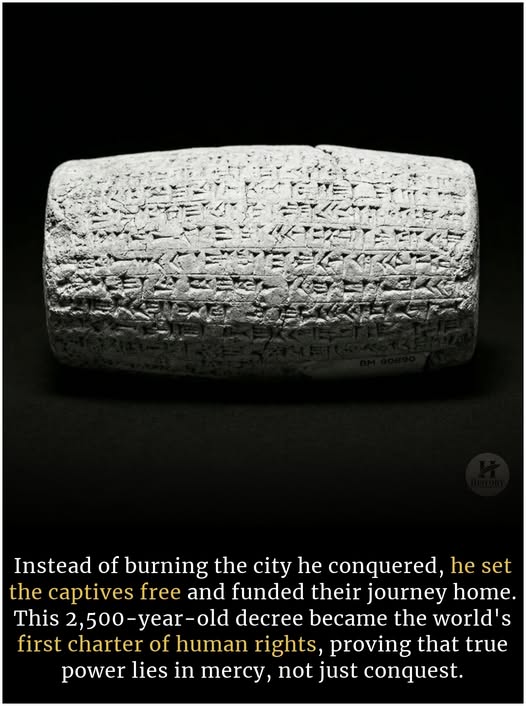
But Cyrus refused to follow the old ways of destruction. He sat down and dictated a message that would be carved onto a simple clay cylinder, changing the course of history forever.
He declared that every person under his rule had the right to live in peace. He promised that no one would be terrorized or forced into subjection under his watch.
But his most shocking move was yet to come. He didn’t just allow people to stay; he ordered that they be sent home to their own lands with resources to rebuild.
He saw their grief. He saw their longing. He saw their humanity.
Among those freed were the Jewish people, who had been held in Babylonian captivity for seventy years. Because of this one man’s decree, they were finally allowed to go home and rebuild their temple in Jerusalem.
This simple clay object, now known as the Cyrus Cylinder, is often called the first charter of human rights in history. It proved that a leader could be powerful without being a tyrant.
Today, this artifact sits in the British Museum as a quiet reminder of a king who chose tolerance over terror. His legacy reminds us that true greatness is measured by what we protect, not what we destroy.
He changed the world by setting people free.
The impact of this decree was so profound that it is mentioned in the Old Testament, where Cyrus is described as a shepherd chosen to bring the people home.
When the cylinder was rediscovered in the ruins of Babylon in 1879, archaeologists realized they weren’t just looking at political propaganda. They were looking at the official record of a humanitarian revolution that happened 2,500 years ago.
Cyrus didn’t just talk about tolerance; he funded the reconstruction of holy sites for multiple different religions out of his own royal treasury.
He believed that a stable empire was one where every citizen felt respected in their own traditions. It is a lesson in governance that many modern leaders could still learn from today.
Sources: British Museum Records / National Archives