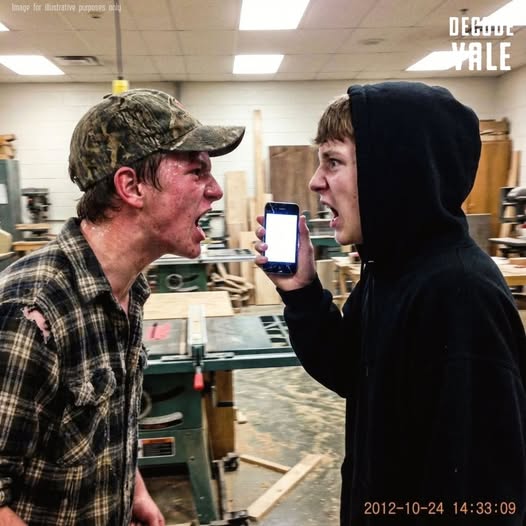
I watched two boys threatening to kill each other over a news headline that wouldn’t matter by Tuesday, standing in a room full of saws they didn’t know how to use.
That was my final Tuesday. The administration called it “The Transition.” I called it what it was: the death of the last place in this school where truth was something you could touch. They were gutting my woodshop to put in a “Digital Innovation Lab.” Apparently, the world needed more podcasts and fewer chairs.
I’m seventy-two. My hands look like tree bark, and I’ve got a lower back that predicts rain better than the Weather Channel. I was just supposed to pack my tools and leave.
But then Hunter and Leo walked in.
They weren’t supposed to be there. They were cutting gym class, hiding out in the dust-choked silence of the shop. Hunter was a kid who wore work boots that had never seen a job site, angry at a world he felt was leaving him behind.
Leo was the opposite—slight, anxious, wearing a hoodie that cost more than my first car, angry at a world he felt was burning down.
I didn’t hear what started it. Probably something they saw on a screen. But when I walked out of the supply closet, they were chest-to-chest.
“You people are the problem,” Hunter spat, his face red. “You’re a dinosaur,” Leo shot back, his voice shaking but sharp. “You’re ruining everything.”
They were parroting scripts written by millionaires in television studios, acting out a war neither of them started.
I could have sent them to the principal. I could have walked away. But I looked at the lathe in the corner, covered in forty years of dust, and I felt a sudden, desperate need to leave something behind that wasn’t silence.
I picked up a piece of scrap pine and slammed it onto a workbench. The sound cracked like a gunshot.
They jumped apart, eyes wide.
“Phones,” I barked. I held out a grease-stained hand. “On the bench. Now.”
“We weren’t doing anything,” Hunter stammered, posturing.
“I didn’t ask what you were doing. I said phones.”
Reluctantly, they handed over their lifelines. Two black rectangles of glass that told them who to hate every morning.
I pointed to the center of the room. There sat the Beast. A twelve-foot solid oak conference table. It belonged to the Town Council. It was built in 1955.
Someone had spilled industrial solvent on it, ruining the finish, and the legs were wobbling. The town wanted to scrap it for a plastic one. I had rescued it.
“This leaves tomorrow,” I told them. “It needs to be stripped, sanded, and stabilized. And I can’t lift it alone.”
“I have a physics test,” Leo said, looking at the door.
“Physics,” I grunted. “Good. Today you’re going to learn about friction and leverage. Grab a sander.”
For the first twenty minutes, the air was thick with resentment. The belt sanders roared, drowning out their ability to argue. That’s the beauty of loud machinery; it forces you to shut up and pay attention to your hands.
Hunter attacked the wood aggressively, trying to force the varnish off. Leo was timid, barely touching the surface.
“Stop,” I yelled over the noise. I walked over to Hunter. “You’re digging in.
You’re scarring the wood because you’re angry. The wood doesn’t care about your feelings, son. Treat it with respect, or it’ll give you splinters.”
I turned to Leo. “And you. You’re afraid of it. You’re dancing around the problem. Put your weight into it. Lean in.”
They glared at me, but they adjusted.
An hour passed. The smell of decades-old varnish gave way to the clean, sharp scent of red oak. It’s a smell that gets into your lungs and cleans out the rot. The sweat started coming. Real sweat. Not the kind you get from stress, but the honest kind that comes from work.
“We need to fix the legs,” I said, flipping the massive table over. “Hunter, grab that end. Leo, get the other. On three.”
It was heavy. Stupidly heavy. Hunter slipped. The weight shifted entirely to Leo.
“I got it!” Leo grunted, his face going pale, knees buckling. “Don’t drop it!”
Hunter yelled, but he didn’t just yell. He scrambled, sliding under the frame, jamming his shoulder up to take the weight off Leo.
For ten seconds, they stood there, panting, locked together by three hundred pounds of timber. If one moved, the other would get crushed.
“Together,” I said softly. “Set it down. Slow.”
They lowered it. When they stood up, they didn’t look at their phones. They looked at each other. Just for a second. It wasn’t a look of friendship, but it was a look of recognition. You have mass. You are real. You are not a pixel.
I brought them over to the broken joint on the leg.
“Look at this,” I said, tracing the jagged wood. “This is a dovetail joint. It’s the strongest joint in carpentry.”
They leaned in.
“You see how the tails are cut?” I asked. “They flare out. They’re trapezoids. Once you fit them together, you can’t pull them apart just by pulling. The only way this joint fails is if the wood itself breaks.”
I looked them in the eye.
“The carpenter who built this didn’t use nails. He didn’t use screws. He used friction. He used tension. The two pieces of wood are cut differently, forced to fit together. The pressure is what holds them up. If they were exactly the same, they’d slide right apart. It’s the difference that locks them in.”
The room went quiet. The ventilation fan hummed in the background.
“You two,” I said, gesturing between them. “You think you’re enemies because you’re cut different. But a house built with only one kind of board falls down in the first wind. America wasn’t built by people who agreed on everything. It was built by people who hated each other’s guts but knew they needed the other guy to raise the barn.”
Hunter looked at his boots. Leo ran his thumb over the raw oak grain.
“Glue,” I ordered.
For the next two hours, the politics disappeared. The headlines about the election, the economy, the social wars—they dissolved in the smell of sawdust and wood glue. There was only the task.
Hold this. Pass the clamp. Too much glue, wipe it. My arm is cramping. Switch sides.
When we finished, the table looked magnificent. The grain popped with a coat of fresh oil, swirling like a topographic map of a country that no longer existed. It was solid. You could have parked a truck on it.
The bell rang. The spell broke.
They wiped their hands on rags. They were covered in the same gray dust. You couldn’t tell who voted for who. You couldn’t tell whose dad was a lawyer and whose dad was a mechanic. They were just two young men who had made something useful.
I handed them back their phones. The screens lit up immediately with notifications—doom, outrage, noise.
Hunter looked at his screen, then looked at the table. He didn’t check his messages. He just slid the phone into his pocket.
“It’s… good,” Hunter said. “It’s solid.” “Yeah,” Leo said, flexing his sore hand. “It’s not going anywhere.”
They walked to the door. Before they left, Leo turned around.
“Mr. Frank? What happens to the table?”
“It stays,” I said. “The Town Council voted to keep it. Said they couldn’t find anything new that felt real.”
They nodded and walked out into the hallway, into the noise of hundreds of kids staring at screens. But I saw them walk out differently. Shoulders back. Heads up. They didn’t walk together, but they walked parallel.
I swept the shop one last time. I left the sawdust on the floor.
We live in a time where everyone wants to be the hammer, smashing down anything that doesn’t look like them. We’ve forgotten that the goal isn’t to break things—it’s to build things that can stand the weight of the world.
We don’t need to agree on everything. We just need to remember that we are the wood, not the fire. And if we don’t learn to lock together, holding tight to the very people we struggle against, we’re going to collapse.
I turned off the lights. The smell of oak lingered in the dark. It smelled like hope.