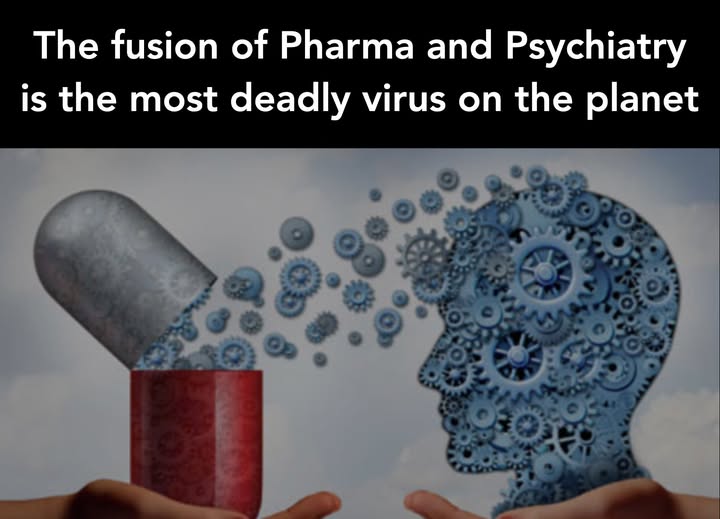
A very thick book is needed to cover all the reasons why this is true.
Depression, mental illness, autism, mass shootings and physical illnesses are ALL increasing in the world because of this coalition between Pharma and psychiatry.
Psychiatry causes far more harm than good on all levels.
Over 90% of their ‘treatments’ involve mind-altering, personality-changing, illness-and-death producing and homicidal/suicidal-causing drugs, as opposed to beneficial counseling or therapy. Psychiatry and Pharma are in bed together.
Let’s hear what the more rational, honest and incorruptible psychiatrists in the world (a very small percentage of the psychiatric industry) have to say on this point:
“Prescription Drugs Are the Leading Cause of Death. Psychiatric drugs are the third leading cause of death. Psychiatric drugging of children is a crime against humanity.
Psychiatry is the only specialty I know of that causes more harm than good; in fact, vastly more harm than good. This disaster can only survive because psychiatrists constantly lie to the public about what they can achieve with their drugs.”
– Peter C. Gøtzsche, MD
“Psychiatry is probably the single most destructive force that has affected American Society within the last 60 years. We have to restore the idea of responsibility, which is corrupted and confused by psychiatry.”
– Dr. Thomas Szasz, psychiatrist
“Going to a psychiatrist has become one of the most dangerous things a person can do. The miracle drugs (anti-depressants) cause the worst plague of brain damage in medical history. Psychiatric drugs are more dangerous than you ever imagined.”
– Dr. Peter Breggin, psychiatrist
“ADHD does not exist.”
– Neurologist Dr. Richard Saul
“There is no such thing as ADHD!”
– Robert Berezin, MD
“I’ve been practicing psychiatry for 38 years. . . But I’ve come to the conclusion that I’m participating in the biggest intellectual scam of this era. We claim to be a science, but have no understanding how thought or behavior is generated.”
– Dr. Paul Minot, psychiatrist
“Psychiatric medications can be criticized not only on the grounds of the potential harms they may cause but also on the grounds that the diagnostic justification for prescribing them leaves much to be desired.”
– Dr. James Davies
“There are many problems with psychiatry, but a core, major problem is that it’s really a form of pseudo-science. Not poor science, but phony or fake science. And this pervades the entire profession and everything in biological psychiatry.”
– Dr. Colin Ross, Psychiatrist
“Psychiatry is a weapon against people. The Emperor called psychiatry has no clothes, not to mention stupid and unscientific. The controversy regarding the myth of mental illness and psychiatry is not about science or medicine; it’s about power.
– Dr. Jeffrey A. Schaler, Professor of Psychology
“I have been criticized for being too hard on psychiatry. I admit that my fervor seems almost religious, but this post will convince you that the shrinks deserve it. Psychiatry has only the lamest of scientific grounding and, worse, is being weaponized to promote agendas.”
– Dr. Robert Yoho
“Modern psychiatry has yet to convincingly prove the genetic/biologic cause of any single mental illness. Patients [have] been diagnosed with ‘chemical imbalances’ despite the fact that no test exists to support such a claim, and . . . there is no real conception of what a correct chemical balance would look like.”
– Dr. David Kaiser, psychiatrist
“There’s no biological imbalance. When people come to me and they say, ‘I have a biochemical imbalance,’ I say, ‘Show me your lab tests.’ There are no lab tests. So what’s the biochemical imbalance?”
– Dr. Ron Leifer, psychiatrist
“All psychiatrists have in common that when they are caught on camera or on microphone, they cower and admit that there are no such things as chemical imbalances/diseases, or examinations or tests for them. What they do in practice, lying in every instance, abrogating [revoking] the informed consent right of every patient and poisoning them in the name of ‘treatment’ is nothing short of criminal.”
– Dr. Fred Baughman Jr., Pediatric Neurologist
“Psychiatry makes unproven claims that depression, bipolar illness, anxiety, alcoholism and a host of other disorders are in fact primarily biologic and probably genetic in origin. This kind of faith in science and progress is staggering, not to mention naïve and perhaps delusional.”
– Dr. David Kaiser, psychiatrist
“While there has been no shortage of alleged biochemical explanations for psychiatric conditions . . not one has been proven. Quite the contrary. In every instance where such an imbalance was thought to have been found, it was later proven false.”
– Dr. Joseph Glenmullen, Harvard Medical School psychiatrist
“The theories are held on to not only because there is nothing else to take their place, but also because they are useful in promoting drug treatment.”
– Dr. Elliott Valenstein
“I believe, until the public and psychiatry itself see that DSM labels are not only useless as medical ‘diagnoses’ but also have the potential to do great harm – particularly when they are used as means to deny individual freedoms, or as weapons by psychiatrists acting as hired guns for the legal system.”
– Dr. Sydney Walker III, psychiatrist
“No biochemical, neurological, or genetic markers have been found for Attention Deficit Disorder, Oppositional Defiant Disorder, Depression, Schizophrenia, anxiety, compulsive alcohol and drug abuse, overeating, gambling or any other so-called mental illness, disease, or disorder.”
– Bruce Levine, psychologist
“Unlike medical diagnoses that convey a probable cause, appropriate treatment and likely prognosis, the disorders listed in DSM-IV are terms arrived at through peer consensus.” – Dr. Ana Dineen, psychologist
“The DSM or the Diagnostic Statistical Manual of Mental Health Disorders is the ‘gold standard’ for diagnosing mental health conditions. Turns out, it was a bought and paid for fraud by big pharma.”
– Dr. Jennifer Brown
“Why must the APA (American Psychiatric Association) pretend to know more than it does? DSM-4 is the fabrication upon which psychiatry seeks acceptance by [the profession of] medicine in general. Insiders know it is more a political than a scientific document.”
– Dr. Loren Mosher, psychiatrist
“Period. No brain condition, no brain damage, ‘mental’ or physical, no physiological evidence whatsoever exists, or has ever been demonstrated to prove that any cause dishonestly referred to as ADHD is valid. None.
“What has been proven and is obvious, is the horrible damage done due to the administration of harmful drugs, especially to the bodies and minds of the not fully developed, and immature young.”
– Dr. Gary D. Barnett
“Ritalin is methylphenidate. Now methylphenidate affects the brain in exactly the same way as cocaine. They both block a molecule that is involved in the re-uptake of dopamine.
“Millions of kids! Think about what we’re doing. We’re robbing kids of their right to be kids, their right to grow, their right to experience their full range of emotions, and their right to experience the world in its full hue of colors. That’s what growing up is, that’s what being alive is! And we’re robbing kids of their right to be. It’s so criminal.”
– Dr. Robert Whitaker
“SSRI antidepressants work no better than placebo, and their benefits do not meet the criteria for clinical significance. You’re probably wondering how in the world such awful drugs generate $16.9 billion annually in global sales. I’ll tell you. It’s because the companies that push these pills have made a concerted and successful effort to deceive physicians and patients.”
– Dr. Julian Whitaker
“The way to sell drugs is to sell psychiatric illness.”
– Dr. Carl Elliot
“1.5 million Xanax addicts are produced (in the U.S.) each year.”
– Dr. John Steinberg
“Deadly Drugs: What Happens When Antidepressants Trigger Killer Instincts?”
– Dr. David Healy
All the reports and studies related to these conclsuions are given in this detailed and comprehensive report:
“Psychiatry and Pharma – The Worst Virus on the Planet?”