Tomato Growing Made Simple

Tomato Plant Tips

Tomatoes reward small, smart habits. A few simple steps can turn average plants into strong, productive ones.

1 Feed the soil first
Add compost or organic matter at the bottom of the planting hole. A little wood ash can also boost nutrients.
Relatable mistake – planting straight into poor soil and expecting miracles.

2 Trim before planting
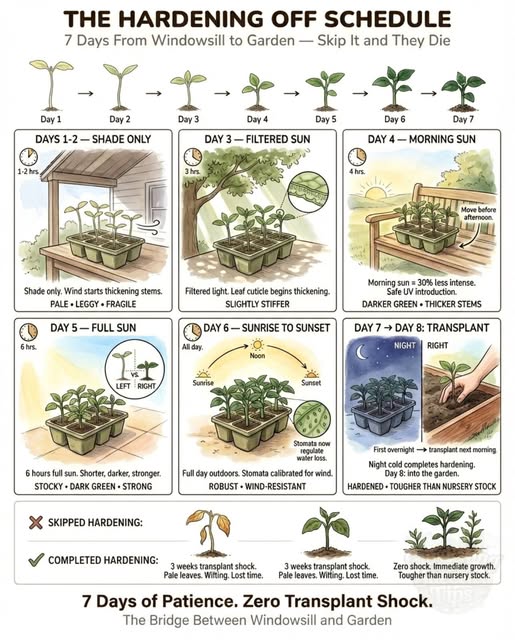
Remove the lower leaves a couple of days before transplanting. This encourages deeper rooting and helps reduce disease risk.

3 Water wisely at the start
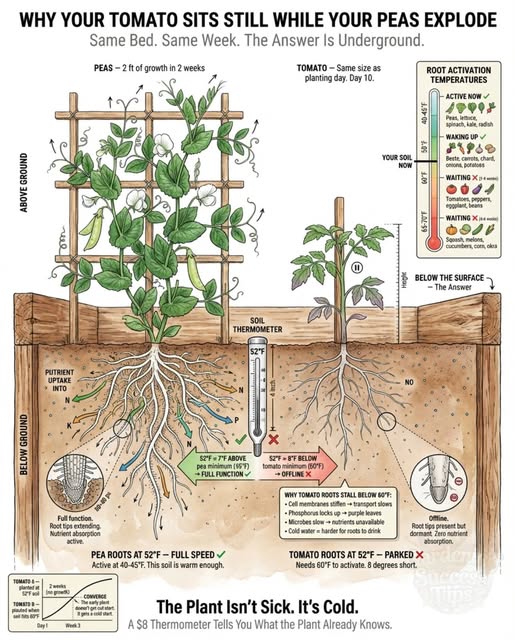
Avoid overwatering early on. Slightly drier conditions encourage roots to grow deeper and stronger.

4 Pinch the suckers
Remove side shoots when they’re about 5 cm long. This helps the plant focus its energy on fruit production instead of extra foliage.

Simple, consistent care leads to healthier plants and a more generous harvest. Small actions, big tomato rewards.

How To Prune Rosemary

How To Prune Rosemary

Rosemary hides its problems well — it still smells good even when half the base is dead. Annual pruning prevents the point of no return from arriving unannounced.

The rule that governs rosemary is the same as for lavender: below the green zone lies grey wood that does not regenerate. Without annual pruning, the shrub lignifies from the base upward, and within three years you have a bare trunk topped by a green tuft at the tips. At that point there is no recovery — old rosemary wood does not carry dormant buds capable of breaking back into growth.

How to manage it through the year in the Northern Hemisphere:
— Late February to early March: formative prune. Cut back the green stems by roughly a third, keeping carefully above the visible junction between the soft young growth and the rigid old wood beneath. That junction is the line that must not be crossed.

— April and May: leave the plant completely alone and enjoy the flowering. This is the main pollinator window — early bumblebees and honeybees depend on rosemary as one of the first substantial nectar sources of the year.

— June: a second light trim to remove spent flowerheads and encourage new lateral growth.

Two rules that never change:
— The dry grey bark at the base is a no-cut zone. Cutting into it leaves permanent stubs that will produce nothing.

— Remove stems that cross through the centre of the shrub. Without airflow, the interior stays damp and fungal problems develop.

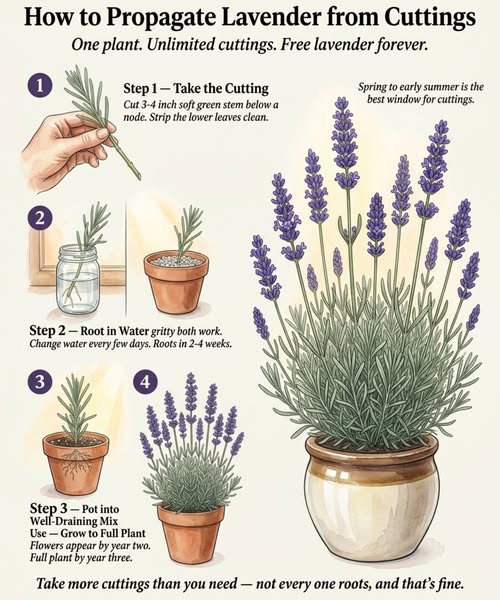
After six to eight years, even the best-managed rosemary thins at the base. Replacing it with a rooted cutting taken in summer is a better option than trying to force recovery from an old plant.

The line between green and woody is the only secret to a compact rosemary for years.

For the Southern Hemisphere (e.g., Australia)

Seasons are reversed, so shift the timing by about 6 months to match the equivalent part of the seasonal cycle:

  • Main formative prune: Late August to early September (your late winter/early spring).
  • Leave alone for flowering: Roughly October–November (your spring flowering window for pollinators).
  • Light trim after flowering: December (your early summer).

Fruit Tree Helpers

Fruit Tree Helpers

Each plant at the base of your fruit trees has a specific role: feeding the soil, deterring pests, attracting pollinators, or covering bare ground. Together they form a self-sustaining ecosystem that works for the tree throughout the year and progressively reduces the maintenance it demands.

Comfrey — deep roots that draw up calcium, potassium, and phosphorus from subsoil layers. Cut the leaves five or six times per year and leave them as a free mineral mulch directly under the tree.

Chives — sulphur-rich foliage that deters aphids and limits fungal disease around the trunk. Self-maintaining once established.

White clover — a living mulch that fixes atmospheric nitrogen in the root zone and provides continuous nectar for pollinators from spring to autumn.

Yarrow (Achillea millefolium) — flat flower clusters that attract hoverflies and parasitic wasps, both significant predators of aphids and caterpillars.

Daffodils — toxic bulbs planted in a ring near the trunk to deter voles and other burrowing rodents that target fruit tree roots.

Calendula — root exudates that reduce harmful soil nematode populations, and a strong scent that disorients flying pests.

Sweet alyssum — a dense mat of tiny flowers that draws hoverflies, lacewings, and parasitic wasps in large numbers throughout the season.

Borage — one of the best bee plants in the British garden, improving fruit tree pollination significantly. Self-seeds reliably from year two onwards.

Nasturtium — the most effective aphid trap plant available. Aphids gather on nasturtiums in preference to almost everything else nearby, drawing them away from the tree.

The more this system matures, the less you need to intervene.

Trench Composting I

Trench Composting

Trench composting lets you skip the compost bin entirely and feed your soil directly where plants will grow, and it is one of the lowest-effort fertility methods a vegetable gardener can use.
The method is straightforward. You dig a trench about 12 inches deep down the center of a raised bed or garden row, layer in organic kitchen and garden waste, cover it with soil, and let it break down in place over several weeks. The decomposing material feeds soil microbes and worms directly in the root zone, which is exactly where you want that activity happening.

This image shows the layering approach well. Straw goes in first as a carbon base, then kitchen scraps like banana peels, eggshells, vegetable trimmings, and coffee grounds, then torn newspaper for additional carbon, then a covering of finished compost or garden soil to close it out. That alternating pattern of carbon-rich browns and nitrogen-rich greens is the same principle behind a traditional compost pile, just done underground.

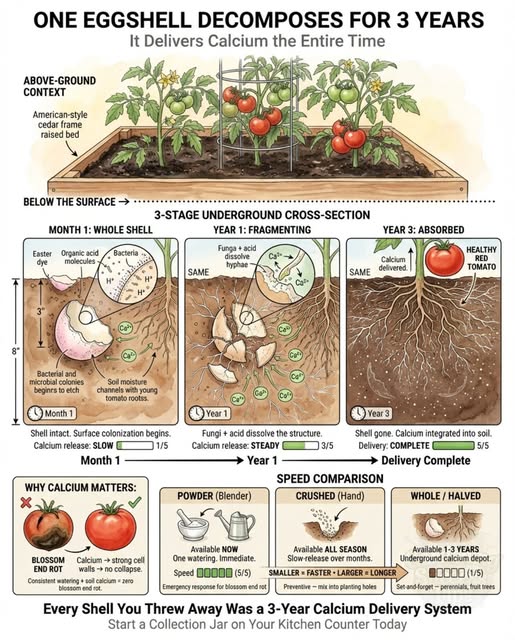
Crushed eggshells are worth adding generously here. They break down slowly and release calcium, which helps prevent blossom end rot in tomatoes and peppers grown in the same bed the following season.

The trench method works on a rotation. Dig your trench in one third of the bed this season, plant on top of last season’s trench, and leave the third you planted last year fallow or in a cover crop. Rotate each year and the entire bed gradually improves.

One thing to avoid: do not add meat, dairy, or cooked food scraps to an in-ground trench. They attract rodents and break down anaerobically, which creates odor and can introduce pathogens. Stick to raw fruit and vegetable waste, coffee grounds, crushed eggshells, straw, and plain paper products.

The dark, crumbly soil mounded alongside this trench is a good sign of what this method produces over time.

9 Crops Needing Pruning

9 Crops Needing Pruning

A little strategic trimming goes a long way in the vegetable garden. Most fruiting crops pour energy into leaves and stems unless you step in and redirect that growth toward the harvest.

Here are nine plants that reward regular pruning with bigger, more consistent yields all season.

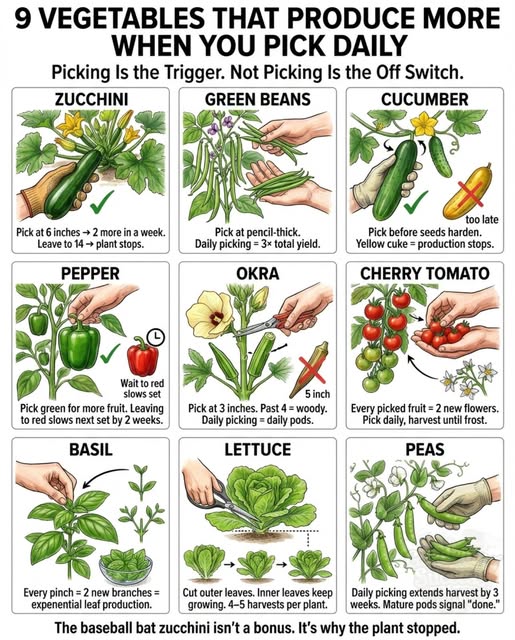
1. Tomatoes — snap off suckers between the main stem and branches every week to keep energy focused on fruit production
2. Peppers — pinch the first growing tip once the plant is 8-10 inches tall to trigger branching and heavier fruit set
3. Basil — clip the top growth weekly right above a leaf pair to prevent flowering and force bushy side growth
4. Zucchini — cut away the oldest lower leaves regularly to improve airflow and reduce powdery mildew pressure
5. Cucumbers — trim the first 4-5 side shoots on the lower stem so the plant channels strength upward into its main vine
6. Eggplant — limit the plant to three or four main branches by removing extra shoots at the base early in the season
7. Pumpkins — pinch off vine tips once two or three fruits have set so the plant stops running and puts everything into sizing up
8. Brussels sprouts — snap off the very top of the stalk about a month before your expected harvest to push the sprouts into full maturity
9. Okra — strip lower leaves as the stalk climbs to improve air circulation and make pods easier to spot and pick

A Buried Pipe Feeds Your Garden Bed From the Inside — Worms Do All the Work

Worm Tower

A worm tower is an underground compost system that delivers nutrients directly to plant roots without a compost bin, without turning, and without any smell. Kitchen scraps go in the top. Worm castings spread through the soil below. The bed feeds itself. The idea is almost too simple to believe: bury a pipe with holes in a raised bed, drop scraps in, let worms handle everything.

What you need:
– A section of drainpipe — 30cm diameter, 50cm long
– A drill with 10mm bit
– A lid or upturned pot to keep rain out
– A garden bed to bury it in

How to build it:
– Drill holes every 5cm across the lower two-thirds of the pipe
– Dig a hole in the centre of your garden bed deep enough to bury the pipe with 10cm above soil level
– Backfill around the pipe and firm soil gently
– Add a handful of compost and a few worms from the garden to start
– Place lid on top

How to use it:
– Drop small kitchen scraps in weekly — vegetable peelings, tea bags, fruit cores, crushed eggshells
– Worms enter through the drilled holes, eat the scraps, and carry castings back into the surrounding soil
– The bed receives a slow, continuous feed of the richest fertiliser on earth
– Never needs turning. Never smells. Never attracts flies if the lid stays on

One tower feeds a 2-metre radius of garden bed. Two towers handle a full-sized raised bed. Your food waste becomes plant food without ever touching a compost heap.

Plant Once Harvest For 20 Years

Plant Once Harvest For 20 Years

Every spring you start over. New seeds. New transplants. New soil prep. New money.

A perennial food garden eliminates all of it. One weekend of planting produces food for decades without reseeding, replanting, or starting over.

Asparagus produces for twenty-five years from a single planting. Blueberries bear fruit for thirty and increase yield every season. Raspberries spread on their own and fill gaps without being asked. Rhubarb outlives the gardener who planted it. Walking onions topset and replant themselves — literally zero effort.

One planting. Decades of harvest.

Layout for a ten-by-twenty plot:
– Back row on the north side (in the Northern Hemisphere, opposite in the Southern) — blueberry bushes and elderberry for height
– Second row — asparagus bed running the full width, one trench gives you a twenty-five-year harvest
– Center — raspberry and blackberry canes with simple wire support
– Front rows — rhubarb crowns, strawberry groundcover, perennial kale, sorrel
– Edges — rosemary, thyme, oregano, chives, walking onions
Year one investment runs roughly a hundred fifty to two hundred fifty dollars for plants, crowns, and bare-root stock.

Asparagus and blueberries need two to three years to hit full production. Raspberries, herbs, rhubarb, and strawberries produce meaningful harvest in year one. By year three the entire plot is producing at full capacity with almost no input.

Maintenance is one spring mulch and one fall compost top-dress. That’s it.

The most productive garden is the one you plant once and never have to start over.