
Margaret Thatcher On Statism
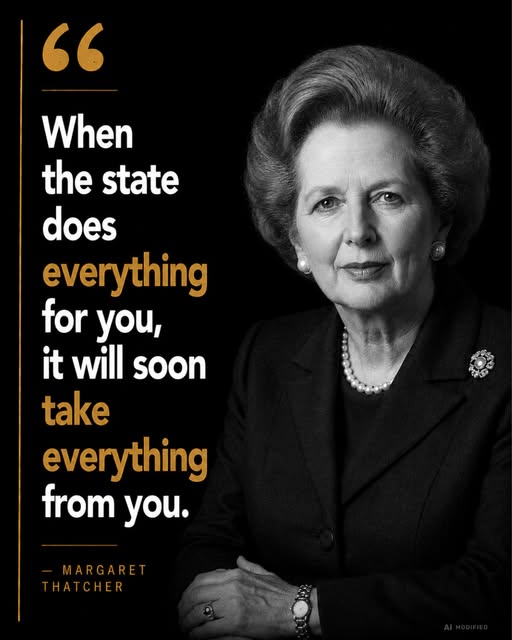
“When the state does everything for you, it will soon take everything from you. You will then have no basis for personal freedom, political freedom, or economic freedom.”
This is What Happens Before A Currency Reset
Debt becomes unpayable.
Authorities lie. Said would not then devalued the pound. When words do not match actions, believe actions.
Set interest rate lower than inflation.
Restrict people from moving out of currency (into gold).
Click to view the video: https://www.youtube.com/watch?v=bJO0jfj47gM
“One Man”: Tucker Carlson’s Mission to Save the Republic
America’s greatest podcaster is trying to save “We the People” from the ruinous consequences of war, debt, and taxes.
John Leake 13 Aug 2026
Every nation gets the government it deserves.
— Joseph de Maistre, August 15, 1811 letter
Now we are engaged in a great civil war, testing whether that nation, or any nation so conceived, and so dedicated, can long endure.
-Abraham Lincoln, Gettysburg Address
A republic, if you can keep it.
-Benjamin Franklin, to a Philadelphia society lady upon walking out of the Constitutional Convention
How can a people be persuaded to preserve their republic if they don’t understand the intellectual, moral, and legal foundation on which their republic rests?
In 1795, James Madison wrote a letter that encapsulates the most important civics lesson that most Americans never learned.
Of all the enemies to public liberty war is, perhaps, the most to be dreaded, because it comprises and develops the germ of every other. War is the parent of armies; from these proceed debts and taxes; and armies, and debts, and taxes are the known instruments for bringing the many under the domination of the few. In war, too, the discretionary power of the Executive is extended; its influence in dealing out offices, honors, and emoluments is multiplied; and all the means of seducing the minds, are added to those of subduing the force, of the people. The same malignant aspect in republicanism may be traced in the inequality of fortunes, and the opportunities of fraud, growing out of a state of war, and in the degeneracy of manners and of morals engendered by both. No nation could preserve its freedom in the midst of continual warfare.
Tucker Carlson is on a mission to save the American Republic from “war, the parent of armies [the military-industrial complex] debts, and taxes.”
He agrees with James Madison that “of all the enemies to public liberty war is, perhaps, the most to be dreaded.”
Like me, he long ago came to the conclusion that all the ruinous wars the US has fought in the Middle East since 2001 do NOT serve the American people, only special interests and lobbies.
In the year 2000, the US national debt was $5.7 trillion. Just 26 years later, it’s bumping up on $40 trillion, and it’s no secret that the US government is finding it harder and harder to find large buys of US debt. Current the government must make interest payments of at least $1.2 trillion annually, with current annualized run-rates approaching $1.38 trillion. This translates to roughly $3 billion per day or over $30,000 every second.
We are looking at a huge house of cards, and God only knows what risks are accumulating in it.
I frequently receive messages from readers—as well as from people in my extended family and social circle—urging me to be more supportive of Donald Trump’s ongoing proxy war against Russia in Ukraine and his war on Iran.
Sadly—given that I find myself increasingly socially isolated—I cannot agree with them, because I cannot unlearn forty years of diligent study of history and political philosophy. I KNOW where this ship of state is headed — i.e., straight into an iceberg.
As far as I can see, Tucker Carlson is the ONLY man of substantial influence in the Republic who has a clear concept of what needs to be done to save the Republic, and who is consistently speaking out in the public forum to to achieve this mission.
He knows as well as I do that every great power in history has fallen not as a result of external enemies and pressures, but because the nation’s leadership and people lost their identity and sense of purpose as a nation.
This will certainly happen to the US Constitutional Republic, just as death will eventually come for all of us. The question is how long can this final day of reckoning be postponed. I applaud Tucker Carlson for making such a valiant effort to persuade the American people to understand and to preserve what we inherited from our forefathers.
If the great French diplomat and political philosopher, Joseph de Maistre, were alive today, he would probably advise Mr. Carlson that most of the American people deserve war, debt, and taxes because they persist in going along and even defending with their insane government.
I believe that Mr. Carlson understands that his effort may well prove to be in vain, but that he will either succeed in making a difference or die trying.
Here’s Why He Paid $25,000 For This Advice
Watch video: https://www.youtube.com/shorts/83v2nd99BWU
The Blue-Collar Path by Adam Sharp
Today’s college graduates are being ejected into the real world and finding a cold, harsh reality.
The job market stinks.
New York Fed data shows that 42% of recent college grads are currently in a job that doesn’t require a degree.
At big tech companies, new graduates now account for just 7% of hires. That’s down more than half since 2019.
Companies across the country are hiring fewer entry-level white-collar workers. Recruiting firm Cadient recently showed that entry level job postings have fallen 73% since 2022 (the same year ChatGPT was released – coincidence?).
If companies aren’t hiring entry-level people, how are young grads supposed to get the experience needed to get more senior jobs?
It’s brutal out there. And stocks are at all-time highs! Imagine what would happen if we got a crash and recession.
The bottom rung of the white-collar career ladder is already breaking. And it’s going to get even more challenging from here.
Blame AI, Immigration, and Outsourcing
Advanced AI agents are playing a big role in this shift. Work that was previously done by new hires and interns is being handed off to ChatGPT, DeepSeek, and Claude.
As AI agents become capable of handling increasingly complex tasks, this disturbing trend will only accelerate.
Add in the massive influx of immigrant workers on visas like the H-1B, who are taking up an increasingly large share of desk jobs, and it’s an ugly situation. These workers happily accept lower pay and longer hours (I don’t really blame them. The blame lies with our politicians for letting it happen).
The idea that America needs to import tech workers from the 3rd world is so laughable I can’t believe anyone says it with a straight face. Yet politicians on both sides of the aisle do so on a regular basis.
Big tech/AI is the worst offender when it comes to hiring foreign workers over Americans. OpenAI, maker of ChatGPT, was recently fined $3.2 million for discriminating against Americans in favor of foreign workers. According to U.S. law, companies are only supposed to get green cards for workers if they can’t find an American to do the job. But OpenAI wasn’t even trying to place Americans in some jobs. They were allegedly aiming for cheap foreign labor first. This scheme is absolutely rampant in tech.
The job listings are initially hidden, so nobody applies. Then they say “gosh nobody applied for this job we hid, so we have to hire a H-1B…”
The $3.2 million settlement is a start. But if we want this situation to change, the fines need to be a lot bigger. $3.2 million is literally nothing to big tech. Boycotts could also be an interesting tool, one which will certainly come into play eventually.
Then we have old-fashioned outsourcing, where a company fires its domestic team and boots up an operation abroad, often in India. Multiple friends of mine have been laid off due to outsourcing in recent years.
Put it all together, and it’s a rough situation for white-collar workers. Especially young ones.
The Blue-Collar Option
For a long time in this country, it felt like the only route to success was getting a college degree and finding a nice desk job. It was never really true, of course. But it sure felt that way when I was a kid.
But with the rise of AI, mass immigration, and outsourcing, this idea is breaking down.
Fortunately there is another path young people can take. The trades. And it’s going to become a lot more popular going forward.
My 17-year old son is a good example. He recently started working as an electrical apprentice. He’s already making $24 an hour. Not bad.
His senior year of high school will be spent learning the trade, while getting paid for it. It’s part of an apprenticeship program run by an organization called Independent Electrical Contractors (IEC). He’ll still graduate with his class, and even get college credits should he ever choose to pursue a degree.
IEC matched him with a local electrical company, which hired him. The company pays for his required classes, gives him a full set of tools, and offers on-the-job training. Not a bad deal.
By 21 years old, he should be making $65,000+ as a licensed journeyman electrician. And by then he should be able to save up $100,000+ living at home.
Apprenticeship programs like this are available all over the country. Many people just aren’t aware of them. For thousands of years, apprenticeships were the standard for professions. They will be again.
Blue-collar careers certainly have their advantages. No college debt, no uncertainty about AI disruption, and plenty of demand.
There are drawbacks, too, of course. It’s a physically strenuous job. But if I were his age, I’d be doing the exact same thing. I couldn’t be prouder of the path he chose.
To be clear, there are some occupations which still require a university degree. Engineering, architecture, medicine, computer science, math, etc. But AI is already eating into these jobs, and there are major disruptions on the horizon.
Let’s face it. The value of most college degrees is plummeting. Especially liberal arts. The snowball’s rolling down the hill, gathering mass and speed.
Blue-collar pay will hold up far better than most “knowledge” jobs over the next few decades. The introduction of AI practically guarantees it, even before factoring in immigration and outsourcing.
Yet despite all the emerging evidence, far too many kids still believe they need to go to college to make a decent living. This simply isn’t the case today. And it definitely won’t be in the future.
More young people should consider a career in the trades. Plumbers, electricians, welders, and other skilled workers make good money and have a lot more job security than most desk workers.
In an era filled with immigration, AI disruption, and outsourcing, the outlook for skilled blue collar work is bright.
So if there are young people in your life who are struggling with direction, encourage them to consider the trades. I’m convinced it’s the best option for many kids (and adults) today.
All the best,
Adam Sharp
for The Daily Reckoning
feedback@dailyreckoning.com
The Fourth Turning Is Here: The Old Order Is Breaking Down
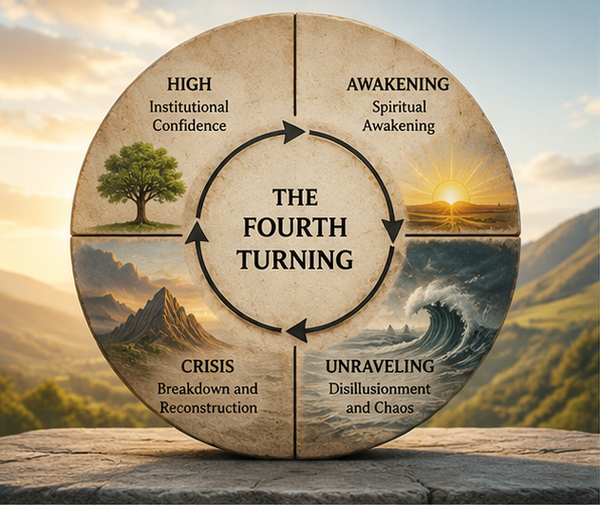
In 1997, historians William Strauss and Neil Howe published “The Fourth Turning,” a cyclical theory of Anglo-American history built around generational archetypes and recurring saecular rhythms of approximately 80 to 100 years — roughly the length of a long human life. Their framework identified four “turnings,” each lasting roughly 20 to 25 years, that repeat in sequence.
The First Turning, the High, is an era of institutional confidence and community solidarity following a great crisis. The rules work, people trust them, conformity is rewarded — think the post-WWII boom, or the post-Civil War Reconstruction era.
The Second Turning, the Awakening, is a spiritual and cultural awakening that challenges the institutional consensus of the High. Individualism resurges; the establishment is questioned — the consciousness revolution of the 1960s-70s, the Second Great Awakening of the 1820s-30s.
The Third Turning, the Unraveling, sees institutions weaken, individualism reach its apex, and civic order decay. Trust collapses — in government, media, corporations, each other — as it did through the Culture Wars era of the 1980s-90s, or the Gilded Age of the 1870s-90s.
The Fourth Turning, the Crisis, is a decisive era of institutional destruction and reconstruction, typically catalysed by an existential threat — war, economic collapse, or civilisational rupture. The old order is swept away; a new one is forged. The Great Depression and WWII. The Civil War. The American Revolution.
The Current Position
By Strauss and Howe’s reckoning, the current Fourth Turning began around 2008 — the Global Financial Crisis being its catalytic spark — and will likely reach its resolution sometime in the 2025-2030 window. We are, in other words, in the heart of it. The battles being fought now — over monetary systems, institutional legitimacy, national sovereignty, and the nature of truth itself — are the defining conflicts of the crisis era.
What Fourth Turnings produce is not predictable in detail but consistent in structure: the old institutions are exposed as either corrupt or incompetent, a battle ensues between competing visions of the replacement order, and the outcome is determined by which faction can mobilise sufficient force — social, political, economic, or military — to impose its vision. The process is neither clean nor just. Fourth Turnings historically produce enormous suffering alongside the reconstruction.
The GFC was Act One: the revelation that the financial system was not a wealth-generation machine but a debt-recycling mechanism sustained by regulatory capture and central bank intervention. The quantitative easing programmes that followed — printing roughly $20 trillion across major central banks between 2008 and 2022 — bought time at the cost of massively inflating asset prices, concentrating wealth, and making the eventual reckoning worse.
Covid was Act Two: a simultaneous crisis of public health, institutional credibility, and civil liberties, weaponised by an apparatus of state control that had been building for decades and found in the pandemic a perfect justification for deployment at scale. More on this shortly.
Act Three is visible on the horizon: the currency crisis that follows years of money creation, the geopolitical realignment driven by a rising China and a fragmenting Western alliance, and the social rupture of populations that have been systematically lied to discovering the magnitude of the deception. Fourth Turnings do not end until the crisis is resolved. We have not arrived there yet.
Editor’s Note: If the Fourth Turning is already underway, the greatest disruption may still be ahead. Periods like this can destroy old assumptions, punish the unprepared, and create rare opportunities for those who understand what is happening early.
In this urgent presentation, legendary investor Doug Casey reveals how he is preparing for the coming turmoil—and the contrarian strategy he believes could help you protect your wealth, stay ahead of the crisis, and profit from opportunities most investors will miss.
The Great Reset – Willem Middelkoop

“Everything points to something breaking in the not too distant future.”
Is Audience Capture Dying?
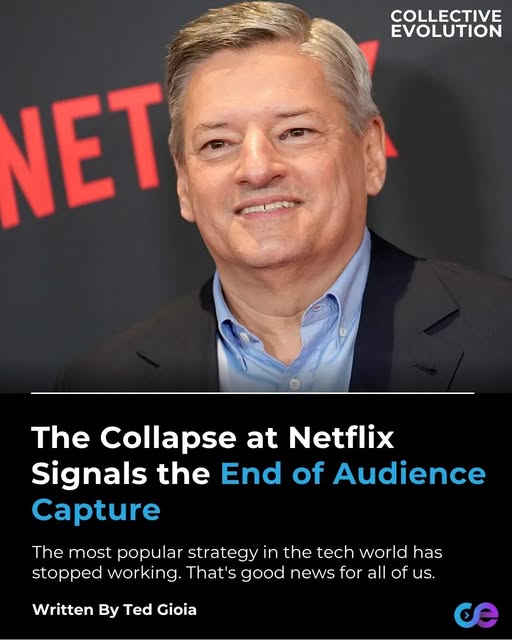
A few weeks ago, I warned about problems brewing at Netflix (and other streaming platforms). In just the last few days, these problems have gotten worse, much worse—and the situation has reached crisis proportions.
Even more revealing—the crisis is now spreading through the tech world like a wildfire. It’s no exaggeration to say that Netflix dragged down the entire NASDAQ today, after the release of its disappointing quarterly results.
That’s because savvy investors on Wall Street now grasp what’s really going on. They fear that the root cause of Netflix’s woes portends the collapse of the dominant business strategy in tech today.
This is hugely important—and not just for investors or technocrats. All of us will be impacted by how this plays out. And I have a strong hunch that what is bad for Netflix might just be good for you and me.
That’s because Netflix’s failed strategy is audience capture. And you and I are part of the audience it wants to keep in captivity.
More on that below—but let’s start by looking at damage done to Netflix’s stock. When I warned about it in June, the price had already dropped 45%.
But today, shareholders woke up to Netflix’s stock being 50% over the last 12 months.
After today’s debacle, Netflix will have wiped out the entire last two years of stock price gains.
This is usually where I take a victory lap, and point out that I warned of the danger three weeks ago. But there’s a bigger story here that must be told.
The disappointing revenue report yesterday is just the tip of the iceberg. The company’s reluctance to provide viewership numbers is an even more revealing sign of how bad things really are.
Netflix once bragged regularly about its growing user base. But yesterday they refused to share updated viewership numbers until 2027 as they move from reporting viewership every 6 months to now every 12.
Yet even without those metrics, I’ve seen evidence of a coming corporate collapse—but only if you dug into the numbers.
Last week, for example, we learned that Netflix’s audience is skipping the second season of the platform’s hottest offerings.
That’s scary stuff for Netflix. But it gets worse. The audience is also losing interest in the platform’s brand new series.
The situation is so dire that even Netflix’s biggest new series of the second quarter failed to get renewed. But if the platform can’t count on its new hits, will anything save it?
Netflix doesn’t want to tell us about users canceling their subscriptions. But just go over to Reddit and other platforms where people say what they really think about the company. You will get an earful.
This is typical:
Funny I was talking to my wife about how Netflix has practically nothing left we want to watch and maybe it was time to move on. If this price increase goes through that would be the final straw. I suspect a lot of others are getting close to that limit….
Another frustrated customer didn’t even make a comment—just shared some numbers. But the numbers paint a dismal picture.
Netflix got into this mess by pursuing a simple strategy: (1) Reduce the number of new scripted series (which peaked in 2022), but (2) Raise subscription prices.
That is the “audience capture” strategy mentioned above. The idea is that the audience got captured years ago with cheap subscription prices, and now the platform can squeeze them mercilessly—offering less and charging more. Netflix has been pursuing this agenda for several years now.
Ah, but Netflix isn’t the only company building its future on audience capture. It’s getting used at almost every streaming platform. And even companies outside of the media space are practicing variants of it. You see it at Google, Meta, X, Apple, etc.
It’s shocking how many companies have learned this technique. The entire printer and toner business is now built on audience capture. The same is true of the software industry—don’t even get me started on my Microsoft Office subscription fiasco. And, of course, all those customer loyalty programs (variants on the frequent flyer gimmicks that started this craze years ago) are examples of the same stale strategy.
Even the AI world is turning into an audience capture business—both for itself and its customers. This is one of the key reasons for my frequent criticisms of AI slop. It feeds into step one of the strategy outlined above. The companies use AI to reduce the cost of content, thus boosting margins while reducing their dependence on human creators.
Audience capture has always existed, but never to this extent. When I consulted at BCG we called it a milking strategy, where you raised prices and reduced capital investment in a business—which was now your cash cow. You squeeze all the money you can from it, for as long as you can.
But back then we realized that milking only worked in the short term. Eventually you killed the cow. And the risk is the same today with “audience capture”—which is just a new name for that poor old bovine.
Sooner or later, the audience refuses to be held captive. And that’s happening now at Netflix—hence the stock sell-off.
But it’s happening elsewhere too, although few are paying attention. Look at the share price at Spotify or Disney for ther examples.
Did you know that Mark Zuckerberg’s social media empire has stopped growing? In the first quarter, Meta saw a decline in users for the first time in the company’s history.
This is not just a coincidence. Meta is the king of audience capture, and when it starts losing that audience, other tech companies ought to pay attention.
You should expect to see more problems of this sort at audience capture corporations. And that’s bad news for the technocracy, because this manipulative strategy is everywhere. If it stops producing results, they will need to take drastic steps.
But their nightmare is our blessing. That’s because the end of audience capture means tech companies will need to return to serving customers, not holding them in bondage.
They aren’t ready to take that step—not now, at least. Pleasing customers is hard work. Milking cows is a simpler business. But they won’t have a choice. The cattle are finally resisting. They might even stampede!
I give the leading audience capture companies 12-18 months at most before the worst consequences of their overreach hit their financial statements. And it may happen even faster.
If they were wise, they would start acting now. But whether they fix the root cause of their audience capture mess now or later, the end result will be the same. That captive audience will find itself liberated.
If I’m right, this may represent the biggest shift in the consumer economy of our time. So check back here for updates—because this will be a bumpy rodeo ride for all parties.
—-
By Ted Gioia
George Ayittey on Socialism In Africa
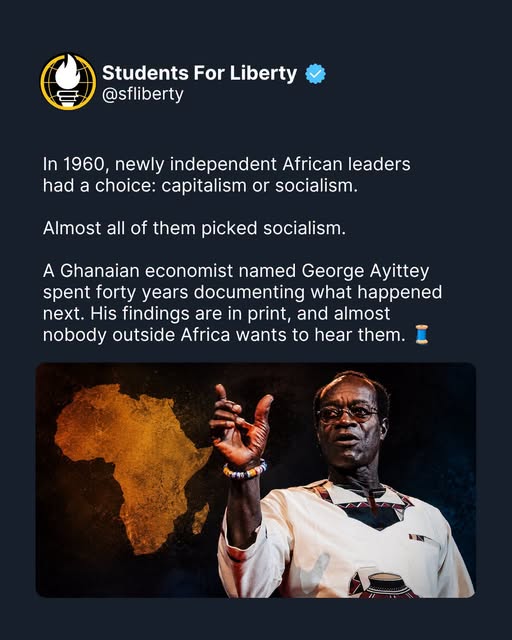
The reasoning in 1960 looked airtight. Colonialism had been run by Western capitalists. So capitalism was a tool of oppression. Socialism, its opposite, would be the path to liberation.
Kwame Nkrumah in Ghana, Julius Nyerere in Tanzania, Sékou Touré in Guinea, Mengistu Haile Mariam in Ethiopia, and Robert Mugabe in Zimbabwe all reached the same conclusion through the same logic.
The logic was tidy. The results were catastrophic.
In Ghana, Nkrumah’s government built 64 state enterprises before his overthrow in February 1966. Only three or four were profitable.
By 1970, the Ghanaian state was setting prices on nearly 6,000 items across more than 700 product groups.
In Tanzania, Julius Nyerere called the program ujamaa, a Swahili word for familyhood.
By 1976, the state had relocated more than 11 million peasants into roughly 8,000 collective villages. Much of the relocation was done at gunpoint. Government bulldozers flattened old houses so families could not return.
Tanzania exported 540,000 tons of maize in 1970. By 1974 it was importing 300,000 tons.
Within a few years a country that had been able to feed itself was depending on Western grain shipments to survive.
Ayittey then asked the question he considered most important: how do the rich get rich in the United States compared to Africa?
In the United States, the wealthiest people are builders.
Elon Musk built Tesla and SpaceX. Jeff Bezos built Amazon. Roughly two thirds of American billionaires founded the company that made them rich.
In socialist-era Africa, the wealthiest people were heads of state and their ministers.
– Mobutu Sese Seko of Zaire (now the Democratic Republic of Congo): estimates of stolen wealth ranged from 1 to 5 billion dollars.
– Sani Abacha of Nigeria: around 5 billion.
– Ibrahim Babangida of Nigeria: roughly 12 billion.
– Hosni Mubarak of Egypt: estimates ran as high
as 40 billion.
– Muammar Gaddafi of Libya: estimates reached 200 billion.
Ayittey put it plainly. The combined net worth of every American president from George Washington through Barack Obama, all 43 of them, was about 2.7 billion dollars in 2010 figures.
Sani Abacha alone stole more than that in five years in office. African socialism built a ruling class that created nothing and extracted everything.
The argument Ayittey most wanted Africans to hear, and the one almost nobody quotes, is that socialism was never African. Pre-colonial Africa had open markets, long-distance trade, and private enterprise. Cloth-weaving, iron and gold smelting, regional commerce. Property was held by extended families and clans, not by the state. Nyerere and his peers took kinship-based property and relabeled it communism. They confused village solidarity with state ownership. They imported a nineteenth-century European industrial ideology and applied it to agricultural societies that already had functioning markets older than the modern European state. Shortages, political prisons, and a parasitic ruling class followed.
South Africa in 2026 is preparing the same policies. The Expropriation Act was signed in January 2025. The MK Party introduced a constitutional amendment bill this April to push land restitution claims back to 1652 and remove compensation from the property clause.
Zimbabwe ran this experiment in 2000. Tobacco export earnings fell from 600 million dollars to 175 million by 2009. Maize production did not return to pre-seizure levels until 2017.
Ayittey warned about this for thirty years. He died in January 2022. South Africa is doing it anyway.