
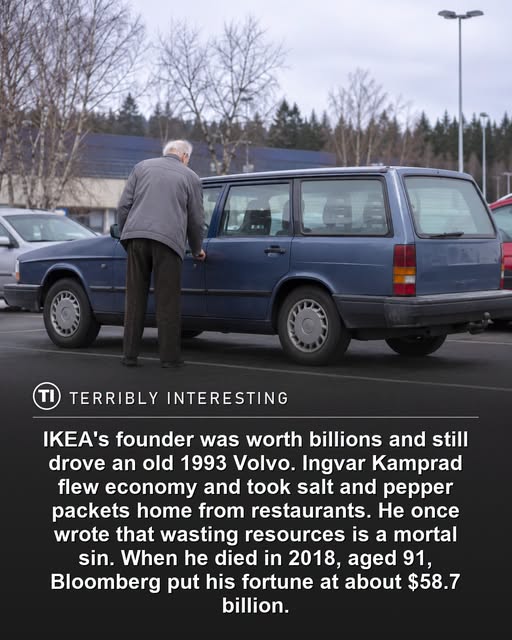
(Tom: Seems the good Ingvar and I share a common view of waste! Not so much his politica leanings. The comments on the original post point out he was a Nazi.)
Ingvar Kamprad was born in 1926 on a farm in Smaland, a poor and rocky part of southern Sweden whose people were known for wasting nothing. He started trading as a boy, buying matches cheaply in bulk in Stockholm and selling them to neighbors one box at a time.
In 1943, at just 17, he used a small cash gift from his father to start his own business, naming it IKEA after his initials, the family farm of Elmtaryd and the village of Agunnaryd. It began as a mail-order company selling pens, wallets and household goods before furniture took over.
The breakthrough came in the 1950s, when an employee took the legs off a table so it would fit into a car. Kamprad saw that customers could carry flat-packed furniture home and build it themselves. The first IKEA store opened in Almhult in 1958, and the company went on to become the world’s largest furniture retailer.
Kamprad kept living as if every krona mattered, flying economy, driving an old Volvo and taking salt and pepper packets home from restaurants. He wrote that wasting resources was a mortal sin for a company built on low prices.
When he died in January 2018 at 91, Bloomberg estimated his fortune at about $58.7 billion.