
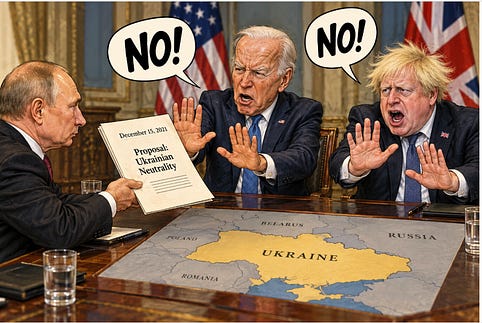
On the 71st Anniversary of Austrian neutrality, reflections on how the Russo-Ukrainian War could have been avoided if NATO had accepted Putin’s Dec. 15, 2021 proposal for Ukrainian neutrality.
John Leake
Oct 26
I started following US, Ukrainian, and Russian affairs while I was living in Vienna in the years 2000–2010. On dreary winter weekends, I sometimes went to Burg Cinema, where the The Third Man, a 1949 film noir masterpiece, still played on the big screen every Sunday. Shot on location in Vienna during the Four Powers Occupation of 1945–1955, the film and its deeply intriguing back story never ceased to fascinate me. As I recounted in my recent book, Mind Viruses: America’s Irrational Obsessions:
The Four Power occupation began in the spring of 1945 when the Soviet army entered Austria from the east and the American army entered from the west and converged on the capital of Vienna. By then it was already evident that as soon as Nazi Germany was defeated, the wartime alliance of the United States and Soviet Union would give way to a fierce rivalry over the fate of Europe. Austria lay in the middle of this conflict. To prevent each other from gaining the upper hand, the US military (along with those of Britain and France) occupied parts of Austria while the Soviet military occupied others. By 1947, US Department of Defense became convinced that withdrawing Western troops would leave the country open to complete Soviet occupation.
After Stalin died in 1953, Soviet Foreign Minister Vyacheslav Molotov told Austrian Chancellor Julius Raab that he was willing to entertain Austrian independence. In April 1955, Raab travelled to Moscow to discuss the matter. Despite his reputation for icy formality, Molotov quickly warmed up to Raab. Ten years after their armies had engaged in the most brutal warfare in history, the two men became conspicuously amiable over a state dinner of conviviality and frequent toasts, and they ironed out the terms of an Austrian neutrality deal. Raab agreed to pay for the “German assets” and oil fields left by the Soviets. Molotov also promised the release and repatriation of Austrian POWs still languishing in Russia.
The Western powers were amazed by the deal, with British diplomat, Geoffrey Wallinger reporting to London that it “was far too good to be true.” Nevertheless, it proceeded as planned and was signed by the representatives of all Four Occupying Powers on May 15, 1955, and came into force on July 27. By October 25, all occupying soldiers had withdrawn from the country, and the next day, Austria’s parliament enacted a Declaration of Neutrality that Austria would never join a military alliance such as NATO or the Warsaw Pact or allow foreign troops to be based in the country. Russia and the United States have honored Austrian neutrality ever since. Today (October 26, 2026) is the seventy-first anniversary of the Austrian Declaration of Neutrality and Day of National Celebration.
Upon his return from Moscow, Chancellor Raab addressed a crowd assembled outside the chancery. His voice breaking with emotion, he said, “I must thank the Lord God that we have been able to experience this hour for Austria.” And indeed, Austrian neutrality has been a great blessing for the nation and its people, and it enabled Vienna to become one of the most open, laid-back, and cosmopolitan capitals in Europe. I believe a similar neutrality arrangement for Ukraine would have served its people equally well.
This brings me to the timely point of this essay. Shortly after President Biden was sworn into office in January 2021, tensions between the United States and Russia began to ratchet up over various disagreements. In the autumn of 2021, Russian intelligence told President Putin that, in addition to the ongoing training and equipping of the Ukrainian military, CIA and British intelligence (MI6) are essentially controlling Ukrainian intelligence and turning it into a “springboard for operations against Moscow.” President Putin found these reports highly alarming, and on December 15, 2021, he submitted a security proposal to the US government, with Ukrainian neutrality a key provision. The Biden administration rejected it out of hand.
As NATO secretary Jens Stoltenberg later recounted to the EU Parliament:
In the autumn of 2021, Russia actually sent a draft treaty that they wanted NATO to sign to promise no more NATO enlargement. That was what they sent us, and that was a precondition for not invading Ukraine. Of course we didn’t sign that.
Why wasn’t Stoltenberg at least willing to try an Austrian style neutrality deal for Ukraine? Given that the Russians proposed it, they had a strong motive to abide by it. If they subsequently violated the terms of their own proposal, the West would have a clear cause for war with Russia.
Implied in Stoltenberg’s statement is that, in December 2021, he found the prospect of imminent war with Russia in Ukraine preferable to making a concession to Russia to avert war for an indeterminate period, perhaps for as long as Austria had remained at peace with Russia.