
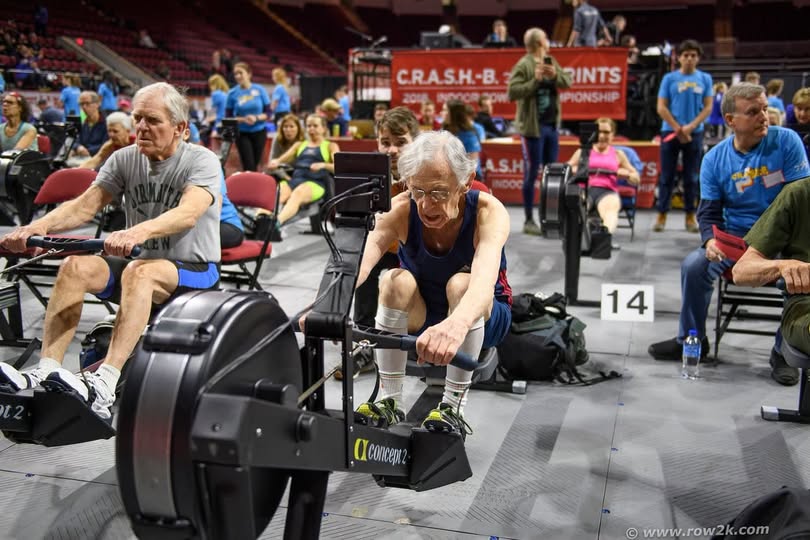
Richard Morgan had spent most of his life as a baker and battery maker. No structured training. No athletic past. At 73 he sat on an erg to kill time and a coach noticed his natural stroke. He never stopped.
By his early 90s he was a four-time indoor rowing world champion. He had rowed the equivalent of nearly ten times around the planet, mostly in a backyard shed. Researchers put him in a lab at 92 and measured what late-starting training had done.
His 165 pounds were roughly 80% muscle and 15% fat. Peak heart rate hit 153 during a 2,000 m trial—among the highest recorded for anyone in their 90s. Oxygen uptake kinetics looked like those of a healthy 30- or 40-year-old. Forced vital capacity and peak power sat well above what the textbooks predict for his age.
He trained about 30 km a week on the erg, mostly easy, with a couple of harder sessions and basic strength work. The body adapted. Muscle stayed. The cardiovascular system stayed responsive. Performance kept rising long after most people assume the window has closed.
The usual story is that you have to start young or you miss the boat. Morgan started in his seventies and collected world titles in his nineties. The systems that matter for rowing—power, oxygen delivery, muscle mass—proved more plastic than the decline curves suggest.