
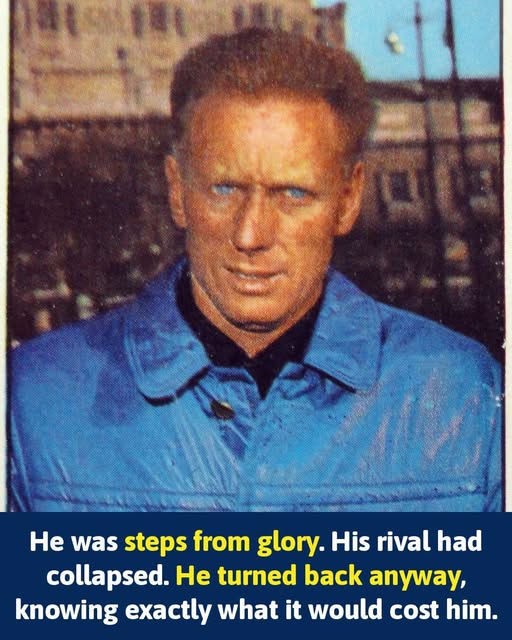
Nobody in that stadium knew his name before that afternoon. By the time it was over, nobody who was there would ever forget it. Fair play, they called it. It was something rarer than that.
It was 1964. Innsbruck, Austria. The Winter Olympics. The bobsled runs were packed with cold and tension, and Eugenio Monti was the man everybody expected to win.
He had been the best in the world for years. Six World Championship titles. A career of precision and nerve on the ice. This was supposed to be his Games.
Then came the run that changed everything.
The British two-man team, Tony Nash and Robin Dixon, had just finished a blistering heat when they discovered a broken bolt on their rear axle. The kind of mechanical failure that ends a campaign. No spare. No time. No solution.
Monti heard about it.
He was in first place. Nash and Dixon were his closest rivals. What he did next had no precedent in the sport.
He removed the equivalent bolt from his own sled and sent it up to the British team.
Nash and Dixon went on to win the gold medal.
Monti finished third.
When reporters pressed him afterward, he refused to treat it as sacrifice. He said, simply, that Nash had won because he drove the fastest. The bolt had nothing to do with it.
The Olympic Committee did not agree that it had nothing to do with it. That year, they created the Pierre de Coubertin Medal, awarded for exceptional sportsmanship. Monti was the first recipient.
He eventually won his own Olympic golds, two of them, at the 1968 Grenoble Games. He retired as one of the most decorated bobsledders who ever lived.
But the moment people remember is not a medal.
It is a bolt. Removed in silence. Sent up the hill to a competitor.
The man who gave away his chance at glory. The man who believed that winning the wrong way was not winning at all. The first name on a list of people the Olympic movement has ever called truly great.