
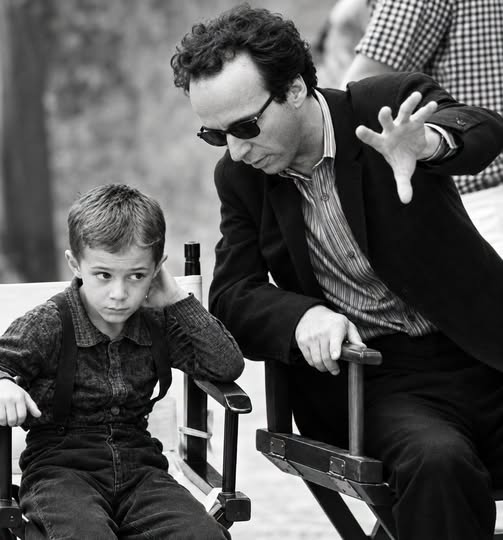
He showed up for his audition alone, without his mother, wearing an enormous overcoat that seemed to swallow his tiny body. Roberto Benigni looked at the little boy and immediately thought he looked like a clown. What he didn’t know was that this child was about to take on one of the most important roles in his film.
It was 1996, and Roberto Benigni, Italy’s beloved comedian, was trying to do something almost everyone around him considered impossible. He wanted to make a movie set inside a Nazi concentration camp. Not a documentary and not a horror film, but a story about a father’s love so powerful that it could create a world of wonder for his child inside one of the darkest places on earth.
His friends told him to give up. He was known as a comedian, not someone who made historical dramas. He wasn’t even Jewish, so some people questioned what gave him the right to tell such a story.
But Benigni knew exactly where the idea had come from, and it wasn’t arrogance. It came from his father.
Luigi Benigni had spent two years in a Nazi labor camp during World War II. When Roberto was a child, his father would sit down with the family at night and tell them about what he had experienced. But Luigi did not describe it exactly as it had happened. He didn’t want to frighten his children. Instead, he told the stories the way a father might explain something terrible to someone he loved, finding the dark humor, the absurd moments, and the small pieces of humanity that somehow survived the horror. He turned something frightening into a story his children could bear to hear.
As Roberto grew older, he began to understand what his father had given him. He realized that this was the film he wanted to make.
He also discovered the story of Rubino Romeo Salmonì, an Italian Jew who had been deported to Auschwitz, survived, and later wrote a memoir that contained elements of bitter comedy. Salmonì had experienced something almost impossible to describe, yet he still chose to look at parts of it through irony. Not because he wanted to minimize what had happened, but because humor was one of the ways he managed to remain human in the middle of it.
Benigni was determined not to get the story wrong. He sent drafts of his screenplay to Jewish scholars and Holocaust historians in Milan. He also consulted the Grand Rabbi of Rome. He knew the subject was too serious to approach carelessly.
The film became *La Vita è Bella*, or *Life Is Beautiful*. It tells the story of Guido, a warm and endlessly imaginative Jewish Italian man who falls in love, builds a family, and eventually watches the Nazis come for the people he loves. Inside the concentration camp, separated from his wife, Guido makes a desperate decision. He tells his young son that everything happening around them is actually an elaborate competition. Points can be earned by following the rules, staying quiet, hiding, not crying for food, and never asking for his mother. The grand prize, Guido insists, is a real American tank.
The little boy believes every word.
And that meant the child playing him had to believe it too. Not pretend to believe it, but truly believe it with the complete trust of a five-year-old who has no reason to doubt his father.
That became one of the biggest challenges Benigni faced.
His solution was remarkably simple. He never told Giorgio Cantarini what the movie was really about.
Giorgio was only five years old and couldn’t read yet, so he learned his lines by listening to them being repeated. At one point, he asked what the word “Jewish” meant because he had never heard it before. Benigni gently redirected the conversation. On set, he played games with Giorgio between takes, kept him relaxed, and made him laugh. Benigni later remembered that sometimes Giorgio would arrive in a bad mood, just like any child can, and his job in those moments was simply to make the boy feel safe enough to play.
That is why the fear on Giorgio’s face in some scenes was real. So was the excitement and happiness. The affection he showed toward the man playing his father was not something he had to manufacture. It was simply the natural trust of a five-year-old who believed the person beside him could turn anything into an adventure.
The audience could feel that honesty because it was genuine.
*Life Is Beautiful* was released in Italy in December 1997 and reached international audiences in 1998. The response was immediate and deeply divided. Some Holocaust survivors wept in theaters. Critics debated whether comedy had any place in such a terrible part of history. Some considered the film dishonest, while others believed it captured something deeply truthful, the idea that when circumstances become unbearable, love can create its own kind of fiction, and sometimes that fiction becomes an act of courage.
Then came the 71st Academy Awards in 1999.
When Roberto Benigni’s name was announced for Best Actor, he didn’t simply walk to the stage. He climbed over the backs of the seats in front of him, scrambling across the theater as the audience erupted in laughter and applause. He finally reached the podium breathless and overwhelmed.
That night, *Life Is Beautiful* won three Oscars: Best Actor, Best Foreign Language Film, and Best Original Score. Benigni became the first person to win the Academy Award for Best Actor for a performance delivered entirely in a language other than English. It remains the only time it has happened.
Three years later, Giorgio Cantarini appeared in *Gladiator*, playing Russell Crowe’s son. He was eight years old and already had an Oscar-winning movie on his résumé from before he was old enough to read.
In later interviews, Giorgio has remembered the warmth of those days on the set. He remembered the man playing his father always making sure he was comfortable and always finding a way to make him smile.
He didn’t understand what they were really making. And that was exactly the point.
A father, both on screen and behind the scenes, had protected the child from the darkness surrounding the story. Giorgio saw only the game. He saw the adventure. He saw a father who wanted to keep him safe.
He never had to see the horror.
*Life Is Beautiful.* Roberto Benigni spent his career believing in those words. And for one extraordinary film, he found a five-year-old boy who believed them too.