Grafting fruit trees was not an expert skill. Every farm kid learned it before they turned fifteen.
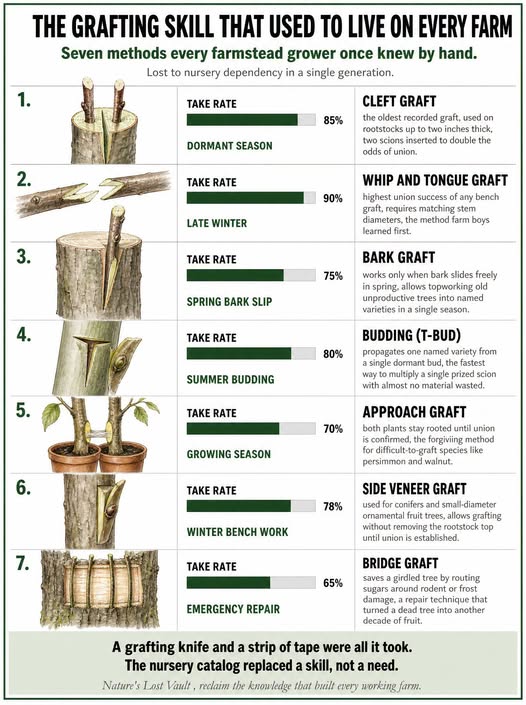
CLEFT GRAFT, splits thick rootstock and takes two scions at once, doubling your odds of union.
WHIP AND TONGUE, interlocking diagonal cuts on matched stems, highest take rate of any bench method.
BARK GRAFT, lifts spring bark to slip a scion under, turns an old useless tree into a named variety in one season.
BUDDING (T-BUD), one shield bud, one cut, one named tree; wastes almost no scion wood at all.
APPROACH GRAFT, both plants stay rooted until the union holds, the forgiving method for stubborn species.
SIDE VENEER, grafts without removing the rootstock top, used where failure would waste a whole plant.
BRIDGE GRAFT, routes sugar around a girdled wound and turns a dying tree into ten more years of harvest.
This knowledge did not disappear because it was too hard. It disappeared because it was too useful. Every grower who could cleft-graft a rootstock in February had no reason to buy a tree in April, and that made nurseries nervous in a quiet, structural way.
What replaced it was a story: grafting is technical, grafting requires training, grafting is best left to specialists. That story sold a lot of trees. It also severed the link between a grower and every variety their land could ever carry, handing that decision to whoever printed the catalog that year.
A grafting knife costs less than one nursery tree. The scion wood is on the tree you already have. The rootstock is a seedling you grew from a pip. The only thing missing is the twenty minutes someone forgot to teach you.