(Tom: Gosh I love people with talent, courage and integrity!)
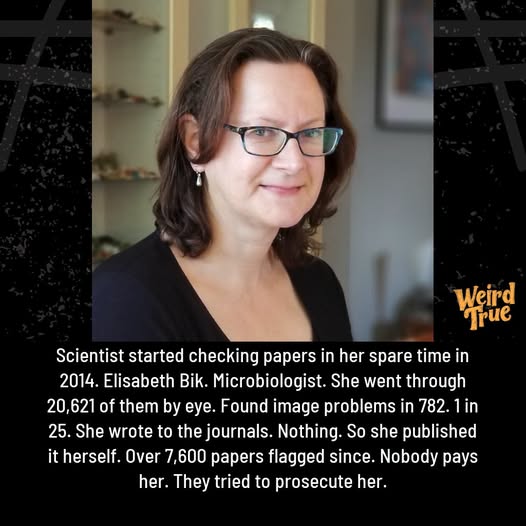
Elisabeth Bik is a Dutch microbiologist. PhD from Utrecht in 1996. Fifteen years at Stanford medical school working on microbiomes.
An ordinary scientific career. Right up until 2013.
That year she found out somebody had plagiarised a piece of her own published work.
So she started hunting plagiarism. Nine months of it. Then she opened a PhD thesis that had lifted text from somewhere else, and her eye caught something different.
A duplicated image.
She sat there thinking, wait. That happens?
That same evening she opened a handful of papers in PLOS One. She found more before bed.
She had discovered something about herself. She can see things in images other people cannot.
A duplicated patch. The same cell photograph appearing twice in one paper under two different labels. A band on a gel copied, flipped, and pasted back in.
January 2014. She found duplicated and altered images across a set of papers from an American medical school.
So she started doing it in her spare time. Evenings. Weekends.
Then she decided to find out how common it actually was.
She sat down and went through 20,621 published biomedical papers. Forty journals. Twenty years of the literature.
By eye. There were no tools for this. She just looked.
She found inappropriate image duplication in 782 of them.
One in 25.
And 196 of those were not honest mistakes. Those were figures that had been altered. Rotated. Flipped. Shifted. Somebody sat down and did it on purpose.
Her own reaction was flat. One in 25 papers I looked at had image problems. I thought that is a lot.
Now the part that says the most about the system.
She wrote to the researchers. She wrote to the journal editors.
Mostly nothing came back.
So in 2016 she published the whole thing herself, with Arturo Casadevall and Ferric Fang, in the journal mBio.
Understand who was not doing this work.
Scientific publishing is an industry worth billions. There are editors. There are peer reviewers. There are universities with entire research integrity offices.
Nobody had been looking at the pictures.
One woman with good eyes was doing it unpaid, after dinner.
And these are the papers medicine is built on. Every drug your doctor reaches for sits on top of this literature.
2018 she left her job in industry and made it her full time work.
Nobody employs her. She is funded by strangers donating through a subscription page.
Since then she has raised concerns about more than 7,600 papers. By late 2024 that had fed into more than 1,300 retractions. Over 1,000 corrections. Hundreds of formal notices of concern.
Papers by senior figures. University presidents. Institute directors. Drug company research.
Then in 2020 she looked at hydroxychloroquine.
The Marseille professor Didier Raoult had published a study reporting success using it against Covid. The claim went around the world. Governments moved on it. Millions of people took it.
Bik went through the paper and raised problems with the methodology and the missing patient data. Then she raised concerns about dozens more papers from him and his institute.
29 April 2021. A lawyer acting for Raoult and his colleague Eric Chabrière filed a criminal complaint with a prosecutor in Marseille.
Aggravated moral harassment. Attempted blackmail. Attempted extortion.
She denies all of it. The payment remark they pointed to was a joke, she said, and her donation page is public.
Her inbox filled with threats. Anonymous accounts went after her appearance. Somebody promised her justice in a real prison in France.
She posts under her own name. Almost nobody else in this field does.
Then more than a thousand researchers signed an open letter standing behind her.
2021 she was given the John Maddox Prize. 2024 the Einstein Foundation Award. She gave that prize money away. It funds other people doing the same work.
Now the honest caveat, because she would want it there.
Her method has real critics. The digital forensics expert Hany Farid has argued that eye-based analysis cannot be audited. You can’t audit her brain, is how he put it. A validation exercise put her accuracy at around 90 percent, which means roughly one call in ten needs another look.
Fair. And it does not touch the number underneath.
One in 25.
Because here is what has not been fixed.
Ten years on, many of those original 782 papers are still sitting in the journals. Uncorrected. Some of them well past anything you could blame on an innocent error.
She is still going. Still unpaid.
An industry worth billions had nobody looking at the pictures.
She did it in the evenings, for free, and they tried to have her charged for it.