
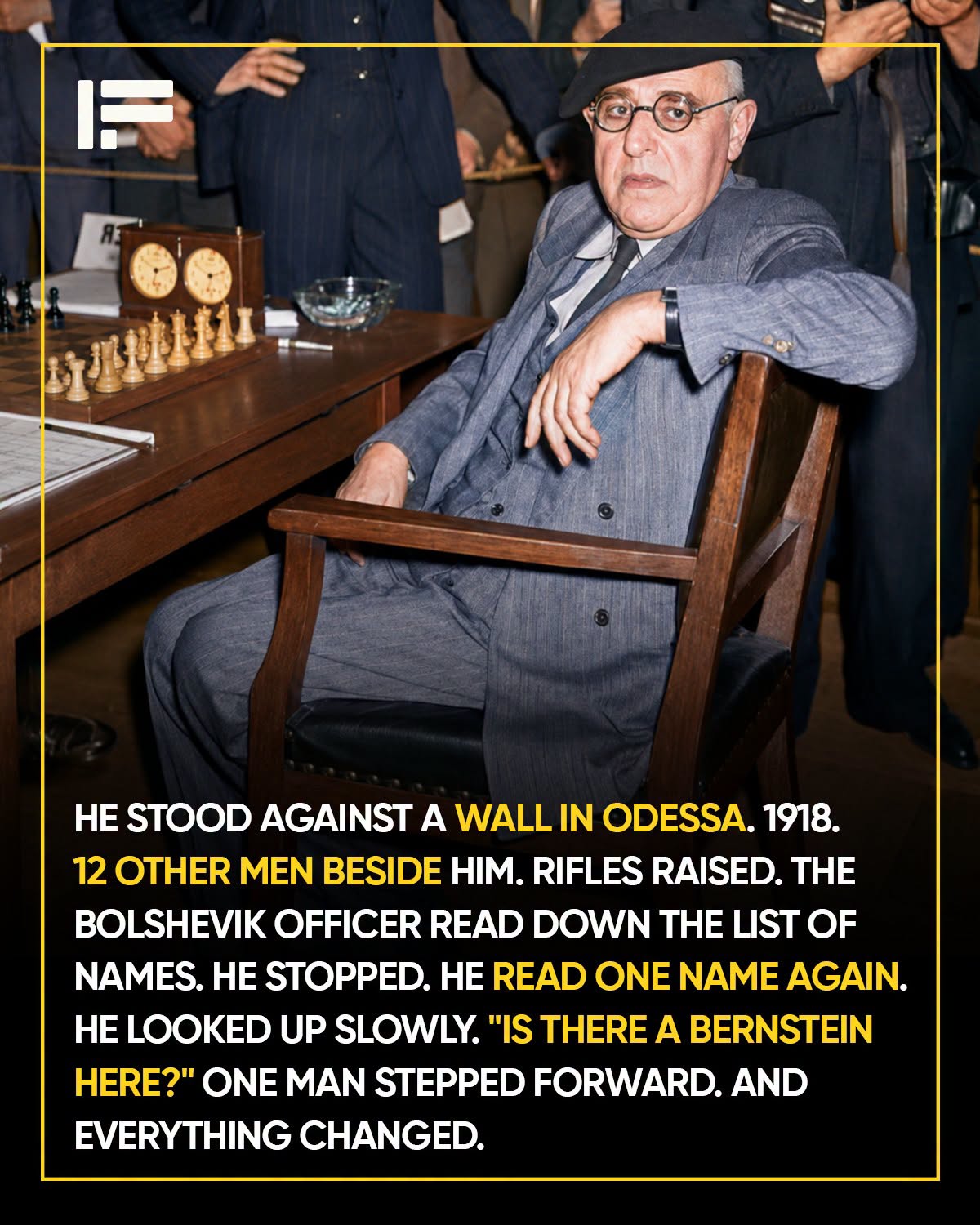
He was standing against a wall in Odessa, in the terror of 1918, with a firing squad lined up in front of him and rifles already raised. His only crime was his profession. And then a Bolshevik officer walked over, looked at the list of names, stopped at one — and asked him a single, strange question that would save his life. It had nothing to do with banking, or politics, or the revolution. It was about a game…
His name was Ossip Bernstein.
He was born on September 20, 1882, in Zhytomyr, in the Russian Empire, into a well-off Jewish family. He was the kind of man who could command any room he entered — not with force, but with the sheer power of his mind. As a young man studying in Germany, he earned a doctorate in law by his mid-twenties, and became a successful financial lawyer, advising banks and businesses. He married, raised a family, and built real wealth.
But alongside the law, Ossip had another gift that would define his life. He was a brilliant chess player.
By the early 1900s, he was one of the finest players in all of Europe — ranked among the top handful in the world, trading victories with legends of the game, tying for first at major international tournaments. He had one of those rare minds that could see ten moves ahead, hold a whole battlefield of possibilities in his head at once, and stay ice-cold under pressure. He was, in every sense, a man of standing.
And that, in 1918, was enough to nearly get him killed.
The Russian Revolution had torn through the empire. The old order was being dismantled overnight — the banks seized, the wealthy hunted, and anyone tied to the old financial world branded an enemy of the new state. Ossip was working in Odessa as a legal adviser to bankers. That was his entire crime. Not violence. Not sabotage. Just his job.
The Cheka — the Bolshevik secret police, feared across Russia during the bloody period known as the Red Terror — arrested him. There was no trial. No courtroom. No lawyer, no appeal. A minor official simply ordered him shot, and had Bernstein and a group of other prisoners lined up against a wall to be executed.
And here is the moment that has echoed through chess history ever since.
As the firing squad stood ready, a superior officer arrived and asked to see the list of prisoners’ names. He ran his eye down the page — and stopped. One name jumped out at him. He knew it. Not from any government file or banking ledger, but from the newspapers, from the tournament results he’d followed for years. He was a chess enthusiast. And the name in front of him belonged to one of the most famous chess masters in Europe.
He looked up. “Are you the chess master? The famous Bernstein?”
Ossip — thirty-six years old, his back to the wall, rifles pointed at his chest — said that he was.
But the officer wasn’t satisfied with a simple yes. Anyone could claim a name to save his skin. If this man truly was the great Bernstein, he would have to prove it — over the board. So the officer sat him down and made him play a game of chess, right then and there, with his life hanging on the result.
Imagine it. After hours of waiting to die, the terror still coursing through him, Ossip Bernstein had to summon the finest chess of his life — on command, with everything he had left riding on every move.
He won. In short order.
There was no longer any doubt who this man was. Convinced, the officer had Bernstein taken back to prison rather than shot — and from there, Ossip managed to escape the country entirely, fleeing to France. A game he’d first learned as a boy had just bought him his life.
But here is what makes his story almost beyond belief. Surviving that wall was only the first catastrophe he would overcome.
In France, he rebuilt everything from scratch — a new career, a new fortune. And then, in the Great Depression around 1929, it was all wiped out again. So he started over a second time, in his late forties.
Then, in 1940, Nazi Germany invaded France. Bernstein was Jewish, and he could not stay. So the family fled once more, this time toward Spain — reportedly hiding in caves by day to avoid the border patrols, Ossip suffering a heart attack from the strain of the escape. He lost his fortune a third time, and settled, with nothing but his name and his mind, in Barcelona.
Three times, life stripped him of everything he had. Three times, he built it all back.
And through all of it — the firing squad, two world wars, three ruined fortunes — the chess never stopped.
In 1950, when the world chess federation created its official titles, Ossip Bernstein was named one of the very first International Grandmasters in history.
And then came his most delicious triumph of all. In 1954, at the age of seventy-two, he traveled to a major tournament in Montevideo. One of his opponents was a much younger grandmaster named Miguel Najdorf, who was so insulted at having to play a man in his seventies — and so certain he’d crush the old man easily — that he actually persuaded the organizers to double the first-place prize money, confident he’d be the one to pocket it.
Bernstein sat down across the board from him and dismantled him in thirty-seven moves. The game was so beautiful it won the tournament’s Brilliancy Prize.
The young man had laughed. The old man had simply played.
On November 30, 1962, Ossip Bernstein died at the age of eighty, in the quiet of the French Pyrenees. And there is one final, fitting detail: he had been on his way back toward Russia to play in a chess tournament — returning, after all those decades of exile, toward the country that had once stood him against a wall — when his heart gave out. Chess was with him, quite literally, to the very end.
He had survived a firing squad, two world wars, and three lost fortunes. He had been branded an enemy, hunted, exiled, and ruined, again and again — and he had refused, every single time, to be erased.
What saved him in that Odessa yard was not luck, and it was not mercy. It was a lifetime of sitting across the board from opponents who wanted to break him — and never, ever letting them.