
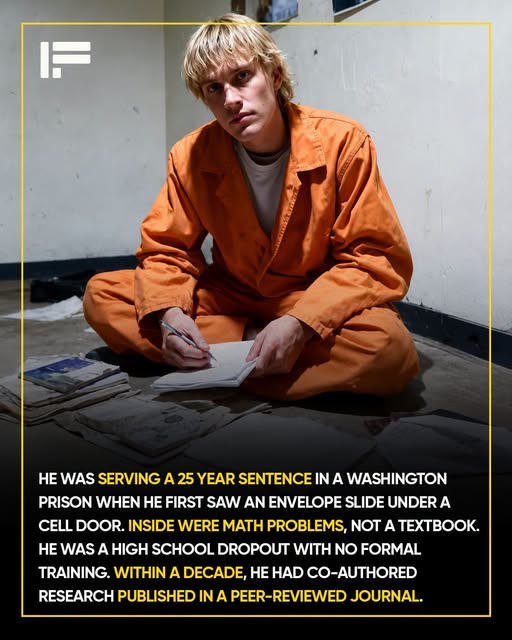
Locked alone in a solitary confinement cell, a man serving a long sentence for murder passed the endless hours with sudoku puzzles — until the day he noticed another inmate handing out little envelopes full of math problems. He asked for one. He solved it. He asked for another. And what happened next, from inside a prison cell with nothing but a pencil and paper, would astonish mathematicians on the other side of the world…
His name is Christopher Havens.
Let's be honest about how his story begins, because it matters. In 2010, Havens took a man's life in a drug-related shooting. He was convicted of murder and sentenced to 25 years in a Washington state prison. He was in his late twenties, his life in ruins, and he struggled badly in his early days behind bars. After an altercation with another inmate, he was thrown into solitary confinement for about a year.
And it was there, in that isolation, that something completely unexpected happened.
To pass the crushing hours, Havens started doing sudoku. Then he noticed a fellow inmate passing around small envelopes stuffed with math problems, and asked if he could have one. He worked it out. Then he asked for another. And another.
Something about mathematics — its logic, its order, its quiet, unshakable truth — connected with Christopher Havens in a way that nothing in his life ever had before. He hadn't been a math student. He'd never chased the subject. But now, alone in a cell, it found him. And he threw himself into it completely, studying, by his own account, as much as ten hours a day.
He devoured every math book the prison library had — and then he ran out. So in 2013, Havens did something audacious. He sat down and wrote a letter to an academic mathematics publisher, asking how he might subscribe to a research journal, and whether any mathematician in the world would be willing to correspond with a prisoner about advanced mathematics.
Most letters like that go straight into the wastebasket. But this one found its way to a number theorist named Umberto Cerruti, a professor at the University of Torino in Italy.
Professor Cerruti was skeptical, to put it mildly. He assumed Havens was probably a “crank” — one of the many amateurs who fall in love with numbers and convince themselves they've discovered something. So, to test him, Cerruti mailed him a difficult problem to solve.
What came back in the mail stopped him cold.
Havens mailed back a strip of paper nearly four feet long — about 120 centimeters — covered in one single, enormous, handwritten formula. Cerruti, half-expecting nonsense, carefully typed the whole thing into his computer to check it. And to his astonishment, it was correct. Completely correct.
This was no crank. This was a genuine mathematical mind — one that had taught itself, alone, in a prison cell.
From that moment, a remarkable transatlantic collaboration was born, conducted entirely through handwritten letters crossing the ocean. Cerruti began sending Havens real material in number theory — one of the oldest branches of mathematics, with roots going back more than two thousand years to the ancient Greek Euclid. And here is the part that makes it truly extraordinary: the work was never dumbed down for him. Havens was handed genuine, unsolved research problems — the kind that challenge trained, professional mathematicians — and he worked through them with nothing but a pencil, paper, and the prison mail. No computer. No classroom. No professor down the hall.
The obstacles were constant. When Cerruti tried to send him math books, the prison blocked them, until Havens negotiated with the administration to let them through. With no computer to typeset his work, he taught himself LaTeX — the intricate coding language mathematicians use to format equations — entirely by hand, visualizing every symbol in his head and mailing pages of handwritten code to his collaborators.
And then, in January 2020, it happened. Christopher Havens published his first paper in a real, peer-reviewed academic journal, Research in Number Theory, as a co-author alongside professional mathematicians. His work revealed, for the first time, certain hidden regularities in the way a vast class of numbers can be approximated — a genuine, original contribution to human knowledge, produced from a prison cell.
And he didn't stop. More publications followed — work tied to a conference in Slovakia, several more academic papers, and even a 2025 textbook on continued fractions from a respected academic publisher. Havens has never set foot in Italy or Slovakia, the countries his collaborators call home. All of it was done by mail, by hand, from inside.
But here is the part that may matter most of all.
Christopher Havens didn't keep his second chance to himself. Realizing what mathematics had done for him, he began — informally, in 2016 — offering to teach math to his fellow inmates, in exchange for a little library access and meeting space. That small effort grew into something real: the Prison Mathematics Project, which he co-founded and which became an official nonprofit in 2020.
Today, that project connects incarcerated students all across the country with volunteer mathematicians and educators who mentor them by mail. In 2025 alone, it reported more than 350 active mentorship pairings nationwide. It runs “Math Circles” — group problem-solving sessions — inside correctional facilities in several states. Havens has even held a part-time university research position, working on problems connected to cryptography.
He has described his own goal for his years in prison simply: that he wants to come out the other side as a functioning, contributing member of society. And he has thrown himself into mentoring other incarcerated students, calling that work central to their rehabilitation — and to his own.
None of this erases what Christopher Havens did. A man died, and that fact remains. But his story is a powerful reminder of something we too easily forget: that a human being is never only the worst thing they've ever done. That the mind is capable of astonishing things, in the most unlikely of places. And that even in a locked cell, with nothing but a pencil and the will to try, a person can begin to rebuild — and even give something back to the world.
Some prisons hold the body. But it turns out there are some things — curiosity, discipline, the hunger to become better — that no wall can ever quite contain.