
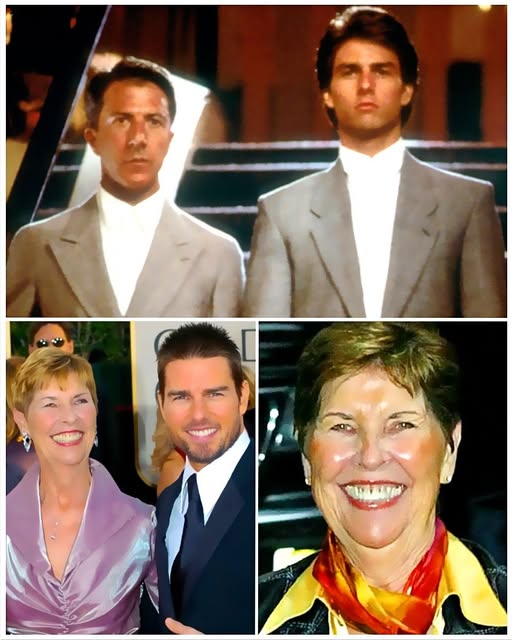
In 1984, Tom Cruise was eating with his younger sister Cass in a New York restaurant when she spotted Dustin Hoffman ordering takeout and demanded that her brother introduce himself.
Cruise refused. He was filming “Legend” (1985), but fame still felt new enough that approaching an Oscar-winning actor seemed more humiliating than exciting.
Cass would not let the moment disappear. Cruise remembered her warning. “If you don’t go up and say hello to him, I’m going to say hello to him, and I was like, ’Oh my god.’” He finally crossed the restaurant, apologized for interrupting, and addressed him as Mr. Hoffman. Then Hoffman looked up and called out Cruise’s surname. The young actor had expected blank confusion. Instead, one of his heroes already knew his name.
Hoffman was appearing in the Broadway revival of “Death of a Salesman” (1984), and he invited Cruise and Cass to attend. Backstage, he gave Cruise another surprise. Cruise recalled, “As I was leaving, he said, ’I want to make a movie with you.’ I was like, ’That’d be nice.’” Cruise answered with the manners he had learned growing up, never expecting the promise to become real. Around two years later, Hoffman sent him the screenplay that became “Rain Man” (1988).
The script placed Cruise far outside the swagger audiences associated with him. Charlie Babbitt was a furious, selfish car dealer who discovers that his late father’s $3 million estate has been left in trust for Raymond, an autistic older brother Charlie never knew existed. Cruise said the role had originally been written as a 57-year-old man. Reworking Charlie for a performer in his twenties gave the character a younger anger. Cruise later called it the best role of his career at that point and said each film was giving him greater confidence to try scenes in different ways.
Getting the film made was almost as difficult as that first restaurant approach. Cruise said he and Hoffman spent more than two years developing it and passed through four directors before Barry Levinson took control. Martin Brest, Steven Spielberg, and Sydney Pollack had all been involved at different stages. Levinson arrived only eight weeks before filming and stripped away gangsters, FBI agents, storms, and other plot machinery. He trusted that two difficult brothers, a 1949 Buick, and a tense cross-country journey could hold an audience.
Hoffman’s confidence also cracked. After watching footage from his first day, he believed his portrayal had failed and suggested Richard Dreyfuss replace him. Three weeks into filming, a scene about Raymond’s missing Hanes underwear unlocked the character. Hoffman explained, “And I suddenly realized that I was playing off myself because I know something about obsession and I’m comfortable being obsessive.” Raymond existed completely in the present, and Hoffman’s own obsessive nature became more useful than the pages of research filling his dressing room.
Hoffman built Raymond through intensive study, consulting specialists and learning from autistic men including Joseph Sullivan. He borrowed real behaviors, such as eating cheese balls with a toothpick, memorizing phone numbers, and reacting intensely to alarms. Hoffman explained his goal with unusual tenderness. “I tried very hard to be myself in this film. But I hope what emerged was Joe’s spirit, because that’s what moved me.” Cruise, meanwhile, made Charlie’s gradual change believable without turning it into a sudden miracle.
The film earned $172.8 million in the United States and Canada, won four Academy Awards including Best Picture, and gave Hoffman his second Best Actor Oscar. It also introduced millions of viewers to autism, while its rare combination of autism and extraordinary savant skills later became an overused stereotype. For Cruise, the deeper reward was learning beside Hoffman. He said their two-year collaboration taught him how carefully scenes could be shaped around another performer’s strengths, a lesson he carried into later work with young actors. Cass pushed Cruise across one restaurant, and Hollywood history followed him.