
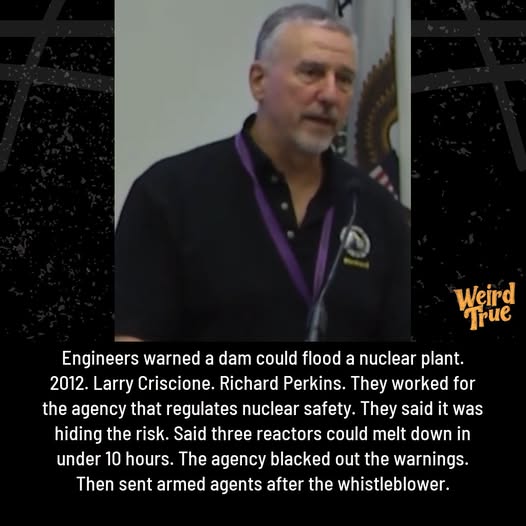
Two engineers warned that a dam could melt down a nuclear plant. So their own agency sent armed agents after them.
Larry Criscione. Richard Perkins. They worked for the Nuclear Regulatory Commission. The agency that is supposed to keep America safe.
They said three reactors could melt down in under 10 hours. They said the agency knew. And blacked it out.
This is not a movie. The plant is still running today. Under the same dam.
Larry Criscione was a risk engineer at the NRC. Government background. Military background.
His job was simple. Find the dangers before they kill people.
Then Fukushima happened.
March 2011. Japan. A wave hit a nuclear plant. Flooded it. Knocked out the power.
Three reactors melted down. The world watched in horror.
A flood. A nuclear plant. Disaster.
And everyone asked the same question. Could it happen here?
Inside the NRC, the answer was already written down.
Richard Perkins was another NRC engineer. In 2011 he led a report on flood risk at American nuclear plants.
The danger from upstream dams. Giant reservoirs sitting above reactors. Held back by walls of concrete.
One plant stood out. Oconee. South Carolina. Run by Duke Energy. Three reactors.
It sits below a giant dam. The Jocassee Dam. Just 11 miles upriver. A whole lake held back above the plant.
Perkins ran the numbers. If that dam failed, the water would come.
A flood. Around 19 feet high. Slamming into Oconee.
The plant’s flood wall was about 7.5 feet.
Do the math. The water goes right over it.
Criscione put it plainly in a letter. If the dam failed, all three reactors would melt down. In under 10 hours.
An American Fukushima.
And here is the part that should make your blood run cold. The NRC already knew.
Back in 2009 the agency told Duke in writing. A Jocassee Dam failure was a credible event.
After Fukushima, NRC staff said Oconee should survive a 19-foot flood.
Duke proposed protecting against 4.5 feet.
The NRC said okay.
Read that again. 19 feet of danger. 4.5 feet of protection. Approved.
Then they hid it.
When Perkins’ report went public, the scariest parts were gone. Blacked out.
The flood heights. The timelines. The odds of the dam failing. All redacted.
The NRC said it was for national security. So terrorists would not spot the weakness.
Perkins and Criscione did not buy it. They said it was not about terrorists.
It was about embarrassment. About liability. About hiding the danger from the people who lived near the plant.
So Criscione did something risky. 2012. He wrote a letter.
He sent it to the head of the NRC. He sent it to members of Congress. He attached stacks of documents. Dozens of letters between the NRC and Duke.
He said the public had a right to know what was being kept from them.
He was not alone. Perkins had spoken up. Another engineer, Jeffrey Mitman, raised the same alarm.
Even back in 2009, a deputy director inside the agency had filed a formal objection. Wrote that a dam failure was the single biggest risk to that plant. By far.
The NRC pushed back. Its spokesman said Duke had taken appropriate action.
Criscione called it double-speak. I think they are being dishonest, he said.
Then they came for him.
The NRC’s inspector general accused Criscione of leaking confidential information.
He was interrogated. By armed agents.
His case was referred to federal prosecutors. They looked. They declined to charge him.
He kept his job. But the message was loud. Speak up, and this is what happens to you.
Think about what these men risked.
They were the experts. The ones you trust to catch exactly this kind of danger.
Safe government jobs. Pensions. Careers. All they had to do was sign off and stay quiet. Let it stay blacked out.
They refused. They put it in writing. They sent it to Congress.
They told the world a dam could drown a nuclear plant and melt down three reactors in under 10 hours.
And the agency tried to bury them for it.
We don’t work for nuclear operators, Perkins said. We work for the American people.
It’s the two of us against the entire federal government, Criscione added.
Now here is the part nobody wants to sit with.
The dam has not failed. But nothing about the danger has changed.
Oconee still runs today. Three reactors. Still sitting below that lake.
The flood wall is still there. The water is still held back by concrete. And the warning is still buried.
If you live in upstate South Carolina, that lake is sitting above you right now.
These men stood by every word. They said the public was kept in the dark about a risk to their own lives. And they paid for saying it out loud.
The dam still stands above the plant.
And so does their warning.
Share this so the next person who lives near a reactor knows what their own government would not tell them.
Would you trust the agency that did this? Tell us below.