
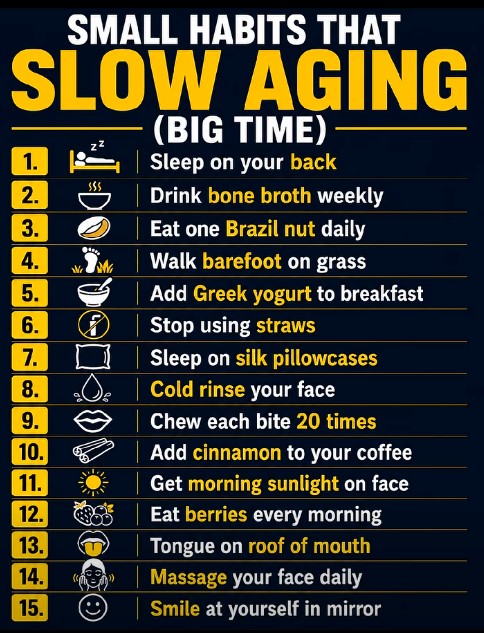
I asked perplexity.com as I had not heard of several of these. It responded:
Yes — a few of those are grounded in real dermatology or nutrition advice, but several are either weakly supported or mostly social-media folklore. The strongest items on that list are sun protection, not smoking, good sleep, a healthy diet, and gentle skin care; the weakest are things like bone broth for “aging,” barefoot on grass, stopping straws, tongue posture, and smiling at yourself in a mirror as an anti-aging intervention.
What looks reasonable
Sleep on your back: plausible for reducing facial creasing from pressure, and dermatology guidance says side/stomach sleeping can crease facial skin; silk pillowcases may reduce friction a bit too.
Greek yogurt at breakfast: sensible as part of a high-protein, balanced breakfast, but it is not a proven anti-aging hack on its own.
Morning sunlight: getting daylight early can help circadian rhythm and sleep timing, which indirectly supports overall health; the skin-aging claim is much less solid than the sleep benefit.
Berries: generally a good diet choice because fruits and vegetables are associated with healthier skin aging patterns, though “every morning” is not a special threshold.
Facial massage: may temporarily improve puffiness or circulation, but it is not proven to slow skin aging in a meaningful long-term way.
What is overstated
Bone broth weekly: there’s no good evidence that drinking bone broth itself slows aging, even if it can be a source of protein or comfort food.
One Brazil nut daily: Brazil nuts are selenium-rich, and selenium matters nutritionally, but “one per day” is not a universal rule because selenium content varies a lot and excess selenium can be a problem.
Chew each bite 20 times: better chewing can help digestion and fullness, but the exact number is arbitrary; it is not an anti-aging intervention.
Add cinnamon to coffee: cinnamon has some interesting lab and topical research, but human evidence that eating it slows aging is weak.
Stop using straws: repeated puckering can contribute to mouth lines over time, but this is a very small effect compared with sun exposure and smoking.
Basically folklore
Walk barefoot on grass: pleasant and grounding, but not a known aging-slowing habit.
Sleep on silk pillowcases: may reduce friction, but evidence for anti-aging benefits is limited. [curology](https://curology.com/blog/anti-aging-pillows-and-other-bedtime-stories/)
Cold rinse your face: can reduce puffiness briefly, not aging.
Tongue on roof of mouth: no credible anti-aging evidence.
Smile at yourself in mirror: good for mood, not a skin-aging strategy.
What matters most
If the goal is genuinely to slow visible aging, the big levers are still the boring ones: daily sun protection, no smoking, enough sleep, regular exercise, a balanced diet, and a gentle skincare routine. Those are the habits dermatology groups consistently emphasize, far more than any of the “viral” items in the image.