
How a Dutch woman cured her Graves’ disease through lifestyle alone — and why a tiny black seed may now be doing the same for Hashimoto’s
Medicine has a curious habit. The moment it cannot offer a cure, the disease itself gets relabeled “chronic,” “progressive,” or “incurable” — and the patient is handed a prescription pad for life.
Graves’ disease is one of those labels. So is Hashimoto’s. Together, they account for the overwhelming majority of autoimmune thyroid disease in the West — and together, they have produced a multi-billion-dollar industry built around lifelong hormone replacement and the occasional removal of the thyroid gland itself.
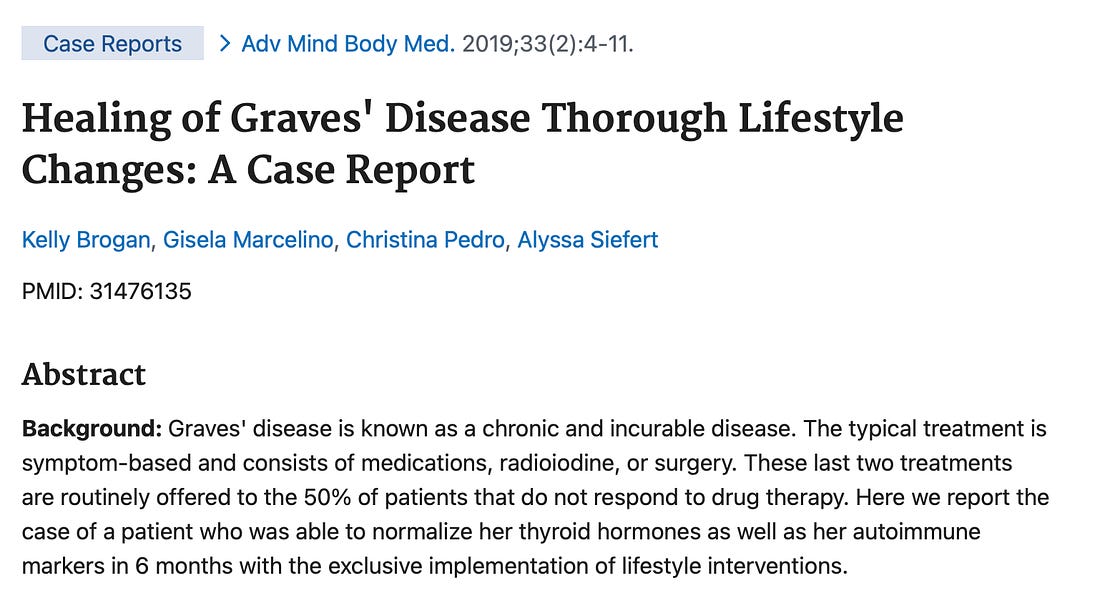
But two studies, published years apart in respectable peer-reviewed journals, quietly tell a very different story. One is a single, remarkable case report of a 34-year-old Dutch woman who reversed her Graves’ disease through nothing more than diet, yoga, oral hygiene, and the deliberate avoidance of environmental toxins. The other is a randomized clinical trial showing that two grams of powdered black seed per day measurably improved thyroid function in patients with Hashimoto’s thyroiditis — reducing autoantibodies by roughly half and pushing T3 in the right direction, all without a single side effect.
If either study had involved a patentable molecule, you would have heard about it on the evening news.
You did not.
The diagnosis that becomes a sentence
Graves’ disease (GD) is an autoimmune attack on the thyroid that drives the gland into overdrive. Patients live with heart palpitations, hair loss, weight loss, mood swings, bulging eyes, goiters, gut disturbances. Standard care begins with anti-thyroid drugs such as methimazole and propylthiouracil — medications whose side-effect list includes rashes, vomiting, joint pain, loss of taste, and a metallic flavor in the mouth that never quite leaves.
For roughly half of patients, drugs are not enough. The next step is radioactive iodine or surgical removal of the thyroid. Both reliably cause hypothyroidism — turning an overactive thyroid into none at all — and commit the patient to taking synthetic thyroid hormone every day for the rest of their life.
Hashimoto’s runs the other direction. It is the most common cause of underactive thyroid in North America, affecting roughly 5% of the U.S. population at some point in life and striking women up to fifteen times more often than men. The thyroid is slowly destroyed by its own immune system. The standard treatment is to manage the wreckage with synthetic T4 (Synthroid), which often normalizes lab values without ever restoring the patient’s actual sense of well-being.
Both diseases share a deeper truth that mainstream endocrinology rarely emphasizes: the thyroid is not malfunctioning at random. It is responding — to inflammation, to gluten, to fluoridated water, to nutrient deficiencies, to a body that has been telling the immune system to attack the wrong target for years.
Which means, in principle, those signals can be changed.
A 34-year-old Dutch woman, one diagnosis, five changes
In 2019, the journal Advances published a case report titled “Healing of Graves’ Disease Through Lifestyle Changes.” The authors — Kelly Brogan, MD and colleagues — followed a Dutch woman who had been diagnosed with Graves’ disease in 2014 and who, by the time of writing, no longer met the diagnostic criteria for the disease.
Her TSH had normalized. Her autoimmune markers had quieted. She was taking no thyroid medication.
She had made five changes — none of them exotic, none of them expensive:
1. An ancestral diet
For one month she cleared the static. Out went the foods that were never part of any pre-industrial human diet — gluten, grains, dairy, legumes, corn, and soy — what I call in Regenerate a blueprint of ancestrally-appropriate, minimal allergenicity and antigenicity foods. Then, one at a time, she reintroduced what she tolerated and listened to what her body said back.
The base of her diet became wild fish, pasture-raised meat, eggs, fruits, vegetables, nuts, seeds, and raw foods — closer to what humans ate for the 200,000 years before grain-based agriculture, and the food industry that followed it, redefined “normal.” This is not nostalgia. It is a corrective for what researchers call evolutionary mismatch, or paleo deficit disorder — the collective deficiency of ancestral inputs in the modern industrialized landscape. Food is not merely fuel. It is information. It is the signaling language — the microRNAs, polyphenols, and gene-regulatory molecules — that tells our 20,000 protein-coding genes how to behave. Feed the body the wrong operating system long enough and the hardware begins to fail. Autoimmunity is one of the ways it tells you.
The autoimmune-thyroid–gluten connection is now well documented. One study of 400 patients with autoimmune thyroid disease found antigliadin antibodies — markers of gluten sensitivity — in roughly 5% of the sample. Another found autoimmune thyroid disease in 13.9% of celiac patients versus 2.1% of non-celiac controls. And gluten is not a problem only for those with a celiac diagnosis: intestinal biopsy studies show that gluten induces “leaky gut” in celiac patients with active disease, celiac patients in remission, non-celiac gluten-sensitive patients, and non-celiac healthy controls. Gluten, simply put, is a bad actor. Wheat alone has been linked, in the indexed biomedical literature, to more than 230 distinct diseases — which is what happens when a monocotyledonous grass seed, introduced to the human diet only ~10,000 years ago, is asked to feed a dicotyledonous primate that spent millions of years eating something else.
If you want the full template — the elimination protocol, the reintroduction sequence, the foods that rebuild the gut barrier and quiet the autoimmune fire — it is laid out in my book Regenerate: Unlocking Your Body’s Radical Resilience through the New Biology and walked through, step by step, in my Regenerate Yourself Masterclass.
2. Oral hygiene from another century
She added two practices: oil pulling with coconut oil and daily flossing with a water flosser. Oil pulling — an Ayurvedic practice in which a tablespoon of oil is swished in the mouth for ten to twenty minutes — has been linked in the literature to improvements in over a thousand conditions, from tooth decay to migraines to renal disorders. The water flosser was shown in one head-to-head study to be three times more effective than string floss at reducing bleeding gums.
The mouth is not a separate kingdom from the body. The thyroid sits inches below it. Chronic oral inflammation feeds systemic inflammation, and systemic inflammation feeds autoimmunity.
3. Yoga, exercise, and meditation
Movement and meditation reduced her cortisol, her muscle tension, her resting heart rate, and her anxiety. In a review of 23 trials, yoga was shown to be an effective intervention for depression — a comorbidity that affects an enormous fraction of thyroid patients and is often pharmacologically managed in isolation, as if it had nothing to do with the rest of the body.
4. A deliberate war on environmental toxins
She switched to purified water (specifically avoiding fluoride, which independent research has linked to a 30% increase in hypothyroidism), to organic produce, and to non-toxic cleaning and personal care products. The thyroid is one of the most chemically sensitive organs in the body. It uses iodine to manufacture hormones, and it cannot tell the difference between iodine and the halide impostors — fluoride, bromide, perchlorate — that have saturated the modern environment.
5. Targeted nutritional repletion
She supplemented the nutrients the modern diet most reliably fails to provide: iodine, iron, selenium, zinc, vitamins A, C, D, B1, B5, B6, magnesium, and probiotics. Selenium alone, in a meta-analysis, significantly reduced thyroid autoantibodies in patients with autoimmune thyroiditis. Vitamin D deficiency is so consistently observed in autoimmune thyroid disease that it has stopped being controversial.
The result: a disease the textbooks call incurable, brought to remission by what a great-grandmother might have called common sense.
And then the black seed trial
While the Dutch case report was an N of 1 — powerful, but a single anchor — a randomized, placebo-controlled clinical trial published in BMC Complementary and Alternative Medicine added a second.
The trial enrolled 40 patients with Hashimoto’s thyroiditis, ages 22 to 50. Half received two grams of powdered, encapsulated Nigella sativa — the ancient seed known across the Islamic world as habbat al-barakah, “the seed of blessing,” and described in a famous hadith as “a remedy for every disease except death.“ The other half received two grams of starch placebo. Both groups continued daily for eight weeks.
The results, in the words of the investigators:
“Treatment with Nigella sativa significantly reduced body weight and body mass index (BMI). Serum concentrations of thyroid stimulating hormone (TSH) and anti-thyroid peroxidase (anti-TPO) antibodies decreased while serum T3 concentrations increased in Nigella sativa-treated group after 8 weeks. There was a significant reduction in serum VEGF concentrations in intervention group. None of these changes had been observed in placebo treated group.”
To translate: black seed reduced the very antibodies that drive the autoimmune destruction of the thyroid by approximately 45 percent. It lowered TSH (a marker of thyroid stress) by roughly a quarter. It pushed active T3 upward by nearly thirty percent. It reduced VEGF, a vascular signaling molecule whose elevation tracks with inflammation and disease severity.
The placebo group — same diet, same lifestyle, same study protocol, different capsule — did none of those things.
What is actually happening inside the seed
Nigella sativa is not a single molecule. It is a tiny, intricate pharmacy in a black shell. Its three best-characterized active fractions are:
Thymoquinone — a powerful anti-inflammatory and antioxidant that quiets the cytokine signaling thought to drive autoimmune flares.
Nigellone — an immunomodulatory compound that appears to rebalance overactive immune responses without suppressing the immune system overall.
Polyphenols and saponins — molecules that support redox balance and the integrity of the gut barrier, an increasingly recognized upstream driver of autoimmune disease.
The 45% drop in anti-TPO antibodies is the headline. Anti-TPO is the antibody that targets thyroid peroxidase, the enzyme the thyroid uses to manufacture hormone from iodine and tyrosine. Every flare of Hashimoto’s is, in essence, an immune assault on that enzyme. Cut the antibody by half and you have cut the assault by half.
What synthetic T4 does — and does only — is replace the hormone the destroyed gland can no longer produce. It is salvage, not repair. It does not touch the underlying autoimmunity. A spice you can buy at any Middle Eastern grocery store, in this trial, did. And, synthetic T4 is both quantitatively (primary amino acid sequence difference), and qualitatively (conformational state; functional state) different from animal derived forms (porcine glandular) which are far more bioidentical to human thyroxine.
Learn more on the difference by reading: The FDA’s War on Natural Thyroid: A Medical Tyranny That Threatens Millions
Learn more about the incredible therapeutic profile of black seed on the GreenMedInfo.com database on the subject.
Why this matters more than a single trial
The point is not that black seed is the answer to every autoimmune thyroid condition. The point is what the existence of this trial reveals about the gap between what is known and what is offered.
Patients diagnosed with Hashimoto’s or Graves’ are almost never told that:
The most common upstream drivers of autoimmune thyroid disease include gluten sensitivity, selenium deficiency, vitamin D insufficiency, environmental halide exposure, and chronic stress — every one of which is modifiable.
A randomized clinical trial has shown that two grams a day of a culinary spice measurably moves the needle on thyroid antibodies, TSH, and T3.
A peer-reviewed case report exists of a Graves’ patient who reversed the disease through ancestral diet, yoga, oral hygiene, nutrient repletion, and toxin avoidance — and remained well off all medication.
What patients are offered is methimazole or Synthroid, often for life, frequently with an explicit message that “the cause is unknown” and “there is no cure.”
That message is not, strictly speaking, false. It is simply incomplete to the point of being dishonest.
A reasonable starting protocol
The studies above describe what worked for specific people in specific studies. This is not personalized medical advice. But for anyone facing an autoimmune thyroid diagnosis and looking for a constructive starting point to discuss with a knowledgeable practitioner, the published evidence converges on a short, sensible list:
Food
Remove gluten, refined grains, industrial seed oils, ultra-processed foods, and conventional dairy for 30 days. Reintroduce only what is genuinely tolerated.
Build meals around wild-caught fish, pasture-raised meat and eggs, vegetables (especially cruciferous, well-cooked), fruit, nuts, and seeds.
Consider adding 2 grams of powdered Nigella sativa (black seed) daily — the dose used in the Hashimoto’s trial. Or one to two teaspoons of cold-pressed black seed oil.
Environment
Switch to fluoride-free, filtered water. Fluoride is a halide that competes with iodine at the thyroid.
Replace conventional cleaning, laundry, and personal-care products with non-toxic alternatives.
Eat organic when possible, especially for the Dirty Dozenproduce items.
Nutritional foundation
Selenium (200 mcg/day, ideally from two Brazil nuts) — repeatedly shown to lower thyroid antibodies.
Vitamin D — dose to a 25(OH)D blood level of 50–80 ng/mL. [Use a UVB producing technology like my personal favorite — the MitoLux — to generate your own Vitamin D (and related biomolecules) year round here.
Iodine — only with proper testing and clinical supervision; iodine handling is delicate in autoimmune thyroid disease.
Zinc, magnesium, B-complex, and a high-quality probiotic.
Daily rhythms
A consistent sleep window, daylight on the eyes within an hour of waking, and movement most days.
A brief daily meditation, yoga, or breathwork practice. The autoimmune nervous system does not respond to logic; it responds to safety signals.
Oral hygiene
Add oil pulling with coconut oil and replace string floss with a water flosser.
None of this is exotic. None of it requires a prescription. All of it has published evidence behind it. And — based on a peer-reviewed case report and a randomized trial — some patients have already used a version of it to walk away from a diagnosis they were told they would carry for life.
The deeper story
What unites the Dutch woman in the case report and the Hashimoto’s patients in the black seed trial is not a single intervention. It is an orientation.
Mainstream endocrinology treats the thyroid as a broken organ to be suppressed or replaced. The evidence, when you actually read it, treats the thyroid as a signal — a sensitive instrument that has been responding, intelligently, to a body and an environment under chronic insult. Remove the insult. Restore the nutrients. Quiet the nervous system. Provide the body with the ancient, food-based compounds it has evolved alongside for millennia. And sometimes — often enough that we should not ignore it — the disease that was called incurable simply stops being there.
The seed of blessing is not magic. The yoga mat is not magic. The gluten-free week is not magic.
Together, they are something more powerful than magic.
They are biology, finally being listened to.