
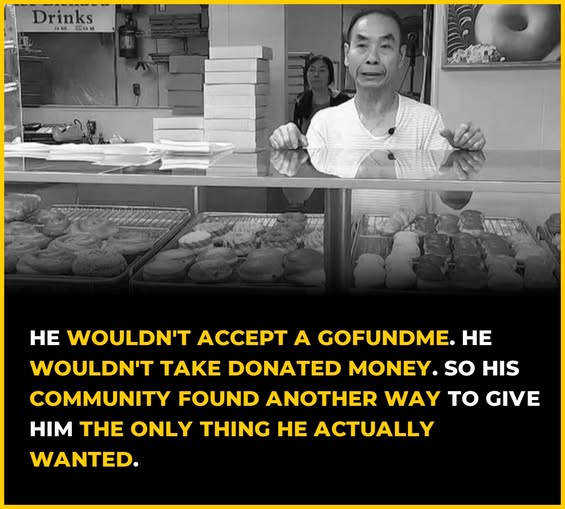
Every morning for nearly thirty years, John Chhan arrived at his donut shop at 2 a.m.
Not 6 a.m. Not 5 a.m.
Two in the morning. Every single day. Seven days a week. No exceptions.
He and his wife Stella had come to the United States as refugees from Cambodia in 1979 — arriving with nothing, building everything. They opened Donut City in Seal Beach, California, and for nearly three decades, the two of them worked side by side in that small shop, making everything fresh before the sun came up, opening the doors at 4:30 a.m. to a community that had come to think of them as family.
Generations of families had grown up buying donuts from John and Stella. Children who had sat on the counter as toddlers brought their own children in years later. The Chhans had become, as one customer put it, “national treasures” of Seal Beach.
Then, in September 2018, Stella suffered a brain aneurysm.
She fell into a coma. Doctors weren’t certain she would survive. When she emerged, she was partially paralyzed and unable to speak. The woman who had stood beside John every morning at 2 a.m. for thirty years was now in a rehabilitation facility, fighting to come back.
And John — alone — kept going to the shop at 2 a.m.
Because what else do you do? The bills don’t stop. The rent doesn’t stop. You bake the donuts. You open the doors. You sell what you can. And then, when the day is done, you drive to the rehabilitation center and you sit beside the person you’ve worked next to every single morning for three decades, and you hold their hand.
Customers noticed immediately that Stella was gone. When they asked John where she was, he told them the truth.
Word spread.
People immediately wanted to help. Someone suggested a GoFundMe. Someone else offered to cover the medical bills directly.
John Chhan said no. To all of it.
He wouldn’t accept a handout. He didn’t want money. He just wanted more time with his wife.
That answer broke Dawn Caviola’s heart.
She was a regular customer — had been for thirteen years. She went home after hearing John’s story and couldn’t stop thinking about it. “I just couldn’t get it out of my head,” she said later. She had never done anything like what she was about to do. But she sat down and wrote a post on Nextdoor — the private community network for Seal Beach residents — and she asked a simple question.
What if everyone just came in and bought donuts early? As many as possible, as fast as possible? Because the moment John sells out for the day, he can close the shop, get in his car, and go be with Stella.
The post spread. Then it jumped to Facebook. Then it went further.
The next morning, the line outside Donut City started forming before dawn.
And then every morning after that.
People came from 50 miles away. From 60 miles. From 70. A woman flew in from Minnesota. A man heard about it through his daughter in Hawaii. People arrived in lines that stretched around the block, buying donuts by the dozen — sometimes two dozen, sometimes more. Some of them didn’t even particularly want donuts.
They wanted John to be able to close early.
By 6:30 some mornings, every donut in the shop was gone. A store that normally stayed open until 3 p.m. was selling out before sunrise.
“A lot of people, they come to buy a lot of doughnuts from us,” John said quietly, “and gave me more time to go visit my wife.”
That was the gift. Not money. Not a fundraiser.
Time.
Every dozen donuts sold was twenty minutes John could spend at Stella’s side instead of behind the counter. Every early sellout was an afternoon he got back. The community wasn’t buying donuts. They were buying him hours — one glazed, one apple fritter, one chocolate old-fashioned at a time.
Stella Chhan came back.
About a year after her aneurysm, after the coma, after the paralysis and the silence and the doubt that she would ever return — Stella walked back behind the counter at Donut City.
“I feel grateful,” she said.
“They give me a hug.”
John and Stella Chhan arrived in America with nothing. They built a life at 2 a.m., one morning at a time, for thirty years. And when that life was threatened, the people who had eaten their donuts for decades showed up before sunrise and bought every single one — not because they were hungry, but because a man who wouldn’t accept charity deserved to be with his wife.
The donuts were just the method.
The message was: we see you. We’ve always seen you. Go be with her.