
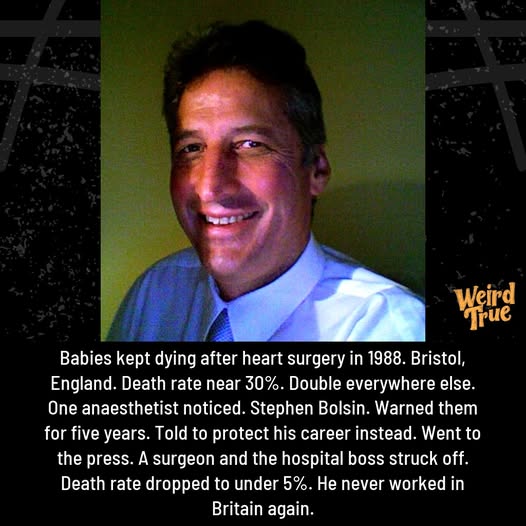
The babies were dying at triple the normal rate. One man noticed. They told him to shut up and protect his career.
His name is Stephen Bolsin. An anaesthetist — the person who keeps you alive on the operating table. In 1988 he took a job at the Bristol Royal Infirmary, a big, famous hospital with a children’s heart unit. The villains in this story are the men who ran it: senior surgeon and medical director James Wisheart, and chief executive John Roylance. Hold those two names. They matter at the end.
The unit operated on babies — tiny hearts with holes in them, defects that kill without surgery and are survivable with it. Simple math. Most of these children should have lived.
They didn’t.
Bolsin had worked heart surgery in London. The numbers there were nothing like this. At Bristol, for the youngest babies, the death rate ran close to 30%. Almost one in three. Dead on the table or soon after — at nearly double the national rate.
So he did the one thing nobody else was doing. He kept records. Quietly. Tracked who died. Compared Bristol to everywhere else. The data was clear: something was very wrong in that unit.
In 1990 he warned the chief executive, Roylance. He got a dismissive phone call. Then he was hauled into Wisheart’s office — one of the very surgeons doing the operations — and told, in so many words, that this was not how to “progress your career in Bristol.” Translation: shut up, or you’re finished.
He didn’t shut up. He took the numbers higher — to the NHS, the Department of Health, the Royal Colleges. The people whose entire job was to protect patients.
They ignored him. For years.
Why? Money. The unit’s status as a “specialist centre” came with funding and prestige. Admit the babies were dying too often, and they’d lose the designation, lose the cash, look incompetent. So nobody checked the surgeons’ results. Nobody was allowed to. The operations continued. The babies kept dying.
Now stop and sit with this part, because it’s about you. Before Bristol, no one in Britain monitored how individual surgeons actually performed. Your surgeon. Your child’s surgeon. There was no scoreboard. No one was counting. You walked into a hospital and simply trusted that the man with the knife was good at it — and if he wasn’t, the system was built to hide it, not catch it.
For five years Bolsin watched children die. Five years of warnings. Five years of being told to be quiet.
In 1995 it broke. A boy named Joshua Loveday was booked for a complex heart operation. Bolsin and others said the risk was too high. Don’t do it. Surgeon Janardan Dhasmana operated anyway. The child died.
That was the end. The program was suspended, and Bolsin took everything to the press — the records, the death rates, the years of being ignored. It became one of the biggest scandals in NHS history.
A massive public inquiry followed under Professor Ian Kennedy. Twelve thousand pages. Almost 200 recommendations. The verdict was brutal: a unit “simply not up to the task,” with “an old boy’s culture,” secrecy about how doctors performed, and nobody watching the results. The official count — between 1991 and 1995, 30 to 35 more babies under one died at Bristol than would have at a normal unit. Dead children who would have lived almost anywhere else. The families’ own lawyer believes the true toll across the full decade was closer to 170.
In 1998 the General Medical Council ruled. James Wisheart — struck off. John Roylance — struck off. Careers over. Dhasmana banned from operating on children. The men who told Bolsin to be quiet, finished.
And the unit transformed. With real oversight and real surgeons, Bristol’s children’s heart death rate crashed from nearly 30% to under 5%. One in three, down to one in twenty. Hundreds of children who would have died now lived.
Then it changed everything. The scandal created “clinical governance” — the rule that hospitals must track results, monitor surgeons, and publish their data. Surgeons across Britain began publishing their own outcomes so this could never be buried again. That scoreboard that didn’t exist before? It exists now. One quiet anaesthetist forced an entire health system to start policing itself. If you have surgery in Britain today, your surgeon is being watched because of this man.
So how did Britain thank him?
It ran him out.
He applied for jobs. Doors slammed. Nobody in the NHS wanted the man who proved the system protected itself before it protected patients. He couldn’t find work anywhere in his own country. So he packed up his family and left for Australia — Geelong, near Melbourne — and never worked as a doctor in Britain again. Australia built him a world-class anaesthesia service and gave him professorships. In 2025 it pinned the Medal of the Order of Australia on him. The country that didn’t raise him valued him more than the one that did.
Here’s the part that should make you furious. Bolsin says it’s still happening. That the NHS still punishes the people who speak up. That honest staff still can’t report danger without fear for their jobs. The wall of silence he tore a hole in? He says it’s still standing — which means somewhere, in some unit, the next person who notices the bodies piling up is being told the exact same thing he was: shut up, or you’re finished.
He saved the smallest, most helpless patients in an entire country. And that country’s first instinct was to silence him, and its second was to exile him.
The men who let the babies die were British heroes until a stranger started counting.
Tag the person you know who would have kept counting anyway.