
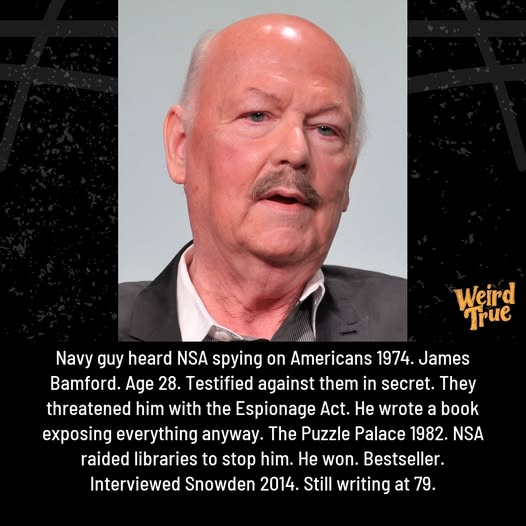
James Bamford was 28 years old when he put on a pair of headphones and heard a crime.
1974. A Navy listening post in Sabana Seca, Puerto Rico. A two-week reservist placement. Routine. Then he heard the operator monitoring the line. American voices. The NSA was spying on American citizens. That was illegal.
He could have unheard it. Law degree almost finished. Safe life waiting. He didn’t.
1975. The Church Committee opens Senate hearings on intelligence abuses. The NSA testifies under oath. Says they stopped intercepting US citizens 18 months ago. Says it’s over. Says trust us.
Bamford knew they were lying. He’d heard it himself. Months earlier. With his own ears.
He called Senator Church’s office. Said the NSA is lying and I can prove it. They brought him into a closed hearing. Church’s private office. He told them what he heard, where, and when. His testimony helped build the case that created the FISA law in 1978 — the law that required a warrant before the government could spy on you.
Then he filed a FOIA request and asked the NSA for everything.
A year later hundreds of declassified pages landed on his desk. And the names of secret programs came with them.
Operation Shamrock. From 1945 to 1975, the NSA secretly copied every international telegram going in or out of the United States. Thirty years. Millions of private messages. Western Union, ITT, and RCA all handed them over. Zero warrants.
Project Minaret. Watch lists of American citizens. Civil rights leaders. Antiwar protesters. Martin Luther King Jr. Jane Fonda. Senator Frank Church himself was on a list — the very senator investigating them.
Bamford decided to write a book. He’d never written anything but legal briefs. Didn’t matter.
1981. Reagan takes office and the Justice Department switches sides. They come after Bamford. Demand the documents back. Say they’ve been reclassified — top secret now. Threaten him with the Espionage Act. Decades in federal prison.
He refused. He’d gotten them declassified, legally. He walked out of a meeting with NSA officials and his own lawyer and just kept the documents.
Reagan signed a new executive order so reclassified documents could be pulled back. The Constitution stopped him — you can’t make something illegal after it already happened. Bamford kept every page.
1982. The Puzzle Palace hits shelves. The first major book ever written about the NSA. National bestseller. The New York Times said he’d uncovered everything except the combination to the director’s safe.
The NSA still wasn’t done. Agents walked into a private library in Virginia, reclassified papers Bamford had used, and physically removed them from the shelves. The American Library Association sued. That’s how far they’d go to bury one man.
Here’s the part that should make you laugh and then make you furious.
In 2001 he wrote a second NSA exposé. Another bestseller. And the agency that tried to throw him in prison invited him to its Fort Meade headquarters — and sold his book in their gift shop.
Then 2005. President Bush admits to warrantless wiretaps on Americans after 9/11. No warrants. No FISA court. The exact thing Bamford’s testimony built the law to prevent. He joined the ACLU and sued the NSA as a plaintiff.
2013. Edward Snowden leaks the files. Mass surveillance of Americans, on a scale beyond Shamrock — exactly what Bamford had been screaming about for almost 40 years. In 2014 he flew to Moscow and sat with Snowden for three days. The longest interview Snowden has ever given anyone.
And it never stopped. The surveillance machine he exposed in 1974 is bigger now than it has ever been. Your calls. Your texts. Your searches. They built the infrastructure to watch everyone, and one Navy reservist saw it coming half a century before the rest of us did.
He’s 79. Lives in Washington DC. Still investigating. Still publishing — his latest book dropped in 2023. Still fighting an agency with a $10 billion budget and 40,000 employees.
Four presidents tried to silence him. They threatened him with prison. They raided libraries. They reclassified his evidence.
He’s still here. Still writing. Still warning you.