
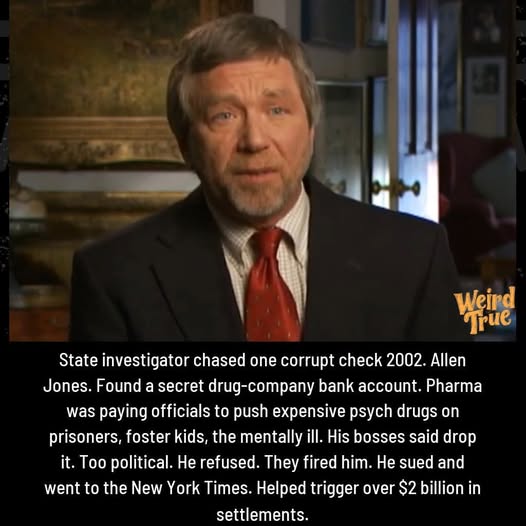
Johnson & Johnson the company whose baby shampoo is in your bathroom ran a secret bank account to bribe state officials into drugging prisoners, foster kids, and psychiatric patients with its most expensive pills. One man found the account. His name is Allen Jones. He was a state fraud investigator, and they fired him for refusing to look away.
2002. Pennsylvania. Jones gets handed a case that looks like paperwork.
The state’s chief pharmacist, Steve Fiorello, is taking checks from drug companies. In Pennsylvania that’s illegal. Small, contained, boring.
Jones starts pulling the thread.
The checks come from Johnson & Johnson and its subsidiary Janssen. The maker of an antipsychotic called Risperdal. On paper the money is “travel and speaking fees.” But state employees can’t keep that money. So it’s sitting in an unregistered, off-the-books account.
Then Jones follows the money out of the account.
It’s flowing to an official in another state entirely. The director of the Texas Department of Mental Health.
A hidden account. Funded by a drug company. Wiring money to officials across state lines.
He’d walked into something with a name. TMAP. The Texas Medication Algorithm Project.
It looked like neutral science. Official state guidelines telling doctors which drugs to prescribe for depression, bipolar disorder, schizophrenia. It carried the authority of the government.
But it steered doctors to one specific group of drugs. The newest antipsychotics. The ones that cost up to ten times more than the older medicines they replaced.
And the older drugs weren’t worse. A government-funded study later found the expensive new drugs were no better at treating schizophrenia than the cheap, off-patent ones.
So TMAP wasn’t medical science. It was a marketing program wearing a lab coat. The drug companies helped fund the guidelines. The guidelines recommended the drug companies’ priciest products. And the officials who pushed it were allegedly getting trips, perks, and money in hidden accounts.
Now ask who was on the other end of those prescriptions.
People in state mental hospitals. People in prison cells. Foster children who are wards of the state. People who don’t pick their own medication and cannot say no. The exact people Jones had spent his career around. Now he could see the money behind their pills.
So he took it to his bosses. Corruption was his whole job.
They told him to drop it. Too political. One manager said it plainly: drug companies write checks to politicians. Both parties.
When Jones refused, they pulled him off the case. Banned him from investigating. Buried him in menial work. Bury it, or be buried.
Then he learned the worst part. TMAP wasn’t staying in Texas. Pennsylvania was about to adopt its own version and switch patients onto the expensive drugs regardless of what they actually needed.
Jones made his choice.
He filed a First Amendment lawsuit to protect his right to speak. Then he took everything to the New York Times.
Pennsylvania fired him for it.
He lost his career for doing his job. But the truth was already out, and it could not be put back.
His story went national. The federal government’s own mental-health agency announced it no longer endorsed TMAP. The corrupt program was abandoned.
Then came the bill.
The Texas Attorney General used Jones’s documents to build a case against Johnson & Johnson. In 2011, Texas settled for $158 million. Other states filed and settled too. And it kept widening — until the U.S. Department of Justice resolved the Risperdal cases against J&J and Janssen for more than two billion dollars.
In 2012, Allen Jones was named Whistleblower of the Year.
And understand what this really was. This is how drug-company money quietly shapes the official guidelines your own doctor is told to follow. It started with the people who couldn’t fight back. But the system that decides which pills get pushed touches everyone.
The people he protected will mostly never know his name. The prisoners. The foster kids. The voiceless, drugged for someone else’s profit. He fought for them anyway.
One investigator followed one check. He exposed how Big Pharma bought its way into state medicine. They fired him for telling the truth.
He brought the whole scheme down.
And he’s still out there demanding accountability today.