
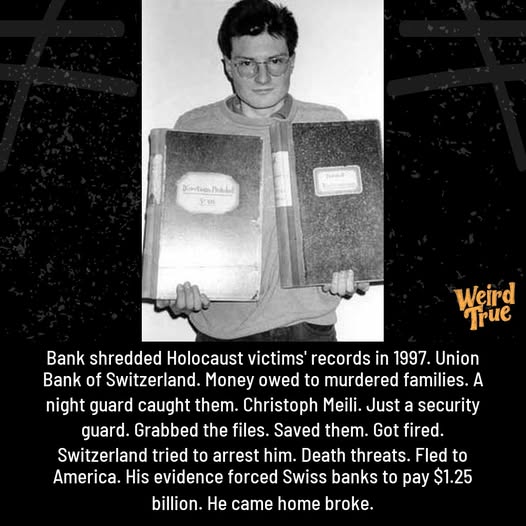
(Tom: This is what integrity look like. Extreme integrity.
It also illustrates how international bankers are on par with big pharma and second only to psychiatrists on the list of evil doers.)
A night security guard caught the richest bank in Switzerland shredding the proof that murdered Holocaust families were owed their money. He was nobody. Union Bank of Switzerland was one of the most powerful banks on Earth. He took the files anyway. And it cost him everything.
His name is Christoph Meili. January 8, 1997. Zurich. He was 28. A night guard for an outside firm, walking empty halls at UBS. Steady paycheck. Nothing special.
On his rounds he passed the shredding room and saw two huge bins of documents waiting to be destroyed. He looked closer. The papers were old. German names. Account records. Property lists from the 1930s and 40s.
Then it hit him. These were Holocaust records.
In 1997 the whole world was asking one question. What happened to the fortunes Jewish families hid in Swiss banks before the Nazis murdered them? Survivors’ children had come looking for decades. The banks said the same thing every time. Sorry. No records. Can’t help you.
And Christoph was standing over those exact records. Going into a shredder.
Here’s what made it a crime. Switzerland had banned the destruction of these documents just weeks earlier. The bank was feeding them to the shredder anyway.
Christoph had watched Schindler’s List. The story of one ordinary man who acted when everyone else looked away. He thought about that movie standing in that room.
Then he made his choice.
He grabbed the ledgers. Stuffed them under his coat. And walked the evidence out of one of the most powerful banks in the world.
He handed them to a Jewish organization in Zurich. They took them to the police. Then to the press. January 14, 1997. The story detonated across the planet. A Swiss bank caught shredding Holocaust victims’ records.
UBS fired him that same day.
Then his own country came after him. Not the bank. Him. In Switzerland, handing bank papers to outsiders breaks banking secrecy. It’s a crime. Prosecutors opened a case. They wanted to arrest the guard who saved the proof.
Let that sink in. The man who ordered the shredding kept his job. The man who stopped it was facing prison.
Then came the death threats. Phone calls. Letters. People who wanted him dead. His wife was terrified. His kids weren’t safe. His own country had turned on him.
So Christoph did something no Swiss citizen had ever done. He fled Switzerland. And begged America for asylum.
The US Senate took up his case. A senator stood up and called him a hero — and pointed out that the official who ordered the shredding still had his job while the guard who stopped it was being hunted. In 1997 Congress passed a special law to take him in. He is believed to be the only Swiss national ever granted political asylum in America.
A Swiss man. Fleeing Switzerland. To be safe.
His evidence changed everything. It proved the banks had been lying. It turned the Swiss banking giants into global villains overnight.
August 1998. They broke. The Swiss banks agreed to pay $1.25 billion to Holocaust survivors and their families. The largest settlement of its kind. Money that should have reached those families fifty years earlier — finally moving. Because one night guard refused to feed the proof into a shredder.
Christoph was owed $750,000 of that settlement. A reward for what he did.
He barely saw it. The money crawled. One lawyer handling Holocaust funds was later disbarred for stealing from survivors. The people who once called him a hero stopped calling. He started over in California. Went to college in his 30s. Became a US citizen. And quietly slid into minimum-wage work, an ocean from home. His marriage didn’t survive it.
In 2009 he went home to Switzerland. Broke. Every cent of the reward gone. And his country still couldn’t decide what he was. Hero? Or traitor?
Now look at where everyone ended up.
The families got their billion. Good. But the bank that shredded the evidence? UBS is still standing. Bigger than ever — today it’s the giant that swallowed Credit Suisse, one of the most powerful banks on the planet. The official who ordered the shredding kept his job. And the night guard who risked everything to stop them came home with nothing.
So ask yourself one thing. You’re alone in that room at 2 AM. Steady job. Two kids asleep at home. A shredder full of stolen history in front of you. Do you walk away? Or do you pick up the files?
Christoph picked up the files. He lost his job, his country, his savings, and his marriage for it. Years later a documentary crew asked if he regretted it.
He said four words.
“I would do it again.”
Christoph Meili. The night guard who beat the richest banks in the world — and the world let him go broke.