
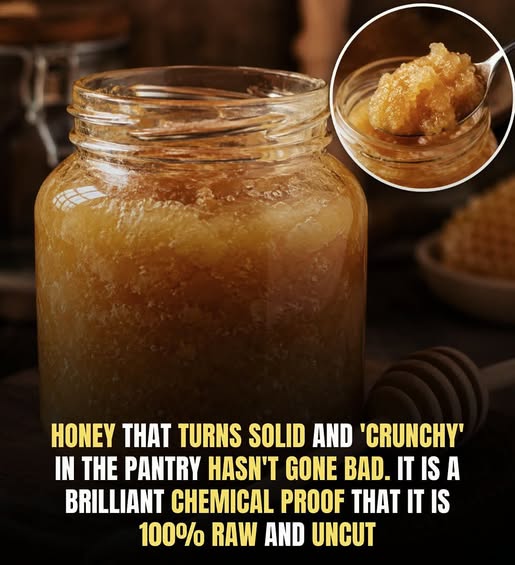
When Honey turns thick, grainy, or completely crystallized in the pantry, many people assume it has spoiled.
In reality, crystallization is usually a completely natural process — especially in raw or minimally processed honey.
Honey contains different natural sugars, mainly fructose and glucose. Over time, glucose tends to separate from the water inside the honey and form tiny crystals. Those crystals gradually spread through the jar, causing the honey to become cloudy, thick, or solid.
Tiny particles naturally present in raw honey — including pollen, air bubbles, wax fragments, and minerals — can act as starting points that help crystals form more easily.
This means crystallization often occurs faster in less processed honey.
However, the idea that all clear, runny honey is fake or mixed with corn syrup is an exaggeration.
Several factors affect crystallization speed, including:
flower source
glucose-to-fructose ratio
storage temperature
filtration level
moisture content
Some genuine honeys naturally stay liquid much longer than others.
Commercial processing and filtering can slow crystallization because removing particles reduces crystal formation sites, and gentle heating dissolves existing crystals. But that alone does not automatically mean the honey is artificial or low quality.
Importantly, crystallized honey is usually still perfectly safe to eat.
If someone prefers liquid honey again, placing the jar in warm water can slowly dissolve the crystals without damaging the honey significantly.
Food scientists generally view crystallization as a normal physical change rather than spoilage — one of the many natural behaviors of real honey over time.