
Most early-season tomato problems aren’t caused by the soil. They’re caused by misreading what the plant is telling you.
A purple leaf gets treated with phosphorus. A yellow leaf gets treated with nitrogen. But in both cases, the plant is often reacting to temperature or its own growth pattern — not a deficiency. Reaching for fertilizer before diagnosing the cause can make things worse.
Three signals that fool people every spring:
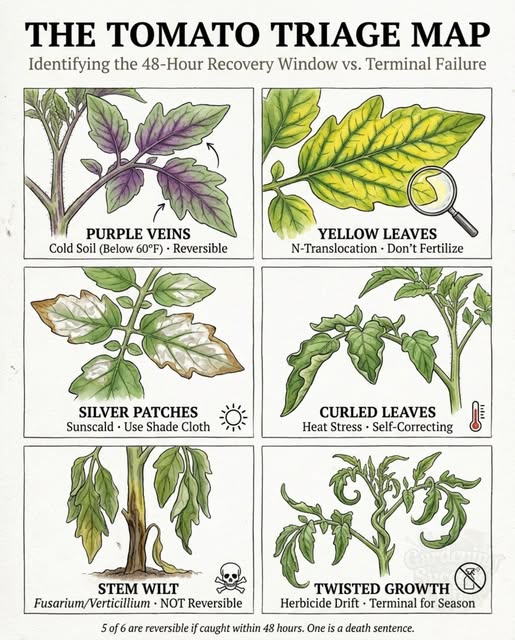
– Purple undersides on young leaves — almost always a temperature response, not a soil deficiency. When the soil is still cool in early spring, the roots can’t absorb phosphorus efficiently even when it’s there. Adding more fertilizer doesn’t help. Warming the soil does — black plastic mulch or a few more weeks of spring sun solves it on its own.
– Yellow lower leaves with green veins — the plant is often moving stored nutrients from its oldest leaves to feed new growth at the top. This is normal internal redistribution, not a nitrogen shortage. Adding nitrogen at this point pushes leaf growth at the expense of fruit set.
– A stem that turns brown or yellow at the base while the whole plant wilts — this one is different. Soil-borne fungal diseases like fusarium and verticillium can’t be treated once symptoms show. Remove the plant, don’t compost it, and avoid planting tomatoes in that spot next year.
Before you reach for anything:
– Check soil temperature first. If it’s still cool, most early-season leaf discoloration resolves on its own as the ground warms.
– Wait a week before adding any amendment. Many early symptoms are the plant adjusting, not the plant failing.
– If the problem is at the base of the stem and spreading upward, that’s when to act fast — remove the plant to protect the rest of the bed.
The best early-season intervention is usually patience. The plant is adjusting, not dying.