
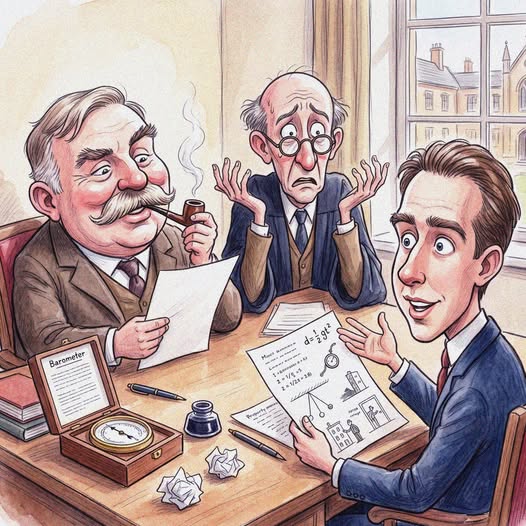
A university professor once turned to Sir Ernest Rutherford, President of the Royal Academy and Nobel Laureate in Physics, for urgent advice. He was about to give a student a failing grade—an F—on a physics exam, while the student stubbornly argued he deserved a perfect A. Both the professor and the student agreed to rely on the judgment of an unbiased third party, and they chose Rutherford. The exam question read: “Explain how you can measure the height of a building using a barometer.”
The student’s answer was bold: “You take the barometer up to the roof of the building, tie a long rope to it, lower it all the way to the ground, then pull it back up and measure the length of the rope. That length will be the exact height of the building.”
It was a bizarrely tough case for an arbitrator because the answer was undeniably complete and accurate! On the other hand, this was a physics exam, and the response had virtually nothing to do with applying knowledge of the field. Rutherford offered the student another shot. Giving him six minutes to prepare, he warned him that his next answer must explicitly demonstrate an understanding of physical laws.
Five minutes passed, and the student hadn’t written a single word on his exam sheet. Rutherford asked him if he was giving up, but the young man confidently replied that he actually had several solutions to the problem—he was just trying to choose the best one. Intrigued, Rutherford told him to go ahead without waiting for the timer to run out.
The new answer read: “Take the barometer to the roof, drop it over the edge, and time its fall with a stopwatch. Then, using the free-fall formula calculate the building’s height.”
At this point, Rutherford looked at his colleague. The professor finally threw up his hands, admitting the answer was satisfactory. However, since the student had mentioned knowing other methods, he was asked to share them.
“Well,” the student began, “there are plenty of ways to use a barometer to measure a building. For instance, you could go outside on a sunny day, measure the height of the barometer and the length of its shadow, and then measure the building’s shadow. By setting up a simple ratio, you get the building’s height.”
“Not bad,” Rutherford said. “Any others?”
“Yes. There’s a very basic one that I’m sure you’ll love. You just take the barometer and walk up the stairs, marking the wall in ’barometer-lengths’ as you go. Count the marks, multiply by the size of the instrument, and you have the height of the building. Pretty obvious.”
“If you want something more sophisticated,” the young man continued, “you could tie a string to the barometer, swing it like a pendulum, and calculate the value of gravity at the base of the building and then on the roof. From the difference in g, you can mathematically deduce the height. Or, using that same pendulum on the roof, you could calculate the height based on its precession period.”
“Finally,” he concluded, “out of the dozens of ways to tackle this, the absolute best method is to take the barometer to the basement, knock on the property manager’s door, and say: ’Mr. Manager, I have a magnificent, top-tier barometer right here. It’s yours if you just tell me the height of this building.’”
At this point, Rutherford asked the student if he truly didn’t know the conventional, textbook solution to the problem (using the difference in atmospheric pressure at the bottom and the top).
The student admitted that he knew it perfectly well. But he added that he was just sick and tired of high school and college, where instructors constantly force students into a rigid, copy-paste way of thinking.
That student was Niels Bohr (1885–1962), the legendary Danish physicist who went on to win the Nobel Prize in 1922.