
In 1998, Joel and Ethan Coen finished writing a script that no studio fully understood how to sell.
The lead character was a shuffling, bowling-obsessed, White Russian-drinking Los Angeles slacker known simply as “The Dude.” He was not a traditional movie hero. He was not polished or ambitious or conventionally handsome. He barely cared about solving the mystery he had been pulled into. He just wanted his rug back because, as he put it with complete sincerity, it really tied the room together.
The Coens had based him on 2 real people. The 1st was Jeff Dowd — a film producer who actually went by the nickname “The Dude,” drove a Chrysler LeBaron, and had a particular fondness for White Russians. The 2nd was Peter Exline, a Vietnam veteran whose messy apartment and memorable real-life misadventures — including tracking down a car thief using homework left in the back seat — became the raw material for several of the film’s most memorable scenes.
Now they needed an actor who could make this unusual character feel true without making him seem like a joke.
For the role of the older, wealthy Jeffrey Lebowski — the so-called Big Lebowski — they tried everyone. Robert Duvall turned it down because he did not like the script. Gene Hackman was taking a break from acting. Anthony Hopkins did not want to play an American. The list expanded to include Norman Mailer, Gore Vidal, George C. Scott, Andy Griffith, and Ernest Borgnine. Their dream choice was Marlon Brando, who was by then in poor health and unavailable. The role eventually went to David Huddleston, who was extraordinary in it.
For the Dude himself, there was really only 1 name that felt right from the beginning. Jeff Bridges.
When Bridges read the script, he laughed out loud. He later told The Hollywood Reporter that his first impression was of a great script unlike anything he had done before. He said he thought the Coen brothers must have spied on him during his high school years in California.
That was the first clue about what would make his performance so alive. Bridges did not have to act like a laid-back California dreamer. He already was one, in the best possible way. He was relaxed, philosophical, and deeply familiar with the rhythm of that kind of life from his own younger years. Much of what the Dude wears in the film came from Bridges’s own closet.
But here is the detail that still surprises most people.
Jeff Bridges was completely sober during the entire production.
Even though the Dude famously smokes marijuana throughout the film, Bridges did not. “While it seems very improvisational, it’s all scripted,” he told Yahoo Entertainment. “It was all done exactly as written. If you add an extra ’man’ in a spot, it didn’t quite feel right. So I really wanted to have all my wits about me. I didn’t burn at all during that movie.”
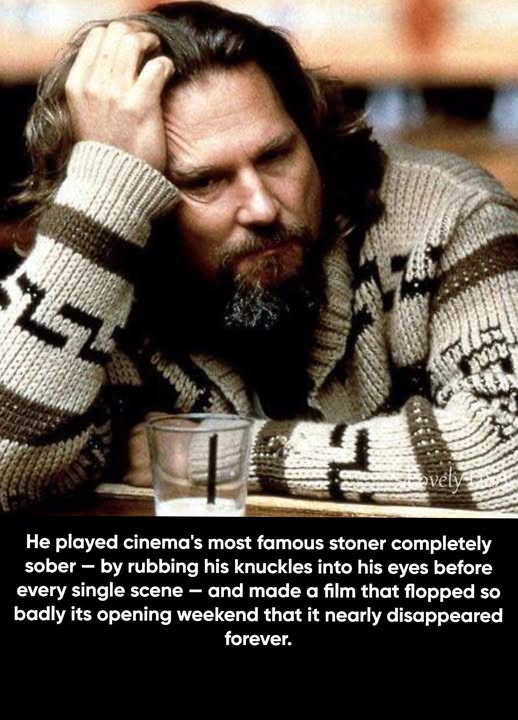
Instead, he developed a small ritual. Before every new scene, Bridges would walk over to Joel or Ethan Coen and ask 1 simple question: “Do you think the Dude burned one on the way over?” The directors would nod yes. Bridges would drift to the corner of the set, rub his knuckles into his eyes to make them bloodshot, and walk back ready to film.
That tiny, repeated moment was one of the only pieces of direction he ever asked for. Joel Coen later said it was essentially the full extent of what they needed to direct him. He showed up. He was, in every sense, already the Dude.
Bridges was also meticulous about the rhythm of the dialogue in a way that most audiences never notice. He has said he and John Goodman were deeply attentive to where every “man” and every pause landed — treating the script like a jazz piece where every note had to hit in exactly the right place. The word “man” appears an estimated 147 times in the finished film, nearly once and a half per minute. Every single one had to feel inevitable.
And then the movie came out.
And it flopped.
Released on March 6, 1998, The Big Lebowski opened to just over $5.5 million at the domestic box office. It was buried under U.S. Marshals, The Wedding Singer, and Titanic, which was still tearing up the charts 12 weeks into its release. Critics were dismissive, many comparing it unfavorably to Fargo, the Coens’ previous film. Julianne Moore, who played Maude, remembered reading the reviews the morning after the premiere in disbelief. “When I saw it, I was like, ’Oh my God, this is so funny.’ And then the next day all the reviews came out and they killed it,” she said. “And I was like, ’That seems weird. I loved it. I thought it was funny.’”
For a while, it looked like the Dude was going to drift quietly into forgotten cinema history.
Then, slowly, something extraordinary began to happen.
Midnight screenings filled. Home video rentals multiplied. The quotes started appearing in casual conversation — “The Dude abides,” “That rug really tied the room together,” “Yeah, well, that’s just, like, your opinion, man.” People began dressing as the Dude at conventions. Annual celebrations called Lebowski Fest were founded across multiple cities. An entire unofficial philosophy — Dudeism — emerged, inspired by the character’s unhurried, calm, deeply unbothered approach to a chaotic world.
The film that had been dismissed in 1998 became, gradually and irresistibly, one of the most beloved cult films in cinema history.
Bridges himself has described what drew him to the character with the kind of simplicity the Dude himself would have appreciated. “There’s an aspect of the Dude I aspired to. He’s authentic, isn’t he? He’s who he is, and that’s about it. He’s a lovely cat.”
That might be the real reason this strange, quiet film has outlasted so many bigger, louder blockbusters from its era. In a world that constantly rewards ambition, hustle, and the performance of success, the Dude reminded audiences that there is another way. Slower. Kinder. A little weirder. A little more honest about what actually matters.
Sometimes the characters who seem to care the least turn out to be the ones we remember the most.
And sometimes, a film that bombs on its opening weekend quietly becomes the 1 that refuses to go away.
The Dude abides.