
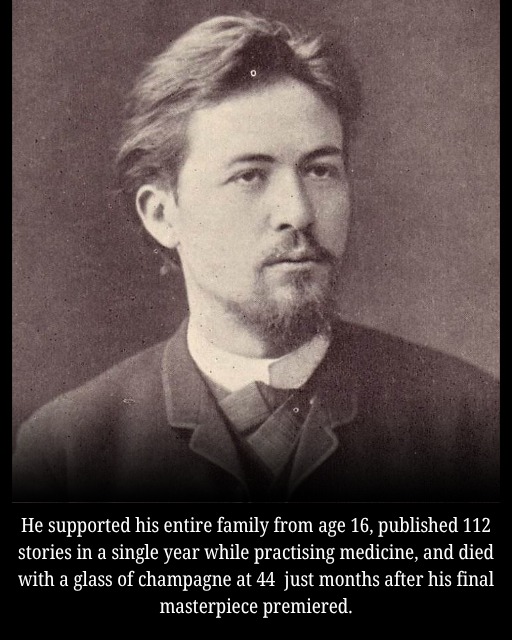
Shortly after midnight on July 15, 1904, in a hotel room in the German spa town of Badenweiler, a doctor arrived at the bedside of a dying man.
The doctor understood there was nothing left to do medically.
So he did something else.
He telephoned the hotel kitchen and ordered a bottle of the finest champagne.
When it arrived, he poured three glasses.
The dying man took a glass, said it had been a long time since he had tasted champagne, and drank it.
Then he set the glass down, rolled onto his side, and stopped breathing.
His name was Anton Chekhov.
He was forty-four years old.
And his death — quiet, precise, tinged with both beauty and sadness — was so perfectly Chekhovian that writers have been retelling it ever since.
Anton Pavlovich Chekhov was born on January 29, 1860, in Taganrog — a commercial port city on the Sea of Azov in southern Russia.
His grandfather had been a serf who bought his family’s freedom in 1841.
His father Pavel was a grocer and a religious fanatic with a violent temper who used his children as unpaid labour in the family shop.
Chekhov described his childhood in a single word: suffering.
He found his escape in language — in stories, in observations, in the details of ordinary life that most people walked past without noticing.
In 1876, his father’s business collapsed under debt.
To avoid arrest, Pavel fled to Moscow with most of the family.
Chekhov was sixteen.
He was left behind alone — to sell the remaining family possessions, finish his education, and find ways to survive.
He tutored younger students. He caught and sold goldfinches. He wrote humorous sketches for newspapers and sent every ruble he could spare to his family in Moscow, along with letters designed to make them laugh.
He was the head of the household at sixteen.
He would be for the rest of his life.
In 1879, he joined his family in Moscow and enrolled in medical school.
To pay tuition and support his parents and siblings, he wrote daily — short, comic sketches of contemporary Russian life, published under pen names like Antosha Chekhonte and Man Without Spleen, in the cheap humour magazines he read himself.
In 1886 alone, he published 112 stories.
One hundred and twelve stories in a single year, while practicing medicine, while supporting a family, while beginning to suspect what was growing in his lungs.
He said of those two vocations: medicine was his lawful wife and literature was his mistress.
He loved both.
By the late 1880s, something was shifting in his work.
The humorous sketches were giving way to something more searching — stories that did not resolve neatly, that ended in the middle of a feeling rather than the end of a plot.
He stopped explaining what his characters meant.
He started showing, instead, what they did.
His short story The Steppe (1888), a child’s slow journey across the Russian countryside, announced him as a writer of a different order — one who was interested not in dramatic events but in the texture of consciousness, the weight of unexpressed emotion, the things people cannot say to each other.
He wrote later that it was not the duty of a writer to solve problems, but to correctly state them.
In 1890, he did something nobody expected.
Frustrated by intellectual critics demanding he hold firmer political opinions, he simply left Moscow — and traveled nearly six thousand miles east, across Siberia by carriage and riverboat, to Sakhalin Island: a remote penal colony in the Russian Far East, notorious for its brutal conditions.
He arrived alone, conducted a census of the entire island population by himself, and spent three months investigating how human beings survived — or failed to — in conditions of almost total deprivation.
The research he published became a respected work of penology.
It was also a statement. He would go and look for himself, at the things that mattered, in the places other people refused to go.
His plays told a different story.
The Seagull — his third major play — premiered at the Alexandrinsky Theatre in St. Petersburg in 1896.
The audience hated it.
The critical reception was so brutal that Chekhov publicly renounced theatre and vowed never to write for the stage again.
Two years later, the Moscow Art Theatre revived the play under the direction of Konstantin Stanislavski.
This time, the response was rapturous.
The seagull became the Moscow Art Theatre’s official emblem — where it has remained ever since.
What followed was the most concentrated outpouring of theatrical genius in modern Russian history.
Uncle Vanya. Three Sisters. The Cherry Orchard.
Four plays, all produced by the Moscow Art Theatre, all exploring the same terrain: people trapped in lives they did not choose, longing for futures that will not arrive, speaking past each other in conversations that never quite reach what needs to be said.
He called them comedies.
His directors staged them as tragedies.
He was never entirely happy with the performances.
During all of this, he had been living with a secret.
As early as 1884, after graduating from medical school, he had begun coughing up blood.
He recognised what it meant.
He told no one in his family.
They were counting on him.
In 1897, a major lung haemorrhage in Moscow made concealment impossible. Doctors confirmed advanced tuberculosis and ordered him to change his way of life.
He moved to Yalta, where the warmer climate was supposed to help.
Tolstoy visited him there. Maxim Gorky visited.
He planted trees and kept tame cranes and wrote letters home assuring everyone he was getting better.
He was not getting better.
He married the actress Olga Knipper in 1901 — the lead actress of the Moscow Art Theatre who had starred in his plays.
By mutual agreement, they spent much of their marriage apart: she in Moscow for the theatre, he in Yalta for his health.
They wrote each other hundreds of letters.
The Cherry Orchard — his last play — was completed in 1903 under great difficulty, and premiered in January 1904.
Six months later, he and Olga traveled to Badenweiler, Germany, hoping the spa air might help.
He wrote cheerful letters home about the food and the weather.
His last letter complained about how German women dressed.
On the night of July 14th, Chekhov became delirious — apparently hallucinating about a journey to Japan.
His wife sent for the doctor.
When Dr. Schwöhrer arrived and understood the situation, he did not reach for another medical instrument.
He ordered champagne.
Chekhov took a glass.
Said it had been a long time.
Drank it. Set it down. Turned onto his side.
The doctor said: It’s over.
His wife later wrote of that moment that there were no human voices and no everyday sounds. There was only beauty, peace, and the grandeur of death.
Chekhov’s body needed to be transported back to Moscow.
In the summer heat, the coffin was loaded onto a freight car — one normally used for transporting oysters.
Mourners waiting at the Moscow station were startled and offended.
Maxim Gorky called it an outrage.
Others recognised it as something else entirely: a scene that Chekhov himself might have written, with its mix of the absurd and the sorrowful, its refusal to let death be simply solemn.
He was buried at Novodevichy Cemetery in Moscow.
He influenced nearly every major short story writer of the twentieth century — James Joyce, Ernest Hemingway, Raymond Carver, Tennessee Williams.
He changed what the theatre believed it was allowed to do.
He showed that a story could end without resolution, that a play could proceed without a plot, that the most important things in human life were the things people almost said to each other.
He was a doctor who wrote.
Or a writer who doctored.
He never quite decided which.
Medicine was the lawful wife.
Literature was the mistress.
He died at forty-four, having just drunk champagne in a German hotel room, with a moth banging against the electric lamp and his wife beside him.
The perfect ending for a man who understood that life’s most important moments rarely announce themselves.