
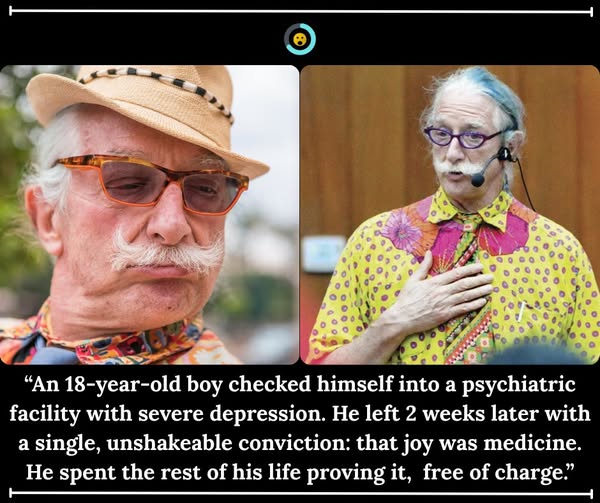
His name was Hunter Doherty Adams. The world came to know him as Patch.
He was born on May 28, 1945, in Washington, D.C. As a teenager, the darkness in his mind became so severe that he voluntarily committed himself for treatment. He was 18. He stayed for 2 weeks.
What happened in those 2 weeks changed the entire direction of his life.
He watches the other patients. He sees loneliness doing as much damage as any illness. He sees how 1 act of genuine human warmth can change the temperature of a room. He sees that nobody in the building is treating any of that.
He makes a decision. He will become a doctor – but not the kind who hides behind clinical distance. A different kind entirely.
He walks out and starts building the life that will prove his point.
1971. Northern Virginia.
Patch graduates from the Medical College of Virginia and moves immediately. He gathers 20 friends, including 3 fellow doctors, and opens a 6-bedroom house to anyone who needs medical care.
No receptionist. No billing department. No insurance forms. No payment of any kind.
The 6-bedroom home in Northern Virginia becomes a fully functioning communal hospital. Patch and his team live directly alongside their patients – cooking together, sharing meals, sharing space. The line between doctor and patient is deliberately and radically erased.
To keep it alive, Patch and another Gesundheit physician moonlight in hospital emergency rooms at night and donate their entire salaries back into the free clinic. Other friends take outside work and do the same.
Here’s what makes it worse, the medical establishment is not impressed.
Treating patients without billing violates every professional norm of the era. The idea that a doctor’s personality, humor, and emotional presence could be as therapeutic as a prescription is dismissed as unscientific and naive. Patch is written off. He is told that what he is doing is not real medicine and cannot last.
He tells them, “The most revolutionary act one can commit in our world is to be happy.”
Then he puts on a clown suit and keeps going.
1971–1983. 12 years. 15,000 patients. Zero bills.
More than 15,000 people receive care at the Gesundheit Institute, completely free. No payment. No malpractice insurance. No formal facilities at all.
Patch rides a unicycle. He juggles. He arrives at hospital bedsides in full clown regalia. He rolls down hills with disturbed patients. He deploys every instrument of human joy he can find – and then performs rigorous, genuine medicine alongside it.
He calls it his “pilot project.” A proof of concept, that a medical practice built on community, humor, and radical generosity can actually work.
In 1981, the Gesundheit Institute purchases 321 acres in Pocahontas County, West Virginia, using donated funds. The dream is a full-scale free hospital, open to anyone in the world.
The medical establishment is still skeptical. The 15,000 patients who received free care are not.
In 1998, Robin Williams portrays Patch Adams in a major Hollywood film that carries his story to audiences across the world.
Patch Adams keeps going. Still traveling. Still wearing the clown suit. Still preaching the conviction he formed alone in a psychiatric ward at age 18 – that a doctor who withholds joy, warmth, and genuine human presence from their patients is practicing medicine with only half the tools available.
He has never sent a bill.
Share this with someone who needs to be reminded that the most powerful medicine in the world is also the simplest, feeling like someone truly gives a damn about you.