
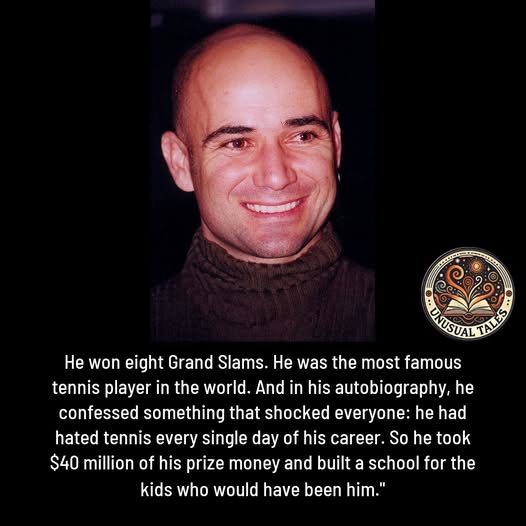
In 1970, in a small house in Las Vegas, a former Olympic boxer named Mike Agassi hung a tennis ball from the ceiling above his newborn son’s crib.
He had immigrated from Iran in 1952 with nothing. He had worked as a casino waiter. He had decided, long before his fourth child was born, that this boy was going to be a tennis champion. He had run the numbers. He had read every article he could find about how the great players of the day had been raised. He had concluded that the difference came down to repetition, and repetition came down to starting young.
His son’s name was Andre Kirk Agassi.
He was four days old when the tennis ball began swinging over his crib.
By the time Andre was three years old, his father had built a backyard practice court behind the family home, complete with a custom ball machine Mike had modified himself to fire balls at higher speed than any commercial model could produce. He called it the Dragon. He aimed it at his small son and turned it on. Andre had to hit the balls back or be hit by them.
By the time he was seven, Andre was hitting more than 2,500 tennis balls a day. Every day. His father had calculated that if his son hit one million tennis balls in a year, he would be unbeatable. He pinned the math to the kitchen wall like a target.
Andre hated it.
He hated it the way only a child who has no other option can hate something — completely, secretly, every minute of every day, while saying nothing about it because there was nobody to say anything to. His father did not tolerate complaint. His mother was kind but powerless. His older brother and sisters were on the same path. By age thirteen, Andre had been sent to a tennis academy in Florida where the discipline was even more severe than at home. He attended a school for eight months a year that was, in his own words, more like a prison than a school.
He turned professional at sixteen.
By the time he was twenty-two, he was one of the most famous athletes on Earth. He won Wimbledon in 1992 in his first appearance at the tournament. He grew his hair long, dyed it blond, wore neon clothing, and became the face of tennis for a generation. He dated Brooke Shields. He married her. He divorced her. He won the U.S. Open. He won the Australian Open. He won the French Open. He became one of only eight men in tennis history to win the career Grand Slam.
He hated every minute of it.
He did not tell anyone. He did not tell his coach. He did not tell his agents. He did not tell his wives. He did not tell the millions of fans who screamed his name from packed stadiums on five continents. He won tournaments while privately wishing he could walk off the court and never come back.
In 2009, three years after he retired, he published a memoir called Open.
It was the most honest book a famous athlete had ever written about his own sport. He admitted, in the very first chapter, that he had hated tennis his entire life. He admitted that the hair he had become famous for had been a wig in the early years, and that he had once lost a French Open final because his wig was falling apart and he was terrified the world would see. He admitted he had used crystal methamphetamine in 1997 and had lied about it to the tour’s drug testers, who had quietly let it go. He admitted everything.
The book was a worldwide bestseller.
The most striking thing about it, the thing nobody could quite put down, was the way he wrote about his father. He did not condemn him. He understood that Mike Agassi had given him everything Mike had never been given. He understood that his father had loved him in the only way he knew how. He simply told the truth about what it had cost.
He also wrote, in the last third of the book, about something he had begun doing in the middle of his career that almost nobody had paid attention to.
In 1994, when he was twenty-four years old, Andre Agassi had started a foundation in Las Vegas to help children in poverty. He had run it for seven years out of an office above a hair salon. In 2001, he had taken eight million dollars of his own prize money and used it to open a school.
He called it the Andre Agassi College Preparatory Academy.
It was a tuition-free charter school in one of the poorest neighborhoods in Las Vegas, on the western side of the city where the violent crime rate was nearly four times the national average, in a zip code where only seventeen percent of high school students had been graduating before the school opened. He built it for children whose parents could not read. For children whose fathers had vanished. For children, in other words, who had nothing in common with him except that they had been born into circumstances they had not chosen.
The school was a longer school day than any in the district. Eight hours of instruction. Mandatory study halls. Mandatory uniforms. He hired teachers personally. He sat in on classes. He attended every graduation.
The first graduating class produced twelve seniors. Every one of them was accepted to college.
By 2024, the school he had built had sent over twelve hundred first-generation students to higher education. Ninety-eight percent of its graduates have been accepted to college. Most of them are the first members of their families ever to attend.
The total he has personally donated to the school and to related education projects is now over forty million dollars. He has spent the better part of three decades — almost as long as his tennis career — quietly raising more money for it, lobbying for more charter schools, expanding the model into Turner-Agassi Charter School Facilities Fund, which has now financed over a hundred and twenty schools nationwide serving over sixty thousand additional kids.
He has been asked many times why he did it.
He has given variations of the same answer.
“My whole life,” he said in one interview, “I felt like I had no choice. I just wanted to give some kids a choice.”
He is fifty-five years old now. He has been married for over twenty-three years to Steffi Graf, the German tennis champion he had quietly fallen in love with at the end of his playing days. They have two children together, a son and a daughter. Neither of them plays tennis. Andre has said publicly, many times, that this was a deliberate choice. He and Steffi told their kids they could do anything they wanted with their lives, as long as it was their decision.
His son Jaden became a professional baseball player. His daughter Jaz is a dancer.
Mike Agassi died in 2021. He was ninety years old. Andre was with him at the end. They had reconciled, in the slow careful way fathers and sons sometimes do, in the years after the book came out. Mike had read every word of Open. He had not been angry. He had been, his son said later, a little sad. He had told Andre, near the end, that if he had it to do over again he might have done some things differently. Andre told him that the school in Las Vegas was the only reason any of it had been worth it. Mike Agassi cried.
There is a thing Andre has said in interviews that almost nobody quotes.
He has said: my father gave me the wrong gift, but he gave it to me his whole life, with everything he had.
Then he turned it into the right one.
The kids at the Andre Agassi Academy in west Las Vegas are graduating this year. Most of them have never picked up a tennis racket. None of them will ever need to.
He did the hitting so they would not have to.